Home Affairs Correspondent
British Muslims are more than twice as likely as their non-Muslim peers to obtain a university degree by the age of 32, yet earn £2.01 less an hour, are nearly four times as likely to live in overcrowded housing and face health disadvantages comparable to ageing 13 years prematurely.
“British Muslims experience disproportionate outcomes in higher education, work and housing, with concerning knock-on health effects. Through systems, policies and processes, structural Islamophobia is defining lives across society, causing deep intergenerational harm,” the report states.”
— The Runnymede TrustThe findings reveal how educational achievement fails to translate into equal opportunities, with disparities extending from university and employment to housing and health, according to a landmark report by the racial justice think tank the Runnymede Trust, published on November 16.
Titled Systemic and silent: understanding structural Islamophobia in the UK, the report examines how institutional systems, policies and practices produce unequal outcomes, often without requiring overt prejudice from individual decision-makers.
Drawing on three nationally representative datasets – Next Steps, the Annual Population Survey and Understanding Society – alongside 2021 Census figures and Higher Education Statistics Agency (HESA) records, it traces the inequalities facing British Muslims across several areas of life.
The Runnymede Trust warns that “British Muslims experience disproportionate outcomes in higher education, work and housing, with concerning knock-on health effects”.
“Through systems, policies and processes, structural Islamophobia is defining lives across society, causing deep intergenerational harm,” the report states.
Calling for institutional accountability, Runnymede Trust Chief Executive Dr Shabna Begum said: “These systems govern lives and where they do not offer fair service to all communities, there needs to be both accountability and redressal. This report sets out a clear agenda for change”.
One of the report’s most striking findings is the gap between educational attainment and subsequent outcomes.
After accounting for socioeconomic background and previous academic attainment, young British Muslims were found to have more than twice the odds of obtaining a university degree by the age of 32 compared with non-Muslims.
Yet that achievement does not translate into equal experiences within higher education. Muslim students remain less likely to attend prestigious Russell Group universities, while graduates are consistently less likely to receive first-class degrees.
In the 2024/25 academic year, just 19.7 per cent of Muslim graduates received a first-class honours degree, compared with 29.3 per cent of non-Muslim graduates.
The awarding gap has persisted every academic year since 2018/19, ranging between 8.2 and 11.4 percentage points.
The inequalities continue beyond university, where higher qualifications offer little protection against unequal pay.
Even after controlling for age, gender, geographical location and employment sector, Muslim workers earn 8.1 per cent less per hour than non-Muslims.
Their median hourly wage is £15.25, compared with £17.26 for non-Muslim workers – a difference of £2.01 for every hour worked.
The concentration of Muslim workers in lower-paid and precarious industries, including hospitality, distribution and transport, contributes to the disparity. But the report finds that the pay gap is not confined to lower-paid occupations, extending across the earnings spectrum and affecting higher-paid professionals as well as those in entry-level jobs.
Lower earnings and insecure employment also have consequences beyond the workplace, restricting access to affordable and adequate housing.
Muslim households are twice as likely to experience severe housing cost pressures, with 18 per cent spending at least 30 per cent of their income on housing, compared with nine per cent of non-Muslim households.
Home ownership among Muslim respondents stands at 69.4 per cent, against 81.4 per cent among non-Muslims, leaving a greater proportion reliant on private renting and social housing.
But the disparity is even more pronounced in the conditions people live in. According to 2021 Census data for England and Wales, Muslims are nearly four times as likely as the wider population to live in overcrowded homes.
The report links overcrowded housing and economic insecurity to measurable deterioration in physical and mental health, suggesting the consequences of inequality extend well beyond living standards.
People living in households with two or more occupants per bedroom score approximately 3.1 points lower on physical health assessments than those living with one person or fewer per bedroom. The difference is comparable to the physical health gap between people separated by 13 years in age.
Overcrowding also carries a substantial psychological cost, with the associated mental health disadvantage approaching that experienced by people who are out of paid employment.
Employment status itself is linked to an even wider physical health disparity. The difference in physical health scores between Muslims in work and those out of employment is comparable to the gap between individuals 17 years apart in age – equivalent to comparing a 40-year-old with a 57-year-old.
The report argues that addressing these disparities requires more than action against individual hate crimes, calling instead for structural reforms across government, workplaces, universities and the housing sector.
Among its recommendations is formally recognising Muslims as an ethnoreligious group, bringing legal protections against anti-Muslim racism into line with those afforded to Sikh and Jewish communities. This would ensure discrimination against Muslims is explicitly covered by race discrimination law.
It also urges the government to bring Section 14 of the Equality Act 2010 into force, allowing people to bring claims of combined or intersectional discrimination involving characteristics such as race, religion and sex.
In employment, the Trust calls for large employers to publish annual pay-gap data broken down by religion and gender, supported by enforceable action plans and clear deadlines for addressing disparities.
Universities should be required to adopt a National Anti-Racist Framework for Higher Education, monitor differences in degree outcomes and strengthen support for disadvantaged students.
On housing, the recommendations include rent controls, beginning with an immediate two-year rent freeze, restoring frozen Local Housing Allowance rates and setting binding targets for the construction of social and affordable homes.
The Trust also proposes a dedicated national commission to investigate racial and religious discrimination throughout the UK housing sector, including the allocation of social housing.
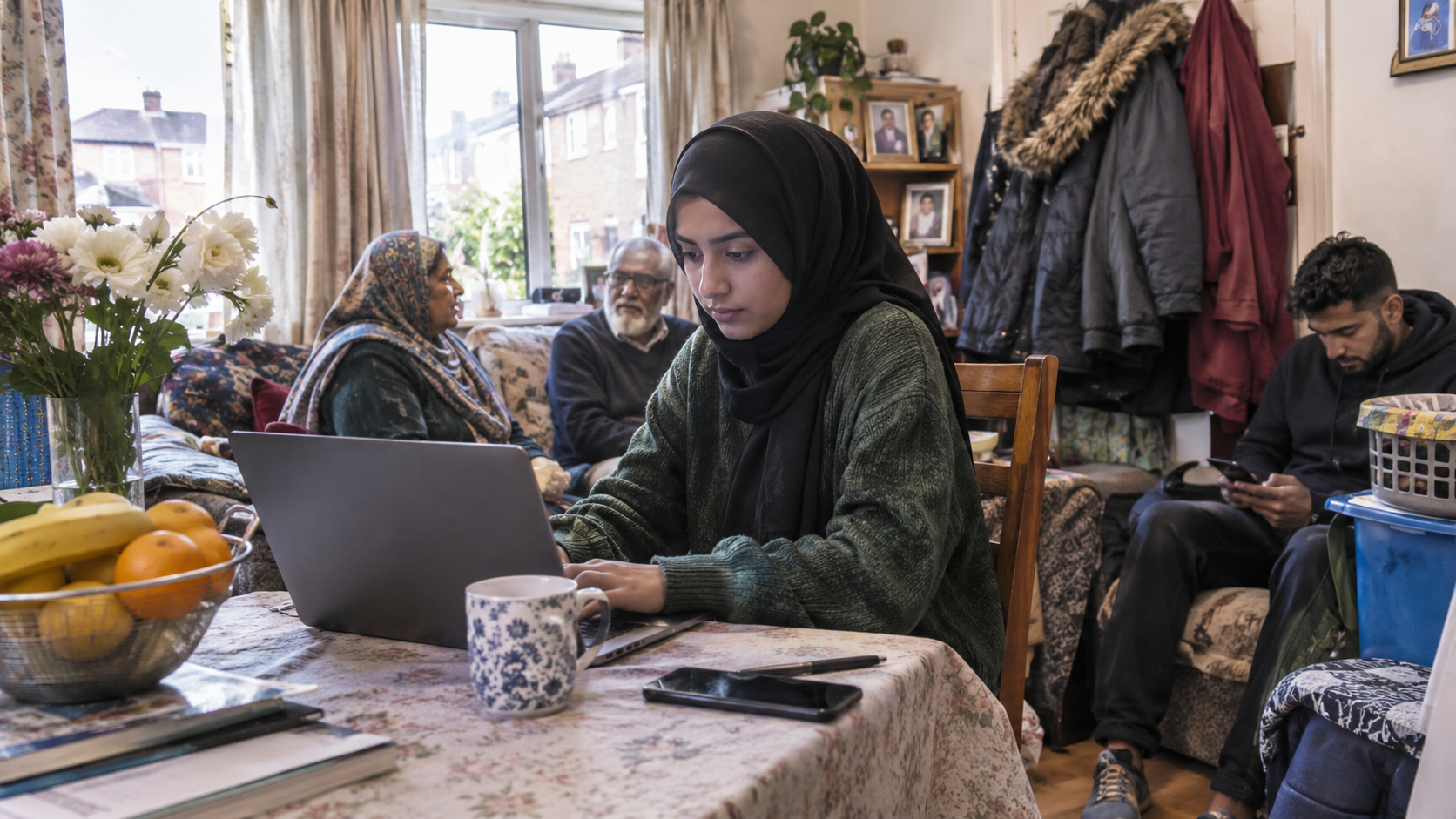
Feature photo: A young British Muslim graduate works from home. A landmark Runnymede Trust report, Systemic and Silent, highlights the inequalities facing British Muslims, including lower pay and significantly higher rates of overcrowded housing despite higher levels of educational attainment. (Credit: The Muslim News/AI))