“Britain’s response to the war in Ukraine should set the standard to apply across the board,” Prime Minister Andy Burnham declared at the Lord Mayor’s Banquet on November 16, presenting a vision of British foreign policy supposedly anchored in principle rather than political convenience.
He described Britain’s support for Kyiv as “driven by our values. Standing up for the underdog and not expecting anything in return”.
It was an arresting declaration, but one that invited an uncomfortable question: if sovereignty, territorial integrity and solidarity with the underdog guide Britain’s response to Ukraine, why are they so much harder to uphold when the underdog is Palestinian?
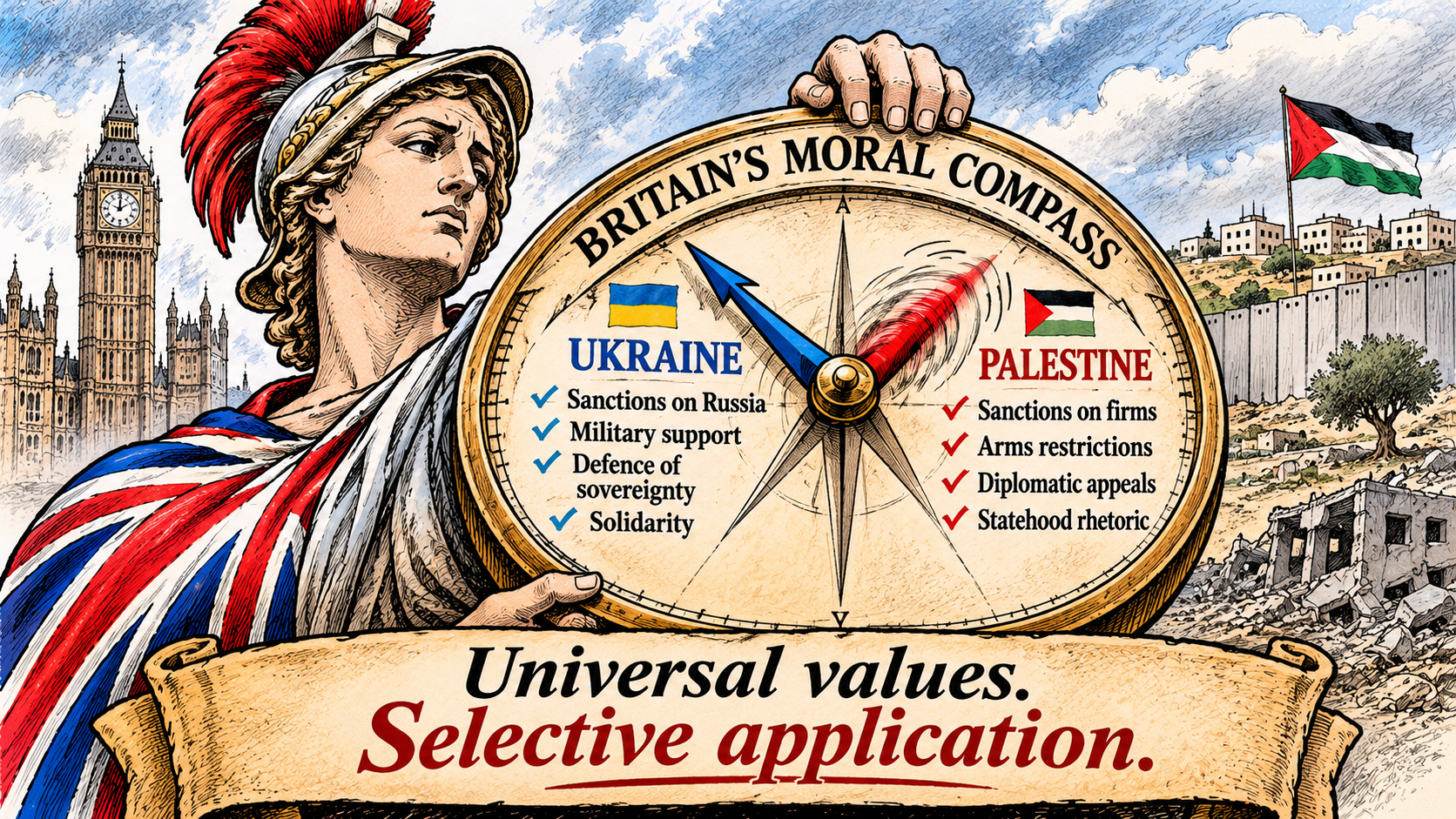
Britain has been unequivocal over Russia’s invasion of Ukraine. It has condemned territorial conquest, imposed sanctions on Moscow, supplied military assistance to Kyiv and maintained diplomatic pressure on the Kremlin. The principle is clear: borders cannot be redrawn by force, sovereignty cannot be extinguished by occupation, and a country’s future cannot be dictated by a more powerful neighbour.
These principles are supposed to apply universally. Yet in Palestine, where occupation and settlement expansion have steadily eroded the prospect of statehood, Britain’s resolve has been considerably less evident.
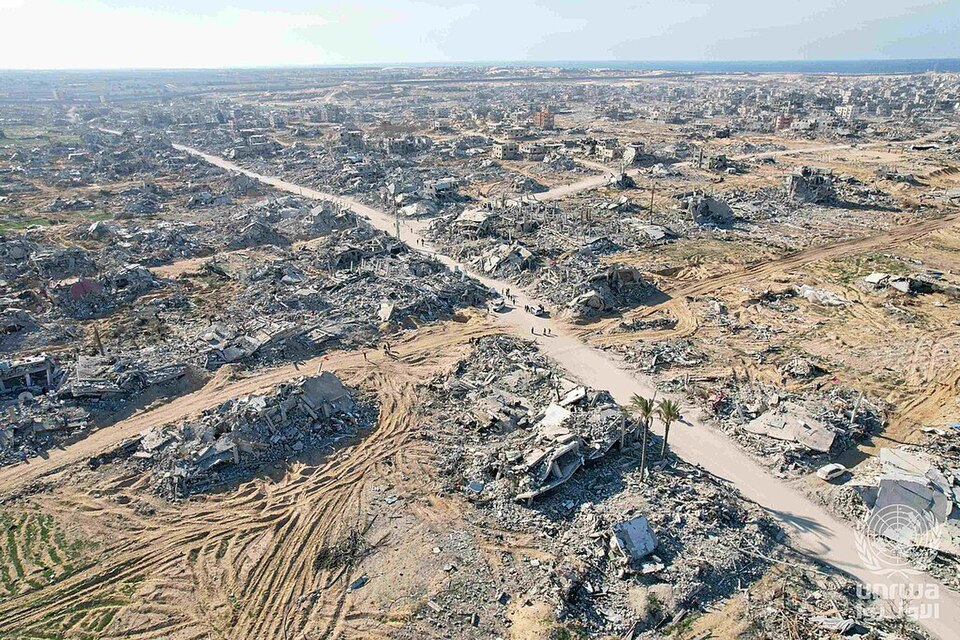
Burnham acknowledged that Britain’s response to what the UN’s own commission of inquiry and the world’s leading association of genocide scholars have concluded is genocide in Gaza “left many questioning our moral compass.” He also defended the two-state solution, warning that new settlements could make it impossible.
The contradiction is difficult to ignore. While ministers continue to champion Palestinian statehood, the territory on which such a state would have to exist is being progressively fragmented. The West Bank is being reshaped by settlement expansion, leaving Palestinian communities increasingly isolated and the prospect of a viable state ever more remote.
Successive British governments have condemned settlements and reiterated their commitment to a negotiated two-state solution. Yet expansion has continued, accelerating under Israel’s present administration.
The histories and circumstances of Ukraine and Palestine are different. But those differences cannot justify applying international principles selectively. Sovereignty, self-determination and the prohibition on acquiring territory by force cannot be universal when Russia is the occupying power and qualified when Israel is.
Britain’s latest sanctions acknowledge the seriousness of the problem, but their reach remains limited.
On November 17, the Government sanctioned eight Israeli construction, property development and architectural companies involved in settlement expansion in the occupied West Bank, alongside Tzav 9, an Israeli activist movement that has organised blockades preventing humanitarian aid convoys from entering Gaza.
The measures target those financing settlement construction and obstructing humanitarian assistance. They are welcome, but raise a more difficult question: why are commercial actors facing sanctions while the Israeli Government that authorises and encourages settlement expansion faces no comparable economic pressure?
Foreign Secretary Ed Miliband has described protecting the two-state solution as the Government’s “North Star”. His warning over the proposed E1 settlement development was equally direct: “Do not bid, do not build, and do not profit from the destruction of the two-state solution.”
The words are clear. The policy is less so.
Settlement expansion has accelerated under Israel’s current administration, which has actively facilitated it. More settlements have been approved during its four years in office than in the preceding twenty.
These are not ordinary residential developments. Settlements entrench Israeli control over occupied Palestinian territory, bring infrastructure serving Israeli communities, restrict Palestinian movement and divide Palestinian land into increasingly disconnected enclaves.
E1 is particularly significant. Development there threatens to sever the northern and southern parts of the West Bank further and separate the territory from East Jerusalem.
A Palestinian state confined to isolated pockets of land, without meaningful control over its borders, movement or resources, might carry the name of a state. It would lack much of its substance.
This is the central contradiction in Britain’s position: ministers insist that a two-state solution remains their objective while the territorial foundations of that solution are being dismantled. Diplomacy cannot restore land absorbed into an expanding settlement network.
The Government has also announced plans to legislate for an import ban on settlement goods and restrictions on advertising services for settlement properties in Britain. These proposals matter, but they remain under development. The question is whether they will be implemented quickly enough, and whether they will impose sufficient costs to change the calculations of those profiting from occupation.
Miliband has said that the “status quo in the West Bank and Gaza is unacceptable” and that Britain will work with a new Israeli government and the Palestinian Authority to advance peace and security.
But Palestinians cannot be expected to wait for this to happen while their land is taken and their communities fragmented. Their right to self-determination cannot depend on the political fortunes of whichever administration happens to hold office.
The same gap between rhetoric and action is evident in Gaza, where Britain continues to demand humanitarian access without clearly explaining what consequences Israel will face for denying it.
Addressing the House of Commons on November 12, Foreign Office Minister Stephen Doughty described the humanitarian situation as “heartbreaking”. Restrictions on essential supplies and machinery had hampered preparations for winter, he said, while more than 150,000 tents and 300,000 tarpaulins purchased by humanitarian partners remained outside Gaza, prevented from entering by the Israeli authorities.
“The problem is not simply whether the international community can provide help; it is whether that help can reach the people who need it,” he said, before delivering his message to Israel: “Let the aid in.”
The urgency is undeniable. But repeatedly pleading with an occupying power to admit humanitarian assistance, without explaining what Britain will do if it refuses, is not a substitute for enforcement.
Liberal Democrat MP Brian Mathew asked whether the Government would consider sanctions against Maj. Gen. Avi Bluth, head of the Israeli military’s Central Command in the West Bank. He referred to allegations by peace activists that Bluth had been observed directing settler militant actions against Palestinian civilians in Jericho. The claims require scrutiny, but raise wider questions about individual responsibility for settler violence.
Doughty said Britain had already sanctioned individuals and was “considering other cases”, promising to update Parliament in due course.
For Palestinians facing displacement and violence, however, accountability cannot remain an exercise in administrative procedure. The consequences are immediate; the timetable for justice remains uncertain.
Liberal Democrat MP Ben Maguire also challenged the Government over the International Court of Justice’s 2024 provisional measures concerning humanitarian access to Gaza. Parliament had heard “warm words” about international law, he argued, but needed to know when those words would translate into action.
Doughty replied that it was “crucial that ICJ orders and positions are respected” and that Britain was working with international partners to raise the issue and hold Israel to account.
The exchange exposed the weakness in the Government’s approach. Ministers can deplore violations, invoke international law and promise to raise concerns with allies. What remains unclear is what consequences Israel will face when those appeals are ignored.
International law cannot depend on the goodwill of the party accused of violating it. Nor can accountability consist indefinitely of diplomatic assurances and promises to review the situation.
The contrast with Ukraine remains difficult to escape.
Britain insists that Russia must not acquire territory through aggression and that Ukraine’s future must be determined by Ukrainians. In Palestine, it supports self-determination while relying heavily on appeals to an Israeli administration whose settlement policies are steadily undermining the possibility of it.
The question is not whether Britain should replicate its Ukraine policy in every detail. It is whether the principles invoked in one conflict genuinely apply to the other.
The same inconsistency is evident in Britain’s military relationship with Israel.
The Government has suspended certain arms export licences, refused applications for exports that would materially contribute to the occupation and pledged to keep existing licences under review. But it has stopped short of a comprehensive arms embargo or ending all arms-related cooperation.
Ministers maintain that restrictions are designed to prevent British exports contributing to violations of international law, rather than impose a blanket ban on arms exports to Israel. Yet important questions remain: what military cooperation is still considered permissible, what would trigger further suspensions, and how can the Government ensure its continuing arrangements comply with its legal obligations?
Saying that licences are under review does not answer those questions. The public is entitled to know what would prompt more decisive action.
Britain wants to be seen as a defender of the international order. Its response to Israel, however, continues to expose the distance between condemning violations and imposing meaningful consequences.
Burnham concluded his remarks by arguing that Britain should lead with its values “because it’s right to do so, and because it is in our interests”.
That is the argument he has made for supporting Ukraine. It is also the standard by which his Government’s approach to Palestine must be judged.
Sanctions against settlement companies, restrictions on certain arms exports, proposed bans on settlement goods and demands for humanitarian access are not insignificant. But they fall short of addressing the scale of the problem.
If settlement expansion is making Palestinian statehood increasingly impossible, sanctioning a handful of companies will not reverse it. If humanitarian assistance is being prevented from reaching civilians, demanding access cannot be the limit of Britain’s response.
The Government must explain what diplomatic and economic pressure it is prepared to exert on Israel, how it intends to hold those responsible for settlement expansion and violence accountable, and how it will ensure its military relationships comply with international law.
There is little purpose in defending a two-state solution while declining to confront the actions destroying its foundations. A Palestinian state cannot be negotiated into existence on land carved into disconnected enclaves, nor can its sovereignty be meaningful while its borders, resources and movement remain subject to another state’s control.
Burnham says Ukraine should set the standard. Miliband calls Palestinian statehood his “North Star”. But political principles are measured not by their eloquence at banquets or parliamentary dispatch boxes, but by what governments are prepared to do when defending them becomes inconvenient.
If sovereignty and territorial integrity matter in Ukraine, they matter in Palestine. And if standing up for the underdog is a measure of Britain’s values, Palestinians should not have to settle for expressions of sympathy while the foundations of their future are dismantled.
The question is no longer whether Britain supports Palestinian statehood in principle. It is whether it is prepared to defend the possibility of one in practice.
Editorial image: Created using AI (The Muslim News)
Petition demanding public inquiry into Britain’s role in Gaza passes 100,000 signatures
UK arms exports to Israel continued under Labour, secret records reveal
Lewisham mosque hits back at Charity Commission over Palestine sermons
Eight in 10 Britons regard Israel as serious threat to world peace, survey finds