Nadine Osman
Islamophobia and right-wing extremist attitudes are gaining ground in Germany, while confidence in democracy has fallen sharply, according to a major study published on November 11. The findings point to growing support for exclusionary views and increasing dissatisfaction with the country’s democratic institutions.
The Leipzig Authoritarianism Study 2026, led by Oliver Decker of Leipzig University and Ayline Heller of the GESIS Leibniz Institute for the Social Sciences, found that 34.1 per cent of respondents expressed anti-Muslim attitudes, up from 33.2 per cent in 2024 and 26.5 per cent in 2022. Respondents were classified as holding such views if they endorsed statements such as “Immigration of Muslims to Germany should be prohibited” or “Because of the many Muslims here I sometimes feel like a stranger in my own country.” The figure had peaked at 40.7 per cent in 2018 before falling below 30 per cent, but the latest results suggest that decline has been reversed.
The divide between east and west is marked. In the eastern states, 41.6 per cent expressed anti-Muslim attitudes, up from 38.2 per cent in 2024, while the figure in western Germany stood at 32.2 per cent. The findings come amid growing electoral support for the far-right Alternative for Germany (AfD), particularly in the east, where the party has gained ground through nationalist rhetoric, anti-immigration campaigning and appeals to voters dissatisfied with the political establishment.
The study also points to a reversal in the longer-term decline of right-wing extremist attitudes recorded since 2002. The proportion of respondents classified as holding a consistently right-wing extremist worldview rose from 4.5 per cent in 2024 to 6.9 per cent in 2026, reaching 8.5 per cent in eastern Germany. Among respondents in this category, 58.5 per cent said they had voted for the AfD. The researchers warned that right-wing extremist attitudes were becoming more socially acceptable again.
Anti-Muslim prejudice appears to be part of a wider pattern of exclusion. Almost one in five respondents (19.9 per cent) endorsed xenophobic statements, including claims that foreigners come to Germany to exploit the welfare system or should be sent home when jobs become scarce. The figure was 27.7 per cent in eastern Germany, compared with 18 per cent in the west. The study also found negative attitudes towards Sinti and Roma among 35 per cent of respondents.
The findings revealed differences between supporters of political parties. Xenophobic attitudes were most prevalent among AfD voters, at 45.5 per cent, compared with 19.5 per cent among Free Democratic Party (FDP) voters, 17 per cent among Christian Democratic Union/Christian Social Union (CDU/CSU) supporters and 14.2 per cent among Social Democratic Party (SPD) voters. The figures suggest that hostility towards minorities is particularly pronounced among AfD supporters, although such attitudes are also present among voters of other parties.
Gender differences were smaller: 20.9 per cent of men and 19.1 per cent of women expressed xenophobic attitudes. Separate findings reported by regional broadcaster MDR showed that 5.6 per cent of men supported a right-wing authoritarian dictatorship, compared with 3 per cent of women. Chauvinistic views were also more common among men, at 22 per cent, than women, at 18 per cent.
Underlying these trends is deepening political disillusionment. According to Deutschlandfunk, 43 per cent of respondents wanted a return to a time when politicians supposedly cared more about people like them, with a further 25 per cent partially agreeing. More than 30 per cent said something radical was needed to change the current situation, and almost 30 per cent partially agreed. The researchers interpret such responses as signs of frustration with the existing political order, creating fertile ground for movements promising simple solutions through authoritarian leadership, nationalism and the exclusion of minorities.
Confidence in democracy has weakened accordingly. For the first time in the survey’s history, support for democracy as an idea fell below 90 per cent, to 89.3 per cent nationally. In eastern Germany, it dropped from 94.6 per cent in 2024 to 85.7 per cent, compared with 90.2 per cent in the west.
Satisfaction with the way democracy functions in everyday life has fallen even more sharply. According to the study, only 33.3 per cent of respondents were satisfied, down from 42.3 per cent in 2024 and 57.7 per cent in 2022. In eastern Germany, satisfaction stood at just 22.8 per cent, compared with 36 per cent in the west. Satisfaction with democracy as set out in the constitution was higher, at 65.2 per cent.
The findings also point to growing openness towards authoritarian rule. Some 22.6 per cent of respondents fully or partly agreed that dictatorship could be a better form of government under certain circumstances in the national interest. A further warning sign was that 23.2 per cent agreed with the statement “What Germany needs now is a single strong party”, while another 24.3 per cent partially agreed.
The findings alarmed human rights groups. Julia Duchrow, Secretary General of Amnesty International in Germany, said it was alarming that more and more people held attitudes showing contempt for human dignity. She argued that political debates questioning fundamental rights contributed to the problem and called for stronger protection for civil society organisations working against discrimination. Such organisations, she said, must be able to participate in political debate without fear of losing their charitable status or funding.
Other evidence points to the real-world consequences of anti-Muslim hostility. A report by CLAIM, the Coalition Against Islamophobia and Anti-Muslim Hostility, recorded 4,096 anti-Muslim incidents in Germany in 2025, up from 3,080 in 2024. More than 60 per cent involved verbal attacks. The report also documented 840 cases of discrimination, 680 other harmful incidents, including physical assaults and property damage, and 61 attacks on mosques.
Presenting the report in June, CLAIM co-Director Rima Hanano told Deutsche Welle that Muslims were often portrayed “primarily as perpetrators,… but not as victims of exclusion and violence”. She said experiences of racism reinforced feelings of not belonging and undermined trust in politics.
The Leipzig study surveyed 2,507 people aged 16 and over between 16 March and 3 June 2026. It is the thirteenth edition of the biennial research series, which has monitored authoritarian and extremist attitudes since 2002. The researchers used a representative sample of randomly selected households, with questionnaires completed privately to reduce the influence of socially desirable answers.
Eastern Germany has consistently recorded higher levels of xenophobia, Islamophobia, chauvinism and support for authoritarian positions. However, the latest findings show that these attitudes are not confined to one part of the country. The differences between political-party supporters also underline the wider challenge of confronting prejudice across society.
The results challenge the assumption that protecting democratic institutions alone is enough to safeguard minorities. Democracy also depends on the protection of fundamental rights, equality and human dignity. The study’s longer-term findings show that anti-Muslim hostility and extremist attitudes have declined during earlier periods, demonstrating that the current trajectory is not inevitable. The challenge for Germany is to confront the normalisation of prejudice and ensure that Muslims and other minorities enjoy the same rights, security and sense of belonging as everyone else.
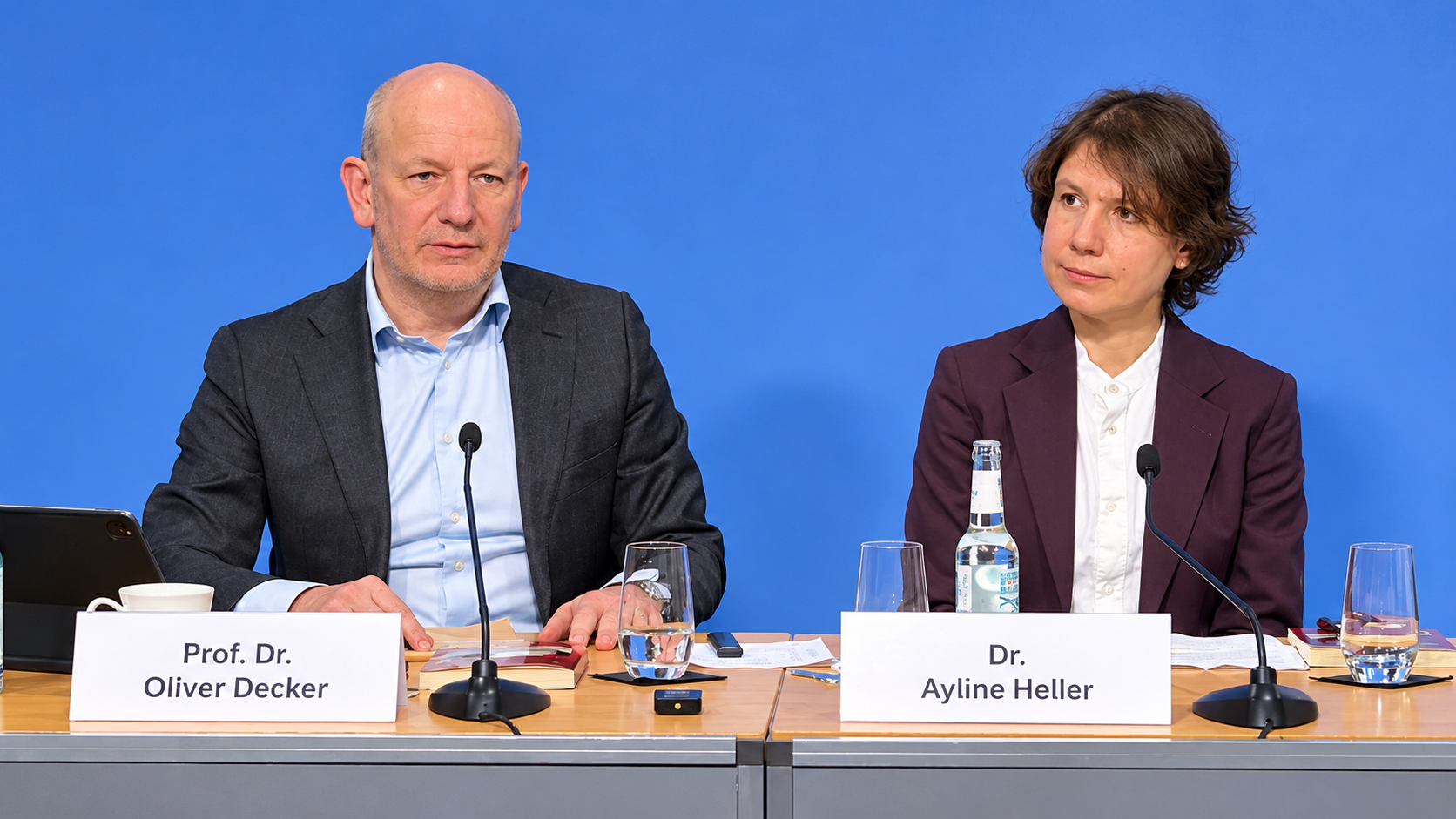
Feature photo: Oliver Decker, Professor at Leipzig University, and Dr Ayline Heller presented the findings of the 2026 Leipzig Authoritarianism Study at a press conference in Berlin on 11 November. The study found increased support for anti-Muslim attitudes in Germany. (Credit: Erbil Başay/Anadolu Agency)