Nadine Osman
Amnesty International and more than 100 civil society organisations have called on European Parliament President, Roberta Metsola, to address what they describe as racist and Islamophobic rhetoric by lawmakers during a parliamentary debate on “Islamist entryism” and the influence of the Muslim Brotherhood.
In an open letter dated November 10, the organisations criticised statements made during a debate on October 7, accusing several MEPs of using defamatory language and making remarks that could encourage discrimination against Muslims.
The letter cites comments portraying Muslims as seeking to infiltrate European democratic institutions, alongside calls to restrict Islamic religious practices, including closing prayer rooms, banning headscarves and halal food, and deporting Muslims accused of placing the Qur’an above national constitutions. One statement reportedly described Muslims as infiltrating democratic institutions “like a creeping poison”.
The controversy centres on a resolution entitled The need for an EU strategy to counter Islamist entryism and the influence of the Muslim Brotherhood network, adopted by the European Parliament on October 8, with 381 votes in favour, 167 against and 15 abstentions.
The resolution calls for a coordinated European approach to countering what Parliament describes as “Islamist entryism”, including alleged attempts by networks associated with the Muslim Brotherhood to influence democratic institutions through civil society organisations and educational bodies.
Although the adopted text distinguishes Islam as a religion from “political Islamism,” it calls for organisations linked to the Council of European Muslims, including the Forum of European Muslim Youth and Student Organisations (FEMYSO), to be denied access to EU institutions and removed from the EU Transparency Register. It also advocates greater scrutiny of organisations and funding arrangements suspected of links to the Muslim Brotherhood network.
The signatories argue that these measures risk undermining legitimate civil society activity by treating advocacy, public campaigning and participation in democratic debate as potential evidence of “Islamist entryism.” They specifically raised concerns about FEMYSO and the European Network Against Racism (ENAR), both of which work on issues affecting Muslim communities and anti-racism initiatives.
The letter also warns that organisations documenting anti-Muslim discrimination could face accusations of exploiting anti-discrimination frameworks, potentially jeopardising their access to European institutions and funding. It notes that ENAR has recently lost its structural funding from the European Commission, adding to concerns about pressure on independent human rights organisations.
FEMYSO was also criticised during the parliamentary debate, with one MEP reportedly describing it as a “Trojan horse” seeking to infiltrate EU institutions. The organisation has rejected such accusations. The signatories point out that FEMYSO has participated in European Parliament activities, including the European Youth Event, since 2016. In September 2026, it organised a European Action Day Against Islamophobia inside Parliament alongside an MEP.
The organisations argue that engagement with elected representatives and participation in democratic institutions should not, in themselves, be treated as evidence of wrongdoing.
The letter also cites the European Union Agency for Fundamental Rights’ (FRA) 2024 report, Being Muslim in the EU, which found that 47 per cent of almost 10,000 Muslim respondents across 13 EU countries had experienced racial discrimination during the preceding five years, compared with 39 per cent in 2016. A further 35 per cent reported discrimination in the year before the survey.
Against this background, the signatories argue that political rhetoric targeting Muslim communities risks reinforcing existing discrimination and hostility.
They have called on Metsola to publicly address the remarks made during the debate and take formal action under the European Parliament’s Rules of Procedure. They have also requested a meeting with representatives of FEMYSO, the Collectif contre l’islamophobie en Europe (CCIE) and ENAR to discuss the resolution and its implications for civil society participation.
The European Parliament’s position is that countering “Islamist entryism” is distinct from targeting Islam or Muslims as a religious community. Its resolution acknowledges this distinction while calling for measures against organisations and networks it considers linked to “political Islamist” influence.
The dispute raises broader questions about how European institutions balance efforts to counter extremist political influence with the protection of religious freedom, equality and the legitimate participation of civil society.
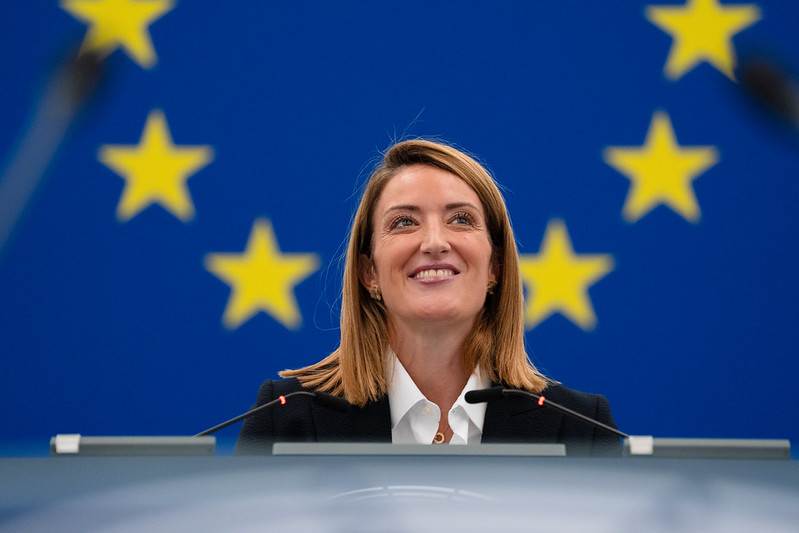
Feature photo: European Parliament President Roberta Metsola, who has been urged by Amnesty International and more than 100 civil society organisations to address alleged Islamophobic rhetoric during a parliamentary debate. (Credit: European Union 2026/ EP/CC).