Elham Asaad Buaras
Muslims are projected to overtake Christians as the world’s largest religious group by 2035, with their global population expected to reach 3.64 billion by 2070, according to a major new demographic study by the Pew Research Center.
The report, The Future of World Religions: Population Growth Projections, 2020–2070, published on November 18, forecasts that the number of Muslims worldwide will increase by 80 per cent over five decades, from approximately 2.02 billion in 2020 to 3.64 billion in 2070.
Muslims will account for almost 36 per cent of the world’s population by the end of the projection period, compared with 25.6 per cent in 2020. Christianity, which currently remains the world’s largest religion, is projected to represent around 29 per cent.
The projections cover 201 countries and territories, representing 99.98 per cent of the world’s population, and examine seven religious categories: Christians, Muslims, Hindus, Buddhists, Jews, followers of other religions and the religiously unaffiliated.
While the world’s population is expected to grow by 29 per cent between 2020 and 2070, the Muslim population will expand considerably faster. Christian numbers are projected to rise by 30 per cent, while the combined non-Muslim population will increase by just 11 per cent.
Sub-Saharan Africa is expected to become an increasingly important centre of Muslim demographic growth, although Asia and the Pacific will remain home to the largest number of Muslims.
Pew attributes much of the projected expansion to the relatively young age profile of Muslim populations and higher fertility rates than those of other major religious groups.
In 2020, the median age of Muslims worldwide was 24, almost a decade younger than the non-Muslim median of 33. Around six in ten Muslims were under 30, compared with fewer than half of non-Muslims.
The difference was particularly pronounced in sub-Saharan Africa, where Muslims had a median age of just 17. In Europe, the median was 34, reflecting differences in the demographic composition of Muslim communities across regions.
Between 2020 and 2025, Muslim women had an estimated average fertility rate of 3.1 children, compared with 2.0 among non-Muslim women.
In sub-Saharan Africa, the respective figures were 5.1 and 4.0 children per woman. In the Middle East and North Africa, they were 3.1 and 2.2, while in Asia and the Pacific they stood at 2.5 and 1.6.
Europe and North America recorded lower rates. Muslim fertility in both regions was estimated at 1.9 children per woman, compared with 1.4 among non-Muslims in Europe and 1.6 in North America.
The combination of younger populations and higher fertility means Muslim communities are expected to experience more births than deaths over the coming decades. Natural population increase, rather than religious conversion, will account for most of their projected global growth.
The Muslim population of sub-Saharan Africa is projected to increase from approximately 369 million in 2020 to 980 million in 2070, a rise of 166 per cent.
Its share of the world’s Muslim population will grow from 18 per cent to 27 per cent. The region is expected to add more than 611 million Muslims, almost matching the projected increase of 619 million in Asia and the Pacific.
Pakistan is projected to have the world’s largest Muslim population by 2070, with 461 million, followed by India with 334 million. Nigeria will rise to third place, with approximately 282 million, compared with 120 million in 2020.
Indonesia, currently home to the largest Muslim population, is expected to fall to fourth place, with 274 million. Bangladesh will remain among the five largest Muslim populations, increasing from 151 million to 218 million.
Ethiopia is also projected to enter the top ten, with approximately 128 million Muslims by 2070, alongside Afghanistan, with around 99 million.
The Muslim share of Europe’s population is projected to increase from 6 per cent in 2020 to nearly 13 per cent in 2070, with numbers rising from approximately 45.5 million to 79.9 million.
Muslims will remain Europe’s second-largest religious group, behind Christians, although the religiously unaffiliated are projected to become the second-largest category overall, increasing from around a quarter to approximately a third of the population.
Christianity’s share is expected to fall from 67 per cent to around 52 per cent, with its population declining from 505 million to 324 million.
Pew attributes Muslim population growth primarily to migration from outside Europe, alongside natural increase. Migration is projected to add approximately 24.9 million Muslims between 2020 and 2070, compared with a natural population increase of 10.9 million.
Muslim women in Europe had an estimated fertility rate of 1.9 children, compared with 1.4 among Christians and 1.3 among the religiously unaffiliated. However, all major religious groups in Europe had fertility rates below the replacement level of approximately 2.1 children per woman.
The report also estimates that 93 per cent of people raised Muslim in Europe continue to identify with Islam as adults, compared with a global retention rate of 99 per cent.
Pew’s country-level projections indicate a substantial increase in Britain’s Muslim population over the next five decades.
Muslims accounted for 6.4 per cent of the UK’s population in 2020. By 2070, that proportion is projected to reach 16 per cent.
The country’s overall population is forecast to increase from approximately 67.35 million to 71.85 million over the same period. Muslims would therefore make up a significantly larger share of Britain’s population, while remaining a minority overall.
The projections place Britain within a wider European trend of growing Muslim populations, declining Christian numbers and increasing religious disaffiliation.
North America is expected to record the fastest percentage growth in its Muslim population, with numbers projected to rise from approximately six million in 2020 to almost 20 million in 2070.
Muslims will increase from 1.6 per cent to 4.9 per cent of the region’s population.
The United States is projected to gain approximately nine million Muslims, who will account for around 4 per cent of its population by 2070. Canada is also expected to experience substantial growth.
Migration will be a major contributor. Pew estimates that it will add approximately 9.8 million Muslims to North America, compared with a natural population increase of 4.6 million.
Without continued migration at recent levels, Muslims would account for only around 2.2 per cent of the region’s population by 2070, rather than the projected 4.9 per cent.
Pew also examines religious switching, defined as a change between the religion in which someone was raised and the identity they adopt as an adult.
Globally, 99 per cent of people raised Muslim continue to identify with Islam, a retention rate higher than those recorded for Christians and Buddhists and comparable to Hindus.
Retention varies by region, falling to 93 per cent in Europe and 85 per cent in North America.
Despite this, Pew projects a net global loss of approximately 7.7 million Muslims through religious switching between 2020 and 2070. This is relatively small compared with the projected natural population increase of 1.62 billion.
The researchers estimate that religious switching will therefore have little effect on the overall growth of the Muslim population.
The report cautions that its switching estimates draw on surveys from 112 countries and territories. For the remaining 89, the model assumes no religious switching because reliable data were unavailable.
By 2070, 54 countries and territories are expected to have Muslim-majority populations, one more than in 2020. Ivory Coast is projected to become the additional country, with Muslims accounting for just over half its population.
Of the 54 countries and territories, 35 are expected to have Muslim populations representing at least 90 per cent of their residents.
Nigeria, while remaining religiously diverse, is projected to have a Muslim population representing 67.5 per cent of its total by 2070.
Across 31 countries and territories, the Muslim share of the population is expected to increase by at least five percentage points. In Albania, the projected increase is 16 percentage points.
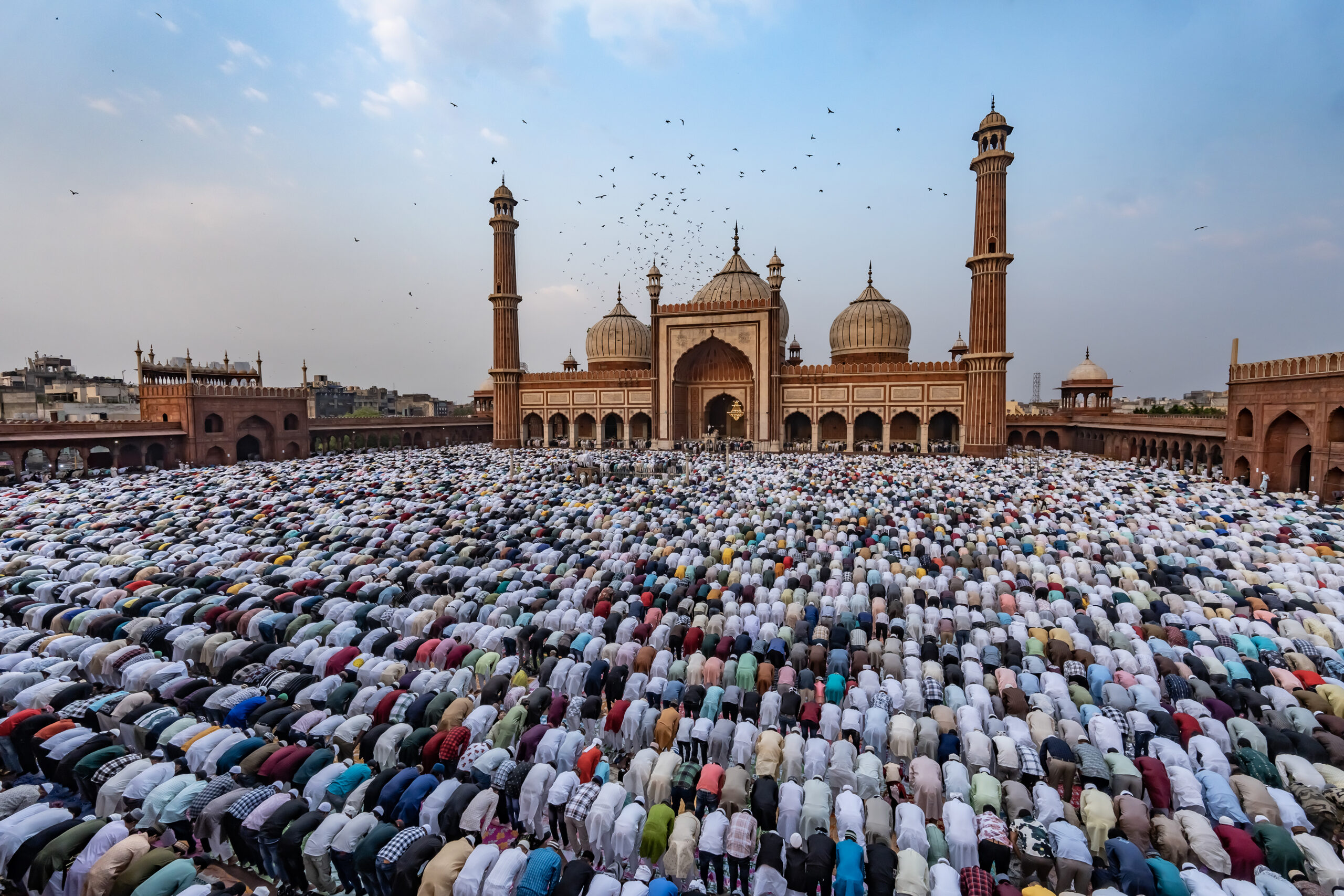
Feature photo: Worshippers gather for congregational prayers at Jama Masjid in Delhi, India. Muslims are projected to account for almost 36 per cent of the world’s population by 2070, rising from 2.02 billion in 2020 to an estimated 3.64 billion, according to the Pew Research Center. (Credit: Amitvakil74/Wikimedia CC)