Nadine Osman
British media were seven times more likely to frame coverage of Qatar’s 2022 FIFA World Cup around human rights and legal issues than the US-hosted 2026 tournament, according to a major study analysing more than 16,000 news articles.
The findings raise important questions about consistency in British journalism and whether Western countries are subjected to the same level of scrutiny as non-Western nations when hosting major international sporting events.
Published on November 20 by the Centre for Media Monitoring (CfMM), the report examined UK online news coverage of both tournaments, identifying significant differences in how controversies surrounding the host nations were reported.
Titled One Game, Two Standards: UK Media Coverage of Qatar 2022 and USA 2026 World Cups, the study analysed 16,315 articles published during the six months leading up to each tournament and throughout both competitions.
Before kick-off, 17 per cent of Qatar-related coverage used a human rights and legal framework, compared with 2.3 per cent of US-related coverage.
During the tournaments, the gap widened: the figure rose to 19.2 per cent for Qatar but fell to 1.3 per cent for the United States – a difference of approximately 15 to one.
The report also found that the disparity was not confined to individual newspapers or broadcasters. All 18 media outlets included in the pre-tournament comparison were more likely to apply a human rights and legal framework to Qatar. During the tournaments, the same pattern appeared across all 15 publications included in the comparison.
The findings suggest that controversies involving Qatar, including migrant workers’ rights, LGBTQ+ rights and women’s rights, were repeatedly presented as evidence of wider problems with the country’s laws, culture and political system.
By contrast, comparable issues involving the United States – including immigration enforcement, Immigration and Customs Enforcement (ICE) activity, entry restrictions, US military action against Iran and alleged breaches of international law – were more commonly framed as matters of national security, foreign policy or isolated tournament incidents.
The disparity had also prompted questions from academics ahead of the tournament. Andreas Krieg of King’s College London questioned why issues surrounding accessibility, human rights and security in the United States had attracted comparatively little critical commentary.
His response was pointed: “Where are all the op-eds?”
The report described this disparity as a “framing inversion”, finding that the pattern persisted across the political spectrum. All 18 media outlets that covered both tournaments, including left-leaning, right-leaning and broadcast organisations, were more likely to apply a human rights and legal framework to Qatar than to the United States.
This finding is particularly significant because the United States generated substantial politically themed reporting. The US-Iran conflict accounted for approximately one-third of pre-tournament US-related coverage, yet only 2.6 per cent of those articles used a human rights or legal framework.
Similarly, only five per cent of articles relating to immigration enforcement and ICE activity applied a human rights and legal framework.
One particularly revealing example concerned Somali referee Omar Artan, who was denied entry to the US shortly before the tournament. The incident generated 29 dedicated headlines over eight days, but only one was classified as using a human rights and legal framework.
Restrictions affecting the Iranian national team were similarly framed primarily as logistical, security or football-administration issues.
The CfMM research builds on a growing body of academic literature examining how Western media portray non-Western countries, particularly when they host major international sporting events.
A 2023 study by Fatima Abdul Rehman and Nael Jebril, published in the peer-reviewed journal International Communication Gazette, examined nine years of coverage of Qatar’s World Cup hosting by BBC World News, Al Jazeera English and RT English.
The researchers found that international coverage frequently prioritised criticism of Qatar, particularly the treatment of migrant workers. Significantly, despite receiving considerable media attention, migrant workers were among the least frequently cited sources in the reporting. International and official sources were more commonly used than migrant workers themselves.
The study also found that conflict was the most frequently employed reporting framework, while human-interest reporting was the least common. This raises questions not only about the volume of criticism directed at Qatar but also about whose voices were included in the international debate.
Further research published in 2025 in the peer-reviewed journal Communication & Sport examined coverage by The Guardian and The New York Times alongside Al Jazeera English. The study, titled Media Bias in Sports Journalism: A Comparative Study of Qatar 2022 World Cup Coverage, used sentiment analysis and topic modelling to investigate differences in reporting.
Its findings indicated that Western outlets frequently foregrounded human rights and workers’ rights, while Al Jazeera English placed greater emphasis on the tournament’s celebratory and unifying aspects.
The research is particularly relevant because it suggests that differences in coverage extended beyond the selection of human rights issues to the way the tournament itself was presented to audiences.
Together, these studies provide a wider academic context for the CfMM findings, highlighting how international media narratives can differ according to the political, cultural and geographical context of the country being reported on.
The study also compared calls to boycott the two tournaments, identifying 18 distinct, verified calls or actions relating to Qatar, against four clear calls directed at the US and one contested case involving Iran’s football federation.
Calls concerning Qatar came from a wide range of groups, including political parties, city governments, football federation staff, LGBTQ+ organisations, former players, businesses and supporters’ groups. Most were made before the tournament began.
By contrast, calls relating to the US came predominantly from public figures, celebrities and officials responding to policies associated with President Donald Trump. Researchers found no verified boycott calls during the US-hosted tournament itself.
The report also examined how cultural moments surrounding the two finals were represented in British media, highlighting differences in the treatment of Qatar’s cultural identity and the United States’ entertainment industry.
At Qatar 2022, Argentina captain Lionel Messi was presented with a traditional Qatari bisht before lifting the trophy. The gesture was frequently interpreted through the wider political debate surrounding the host nation.
By contrast, coverage of the half-time entertainment at the US-hosted final focused more narrowly on the event’s scale, presentation and commercialisation.
The half-time show attracted more than twice as much coverage overall as the bisht moment, although the number of articles published on the day of each final was comparable.
The contrasting treatment raises questions about how cultural expressions associated with non-Western countries can become politicised, while comparable displays associated with Western hosts are more readily treated as entertainment or sporting spectacle.
Positive coverage of Qatar as a World Cup host was also relatively limited. Researchers identified 11 distinct stories highlighting favourable experiences, including accounts from women who said they felt safer in the country’s alcohol-free stadiums.
None appeared during the six-month build-up to the competition. All were published after the tournament began, with five appearing in its final ten days. Even then, positive observations were frequently accompanied by caveats or references to other controversies surrounding Qatar.
The findings also connect with wider debates about Orientalism and the representation of non-Western societies in international media. Academic research into major sporting events has examined how countries outside the West can become subject to heightened scrutiny over their political systems, cultural practices and social values.
This does not mean that legitimate human rights concerns should be dismissed or that Qatar should have been exempt from criticism. The treatment of migrant workers, restrictions affecting LGBTQ+ people and other serious issues warranted rigorous journalistic investigation. The central question is whether the same principles of accountability, international law and human rights are consistently applied when the host country is a Western power.
The report also raises questions about the role of editorial decision-making.
David Walsh, chief sportswriter at The Sunday Times, recalled a conversation with a journalist covering Qatar 2022 who said that, despite having positive experiences and stories to report, editors in London had repeatedly indicated that “good” stories about the World Cup were not wanted.
Although this is one journalist’s account and cannot establish a general editorial policy, it raises questions about whether editorial preferences may have influenced the balance of coverage surrounding Qatar.
The question of consistency was also raised by David Hearst, Editor-in-Chief of Middle East Eye. In an article examining the 2026 tournament, Hearst argued that applying the same human rights criteria used to assess Qatar to the United States would also call into question its suitability as a World Cup host.
His argument reflected the central issue raised by the CfMM research: whether the standards applied to one country are being applied consistently to another.
Rizwana Hamid, Executive Director of CfMM, said the report, published on the fourth anniversary of the start of the Qatar World Cup, offered an opportunity to assess whether the principles invoked during the 2022 competition had been applied consistently.
“This report is not an argument that Qatar should have escaped scrutiny. Its treatment of migrant workers, LGBTQ+ rights and other serious issues deserved rigorous journalistic examination. The question is why a similarly searching standard was not applied to the USA,” she said.
Hamid added that Qatar’s shortcomings had frequently been presented as reflections of the country, its culture and political system, while controversies involving the US were more often portrayed as isolated policies, security concerns or the actions of a particular administration.
“Human rights should not become more or less newsworthy depending on whether a tournament is hosted by a Western country or a Muslim and Arab nation. The same standards of scrutiny, context and accountability must be applied to every host,” she said.
The research drew on four datasets covering the build-up to and duration of both tournaments. Articles were classified using a rules-based framework that examined their subject, primary framing, the prominence of the World Cup and the political orientation of the outlet.
CfMM acknowledged several methodological limitations, including the absence of validation against an independent human-coded sample and the use of stricter classification rules for coverage published during the tournaments. It also noted that the two competitions took place against different geopolitical backdrops.
The organisation emphasised that its findings identify patterns in media coverage but do not establish editorial intent or prove that individual journalists deliberately applied different standards. The research also concerns UK online news coverage and should not automatically be generalised to every form of British print and broadcast journalism.
In response to its findings, CfMM called on sports editors, journalists, publishers and broadcasters to apply consistent standards when reporting on countries hosting major international sporting events.
It urged news organisations to subject Western and non-Western hosts to the same level of human rights and legal scrutiny, distinguish criticism of governments from generalisations about entire countries and cultures, and provide greater international context when reporting on legal and social restrictions.
It also called for serious human rights and due-process concerns to be treated as substantive issues rather than dismissed as logistical matters or incidental football stories.
Ultimately, the report raises a question that extends well beyond football: if human rights are universal, why does the intensity of media scrutiny appear to depend so heavily on which country is being examined?
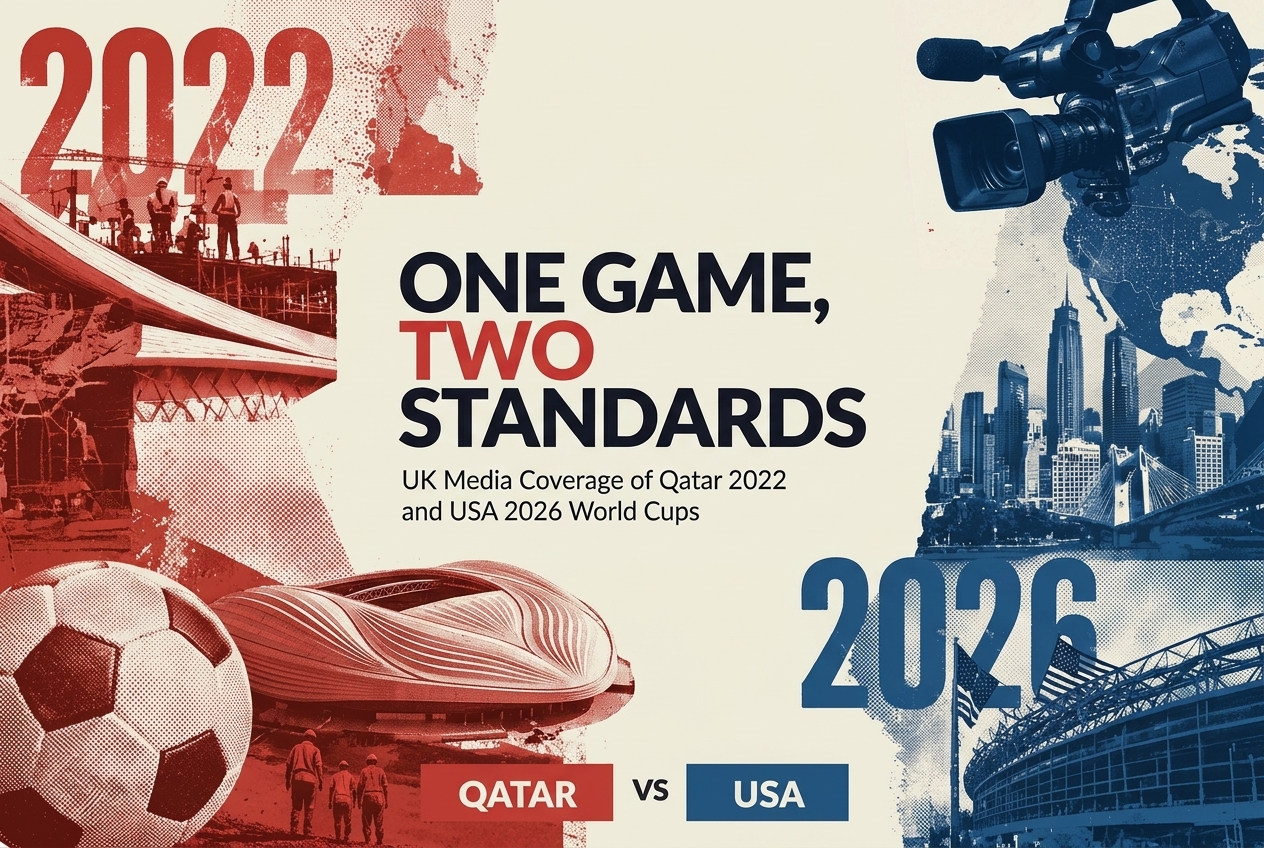
Feature photo: Report cover – One Game, Two Standards: UK Media Coverage of Qatar 2022 and USA 2026 World Cups (Credit: CfMM)