Nadine Osman
Texas Attorney General Ken Paxton has withdrawn a lawsuit seeking to shut down the Council on American-Islamic Relations (CAIR), the largest Muslim civil rights and advocacy organisation in the US, and prevent its Texas chapters and the Muslim Brotherhood from operating in the state.
The withdrawal, filed on November 16, ends the state’s attempt to have CAIR declared a foreign terrorist and transnational criminal organisation. However, a separate designation imposed by outgoing Republican Governor Greg Abbott remains in place and is being challenged in federal court.
Paxton filed the original lawsuit on February 5, seeking to designate CAIR, its Austin, Houston and Dallas-Fort Worth chapters, and the Muslim Brotherhood as foreign terrorist and transnational criminal organisations.
The petition sought to prevent the organisations from operating in Texas, including raising funds, recruiting members and acquiring property, and to impose penalties associated with the proposed designations.
Paxton alleged that CAIR was an American extension of the Muslim Brotherhood, an international Sunni Muslim movement, and accused it of seeking to “usurp governmental power and establish dominion through Sharia law”.
Announcing the lawsuit, he said: “Sharia law and the jihadists who follow sharia law have no business being in Texas.”
He added: “It’s imperative that they are stopped from operating in Texas.”
The lawsuit drew heavily on Abbott’s November 18, 2025 proclamation, which designated CAIR and the Muslim Brotherhood as foreign terrorist and transnational criminal organisations under Texas law.
Abbott accused the groups of seeking to impose Sharia law and supporting terrorism internationally. His order also barred them, their affiliates and members from purchasing or acquiring land in Texas.
“The Muslim Brotherhood and CAIR have long made their goals clear: to forcibly impose Sharia law and establish Islam’s ‘mastership of the world’,” Abbott said.
He also cited alleged “violence, intimidation, and harassment” and declared that the organisations were not welcome in Texas.
Two days later, Abbott directed the Texas Department of Public Safety to investigate both organisations.
CAIR rejected the allegations and challenged the governor’s proclamation in federal court, arguing that he had exceeded his authority and violated constitutional protections.
Filed on November 20, 2025, by CAIR’s Texas Dallas-Fort Worth and Austin chapters, the lawsuit named Abbott and Paxton as defendants. It argued that the designation had been imposed without due process and threatened the organisations’ constitutionally protected rights. The case remains ongoing.
CAIR has consistently denied supporting terrorism, describing its work as defending civil rights, challenging stereotypes about Islam and Muslims, promoting justice and empowering American Muslims.
Following Paxton’s February lawsuit, a CAIR spokesperson accused the state of targeting the organisation because of its opposition to Israel’s war in Gaza and its advocacy for Palestinian rights.
“We have also defeated Greg Abbott’s attacks on the Constitution three different times in a row,” the spokesperson said. “We look forward to doing so again.”
CAIR also accused Paxton of attempting to silence Texans who had criticised Israel’s actions in Gaza.
The withdrawal comes amid a series of cases abandoned by Paxton’s office following the November 3 midterm elections, which saw Democrats win the Texas governorship and other statewide offices.
Paxton lost his bid for the US Senate, while Abbott was defeated by Democratic governor-elect Gina Hinojosa, who is due to take office on January 19. Democrat Nathan Johnson also defeated Republican Mayes Middleton in the race for attorney general.
Paxton’s office has also abandoned legal proceedings involving immigrant rights organisations and the NCAA. These include cases seeking to shut down Houston-based immigrant rights organisation FIEL and targeting Annunciation House, a migrant shelter in El Paso. Another lawsuit accused the NCAA of misleading consumers by allowing transgender athletes to compete in women’s sporting events.
The change in political leadership has raised questions about the future of Abbott’s policies targeting Muslim organisations.
Hinojosa pledged to reverse CAIR’s terrorist designation when she takes office. In an interview published on November 14, she criticised the use of state resources for political purposes rather than genuine public safety measures.
“We have to use public safety measures for public safety,” she said.
CAIR and its Texas chapters welcomed her commitment in a November 16 statement, describing Abbott’s order as unconstitutional and urging incoming officials to end measures targeting Muslim institutions, including mosques and private schools.
“Greg Abbott, Ken Paxton, Bo French, and Mayes Middleton staked their political campaigns on shredding the First Amendment to target Texas Muslims, but the people of Texas rejected this un-American bigotry,” the organisations said.
“Anti-Muslim hate is no longer an effective political weapon in Texas, and it must no longer have any place in state governance.”
CAIR also called on the incoming administration to review other measures affecting Muslim communities.
CAIR-Dallas Executive Director Mustafaa Carroll welcomed the prospect of a change in the state’s approach.
“We’re tired of fighting this fight,” he said. “We want to get along with folks.”
Paxton’s withdrawal does not automatically overturn Abbott’s designation or resolve the separate federal lawsuit challenging it. Hinojosa’s pledge will therefore be significant when she takes office in January.
Paxton’s office has not publicly explained its decision to abandon the case.
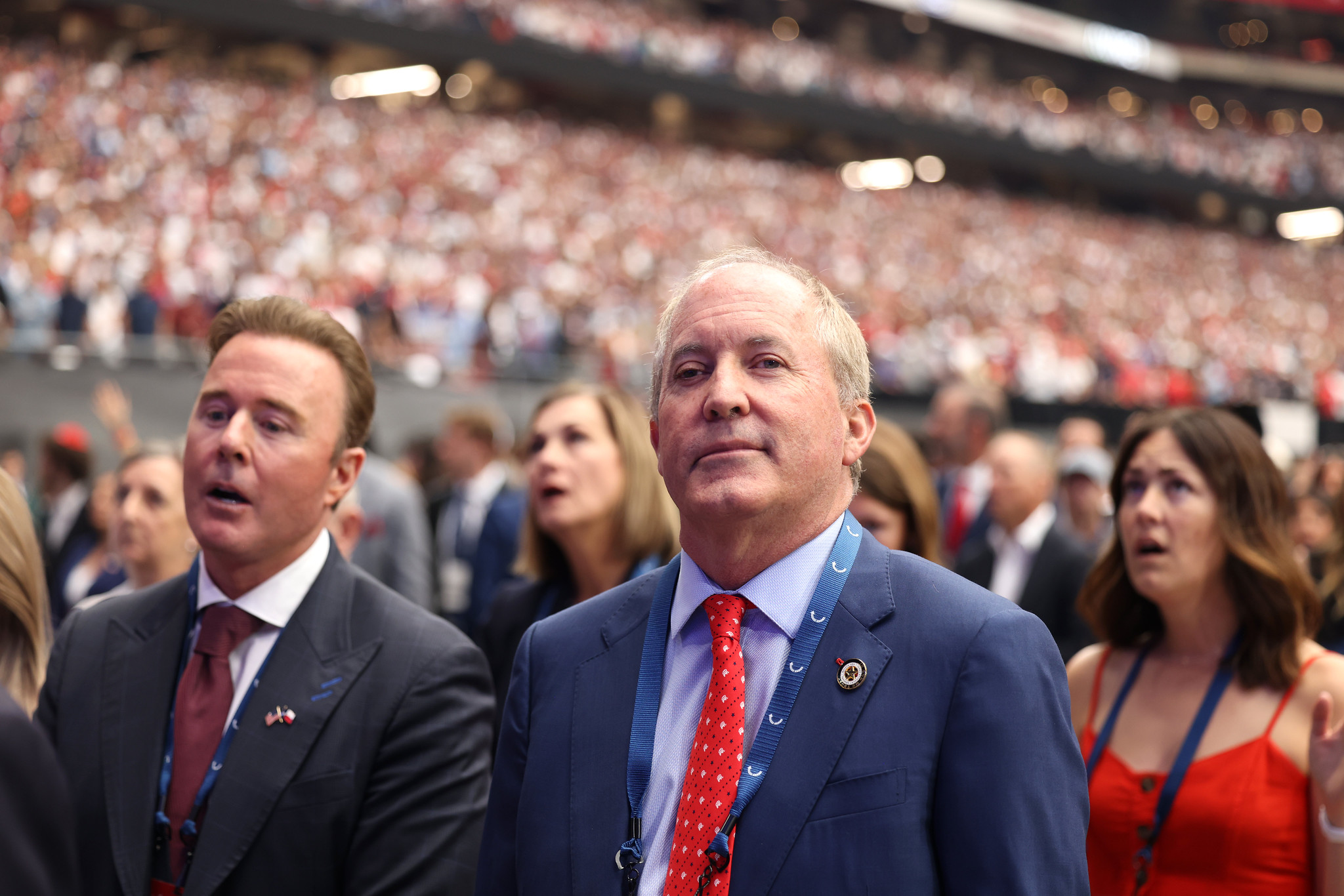
Feature photo: Texas Attorney General Ken Paxton, whose office has withdrawn a lawsuit seeking to shut down Muslim civil rights organisation CAIR and its Texas chapters. (Credit: Gage Skidmore/Flickr CC)/p>