Elham Asaad Buaras
The University of Toronto has rejected all 57 recommendations made by a working group it
established to investigate discrimination against Muslim, Arab and Palestinian students and staff.
The report, Over-Policed, Under-Protected, was produced by the university’s Muslim, Arab and Palestinian Discrimination Working Group (MAP DWG) following 85 individual and group consultations and 525 responses to a university-wide survey conducted between March 2025 and January 2026. Participants included students, faculty, staff and librarians across its three campuses.
The group identified what it described as a “general pattern of over-policing and under-protecting” Muslim, Arab and Palestinian members of the university community, documenting allegations of discriminatory treatment, restrictions on academic freedom and freedom of expression, inconsistent complaints procedures and disproportionate scrutiny of pro-Palestinian activities.
Among the testimonies was an account of a physician allegedly turning away from a newborn a medical trainee wearing hijab, remarking: “Careful, she may throw rockets at us.”
Another faculty member reportedly warned a student: “If you report me, I will know it was you.”
One Palestinian respondent described a campus climate in which “lying down and dying quietly is the only way to be Palestinian without being anti-Semitic.”
The report also identified what it called a “Palestine exception”, citing concerns that research, teaching, events and advocacy relating to Palestine faced additional scrutiny and restrictions.
It said academic and outreach activities concerning Muslim, Arab and Palestinian communities had sometimes been treated as potential instances of antisemitism warranting disciplinary action.
“The most prevalent pattern we encountered, however, was a generalized ignorance of the histories, cultures, and lived experiences of Muslims, Arabs, and Palestinians, and the ways in which anti-Muslim, anti-Arab, and anti-Palestinian discrimination and harassment take shape,” the report stated.
Its 57 recommendations included reviewing campus security and risk-assessment procedures, ensuring protests and postering were policed without discrimination based on content, strengthening academic freedom protections and improving complaints procedures.
The group also called for scrutiny of university partnerships with organisations including school boards and affiliated hospitals, following concerns about discriminatory treatment of students and clinical faculty. It further recommended considering a ban on investments that aid or abet violations of fundamental international legal norms.
The accounts were collected through consultations and survey responses and were not adjudicated findings in individual cases.
In its response, published alongside the report on November 12, the university said it could not accept the findings and recommendations as presented.
It argued that the report departed from previous equity investigations by including extensive commentary on international events, and questioned its scope, methodology and some proposals. The administration said certain recommendations conflicted with collective agreements and academic freedom protections, while others fell outside its jurisdiction or contradicted its position of institutional restraint.
While acknowledging discrimination against Muslim, Arab and Palestinian members of the university community, it said it remained committed to addressing it. However, it warned that parts of the report would also upset other members of the university.
“While we expect that the working group’s report will validate the experiences of many members of our community, aspects will also be offensive and upsetting to other members of our community, including some Jewish and Israeli colleagues and students,” it said.
University President Melanie Woodin disputed the working group’s characterisation of the university’s decision .insisting “There’s no rejection. We didn’t accept the report as written.”
Woodin acknowledged that Muslim, Arab and Palestinian students faced an unacceptable discriminatory environment but maintained that some recommendations conflicted with the university’s principles and existing obligations.
Instead, the university announced further work to provide appropriate Muslim prayer and multi-faith spaces across its three campuses, an educational module on discrimination against Muslim, Arab and Palestinian communities, and an information session for members of its governing council.
Professor Anver Emon, who chaired the working group, challenged the decision, saying the recommendations had already undergone extensive scrutiny with senior administrators.
Emon said he had spent several months working with university officials to refine the proposals and ensure they were feasible before submitting the final report.
“I find it startling that the university would simply reject the report outright, reject the recommendations as somehow written inappropriately without any accountability to the 57 recommendations that are there,” he said.
In a subsequent CBC interview, he described the response as “wholly insufficient”, arguing that measures such as improving prayer facilities failed to address the wider institutional problems identified by the investigation.
“The university effectively denies that there are structural considerations that it needs to address,” he said.
Emon also contrasted the response with the university’s handling of previous working groups examining anti-Black racism, anti-Asian discrimination and antisemitism, whose recommendations he said had been accepted.
Hunain Sindhu, a student and former president of the university’s Muslim Students’ Association, said Muslim students had repeatedly raised concerns about discrimination without seeing meaningful change.
“There are students on their campus, Muslim students on their campus being called a terrorist in their classes, in their classrooms, that they have a hostile classroom environment. They still don’t do anything about it. There’s no policy change,” he told The Canadian Press.
He said the decision sent a damaging message to students who had campaigned for the investigation.
“I think it sends a really loud message that all of those Muslim students hurting on campus, the university does not care about them,” he added.
Law Professor Mohammad Fadel, who chaired the report’s Arab subcommittee, also questioned the university’s position, telling NOW Toronto that the recommendations had been discussed extensively with administrators before publication.
“We spent five months with them, going over the report line by line, including over all the specific recommendations,” he said. “There’s nothing in it that was a surprise to them. They gave comments, and we worked on it together.”
Fadel questioned the purpose of the consultation process if its findings were not to be acted upon and called for public pressure to ensure the recommendations were taken seriously.
Emon urged the university to reconsider, accept the report and its recommendations, and submit the findings to its governing council. He also called for an independent external review of the institution’s practices.
The Muslim Communities Research Observatory (MCRO) also criticised the decision. Its founder and executive director, Amira Elghawaby, Canada’s former Special Representative on Combatting Islamophobia, said the response raised fundamental questions about the university’s willingness to confront discrimination.
“The test of an institution’s commitment to fighting racism is not whether it commissions a report. It is what happens when that report asks the institution to change,” she said.
“When the naming of racism becomes more objectionable than confronting the racism itself, the institution has become part of the problem.”
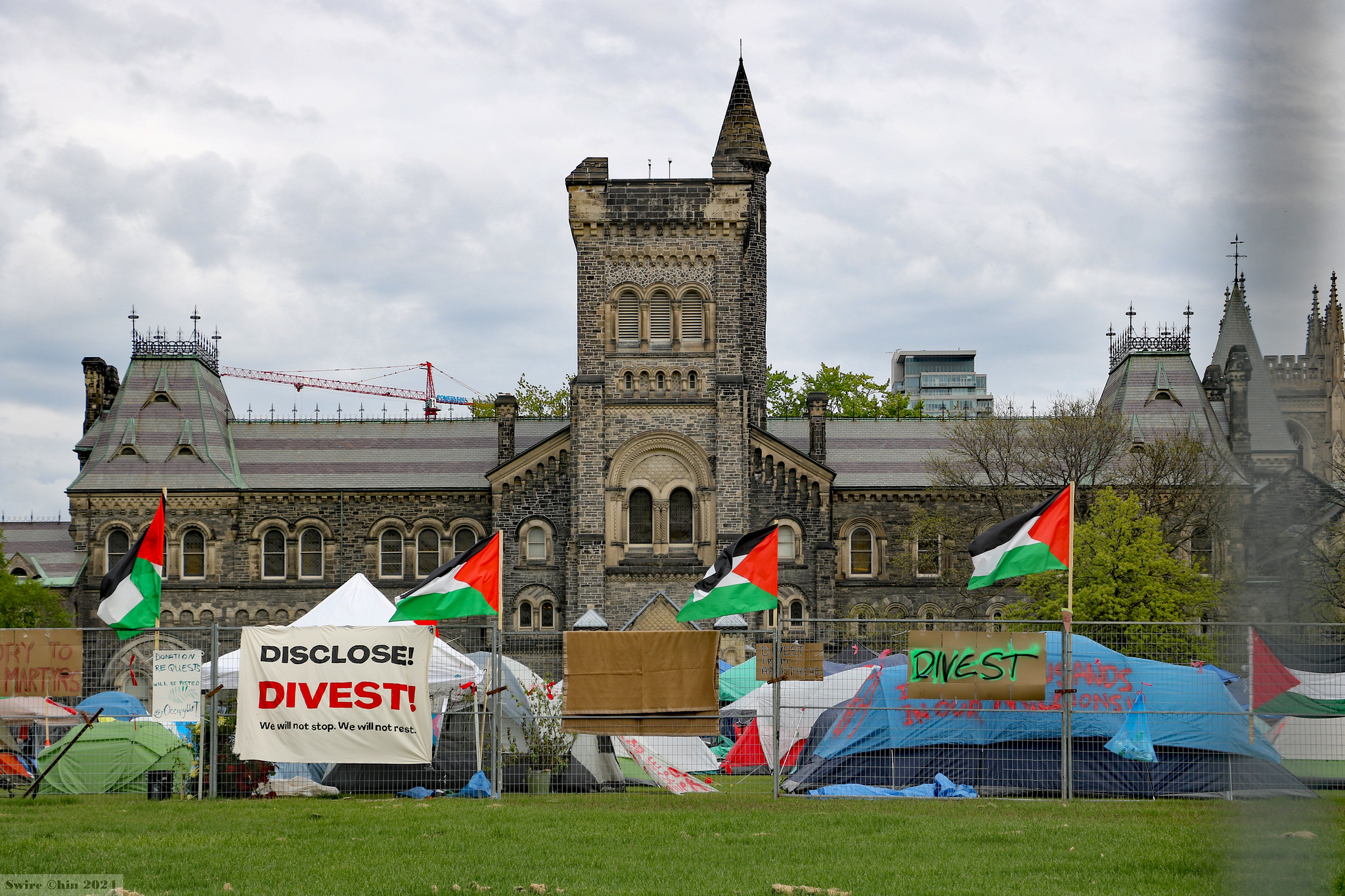
Feature photo: Pro-Palestinian demonstrators, students and faculty members established an encampment at King’s College Circle on the University of Toronto campus on May 2, 2024, amid protests over the university’s investment policies. The working group’s report later documented concerns about the disproportionate scrutiny of pro-Palestinian activities and restrictions on academic freedom. (Credit: Can Pac Swire/Flickr CC)