Nadine Osman
Authorities in the German city of Bremen have withdrawn a campaign warning of Islamist infiltration after Muslim organisations accused officials of portraying Muslims as a threat and encouraging suspicion towards their communities.
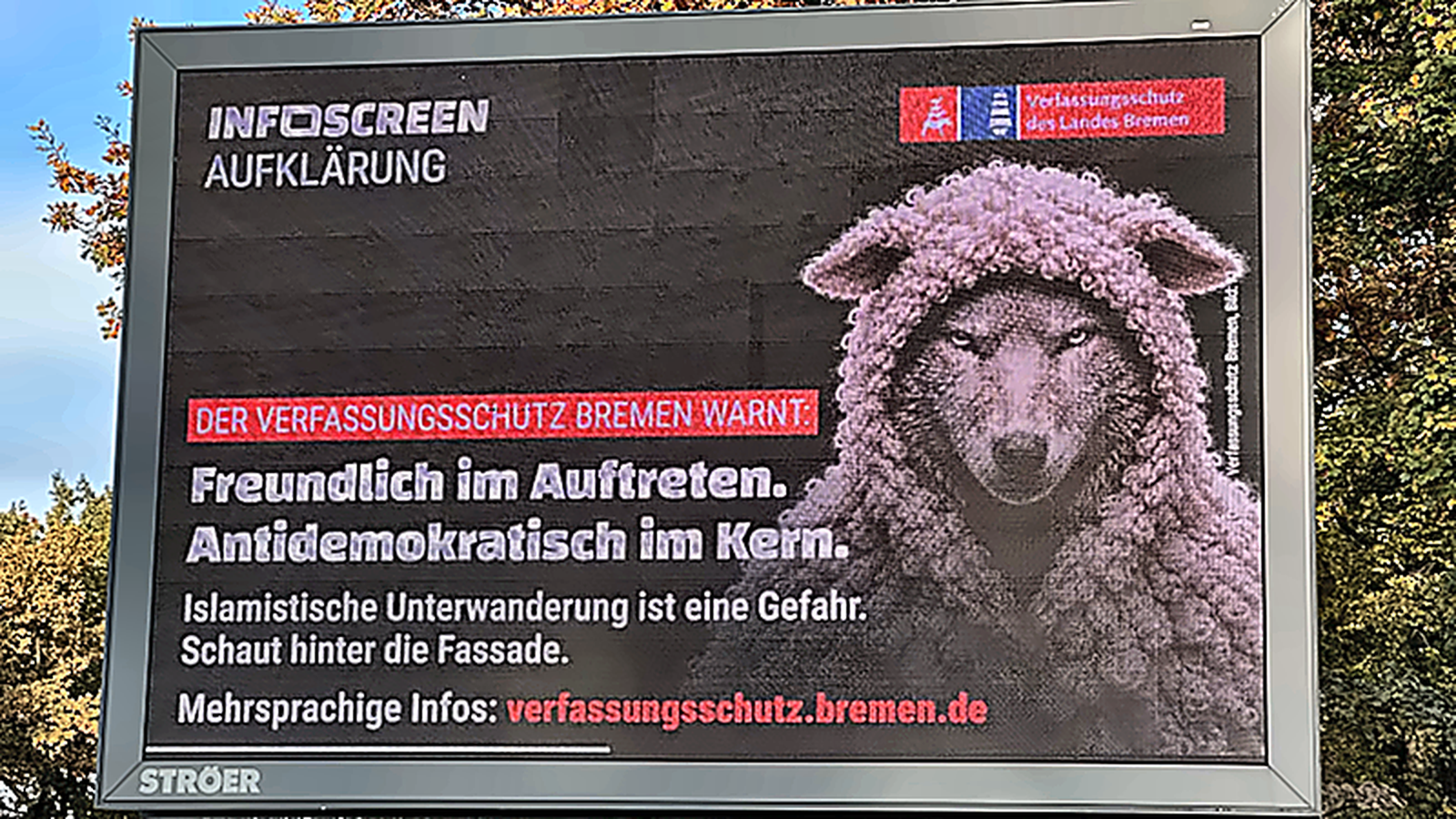
Launched on November 4, the campaign featured a wolf dressed in sheep’s clothing alongside the slogans: “Friendly in demeanour. Anti-democratic at its core. Islamist infiltration is a danger. Look behind the facade.”
The posters appeared on digital advertising screens across the city. They were intended to warn about groups that German security authorities accuse of seeking to undermine the constitutional order through legal and political means rather than violence.
The imagery prompted strong criticism from Schura Bremen, the umbrella organisation representing Muslim communities in the city. It said depicting Muslims as wolves in sheep’s clothing was dehumanising and risked fuelling prejudice against the wider Muslim population.
In a statement Schura said it was “stunned and dismayed” by the campaign, arguing that its message amounted to: “Do not trust Muslims! Behind a friendly face, there could be a dangerous agenda.”
The organisation demanded that the campaign be stopped, an apology issued and measures taken to address the harm caused. It also recalled an earlier campaign encouraging the public to report suspicious appearances and behaviour, warning that such initiatives risked placing Muslims under general suspicion.
Bremen Interior Senator Eva Högl announced on November 14 that the posters would be withdrawn early, just ten days after the campaign began.
“I deeply regret this,” she said. “The goal was right. The implementation was not.”
She acknowledged that the campaign had caused hurt among Muslims, adding: “A campaign that makes friendly behaviour appear suspicious does not reach the few people it is aimed at, but unfortunately affects many people who are not its target.”
Högl maintained that the authorities needed to raise awareness of Islamist extremism, particularly networks associated with the Muslim Brotherhood. She said some groups sought to establish a religious order above the constitution while using non-violent and ostensibly lawful methods.
The head of Bremen’s state domestic intelligence agency, Thorge Koehler, had described the alleged approach as using “supposed willingness to engage in dialogue as a disguise and our freedoms as a tool”.
However, critics questioned the broad language used in the campaign and the failure to distinguish between Islamist organisations and the wider Muslim population. The term “legalistic Islamism”, used by security authorities to describe groups they suspect of pursuing anti-democratic aims through lawful means, has also attracted criticism from legal and academic experts.
Legal and Islamic studies scholar Nahed Samour warned that the concept was “dangerous from the perspective of the rule of law”, arguing that it could expose religious communities to suspicion simply for participating in public life and exercising their democratic rights.
The wolf imagery also attracted criticism because of its historical associations. The Nazi newspaper Der Stürmer used the phrase “wolves in sheep’s clothing” in articles in 1925 and 1926 targeting Protestant clergy of Jewish descent and Christian clergy who defended Jews.
Bremen’s political parties were divided over the withdrawal. The Social Democrats and Christian Democrats said criticism of the posters should be taken seriously while warning that the threat posed by Islamist extremism remained. The Free Democratic Party criticised the decision, arguing that Högl had yielded to pressure.
Although the posters have been withdrawn, the wider campaign against what the authorities describe as Islamist infiltration is continuing. Bremen’s Interior Department had announced a partnership with advertising company Ströer in April to use digital screens for public information campaigns. The posters were produced internally and displayed without advertising costs.
Authorities in neighbouring Lower Saxony, which had cooperated with Bremen on the initiative, said they had not used the wolf image on public screens. Their awareness work had instead relied on social media and information in their domestic intelligence report.
Feature photo: Bremen’s controversial wolf-themed campaign poster, withdrawn on November 14 following backlash from Muslim organisations over concerns it stigmatised Muslims. (Credit: Landesamt für Verfassungsschutz Bremen)