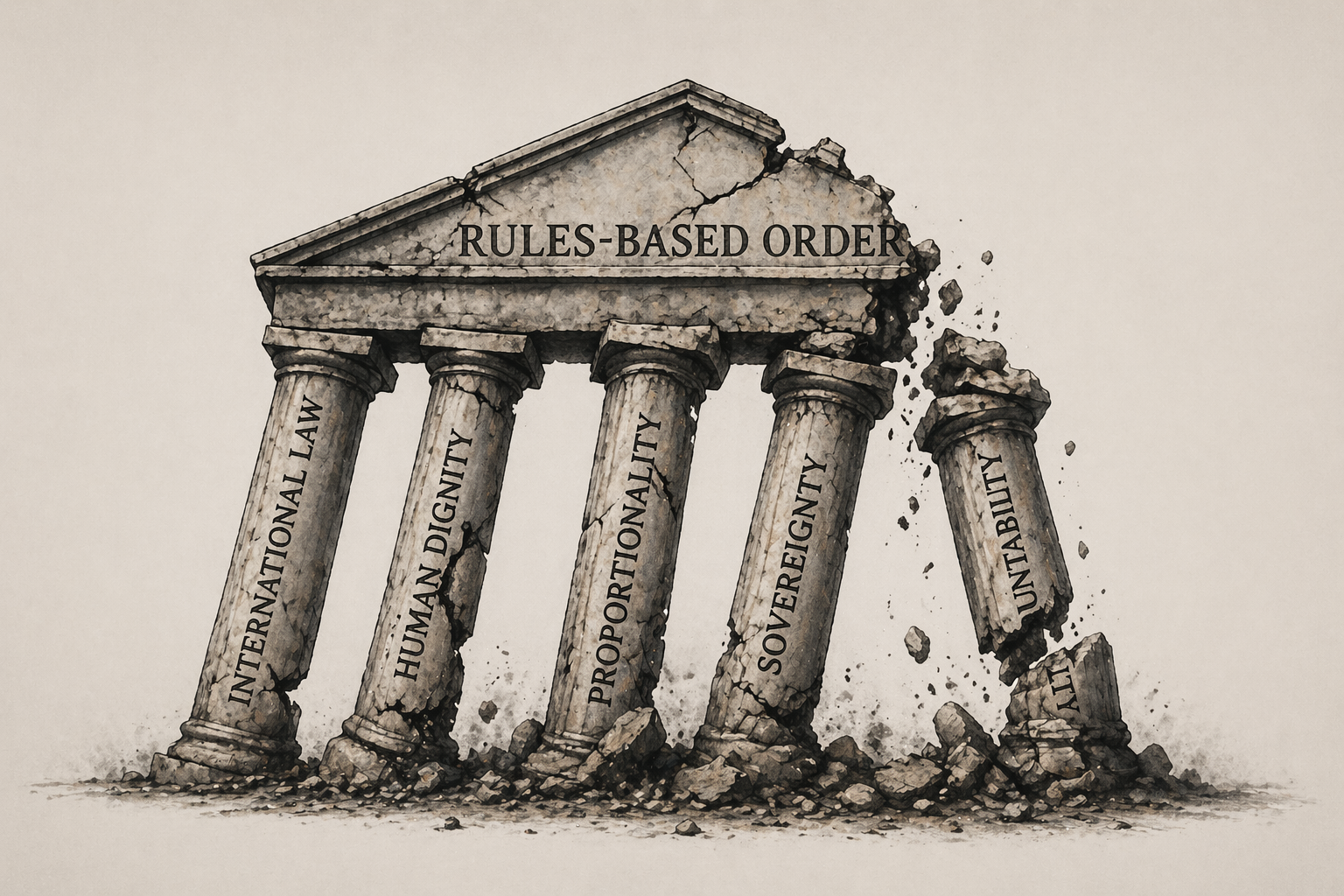
The rules-based order isn’t under strain. Strain implies something still intact. What we’re witnessing across Gaza, Lebanon, and Iran is selective enforcement dressed as moral authority.
Gaza: death streamed, regretted, uninterrupted. Lebanon: sovereignty nominal, occupation real, rubble a footnote. Iran: sanctions as siege, unnamed. Three locations, one fiction: rules govern force. The truth? Exceptions. It depends who acts.
The UN Charter prohibits force. International humanitarian law demands distinction, proportionality, civilian protection. A system designed rules would control outcomes—not public relations.
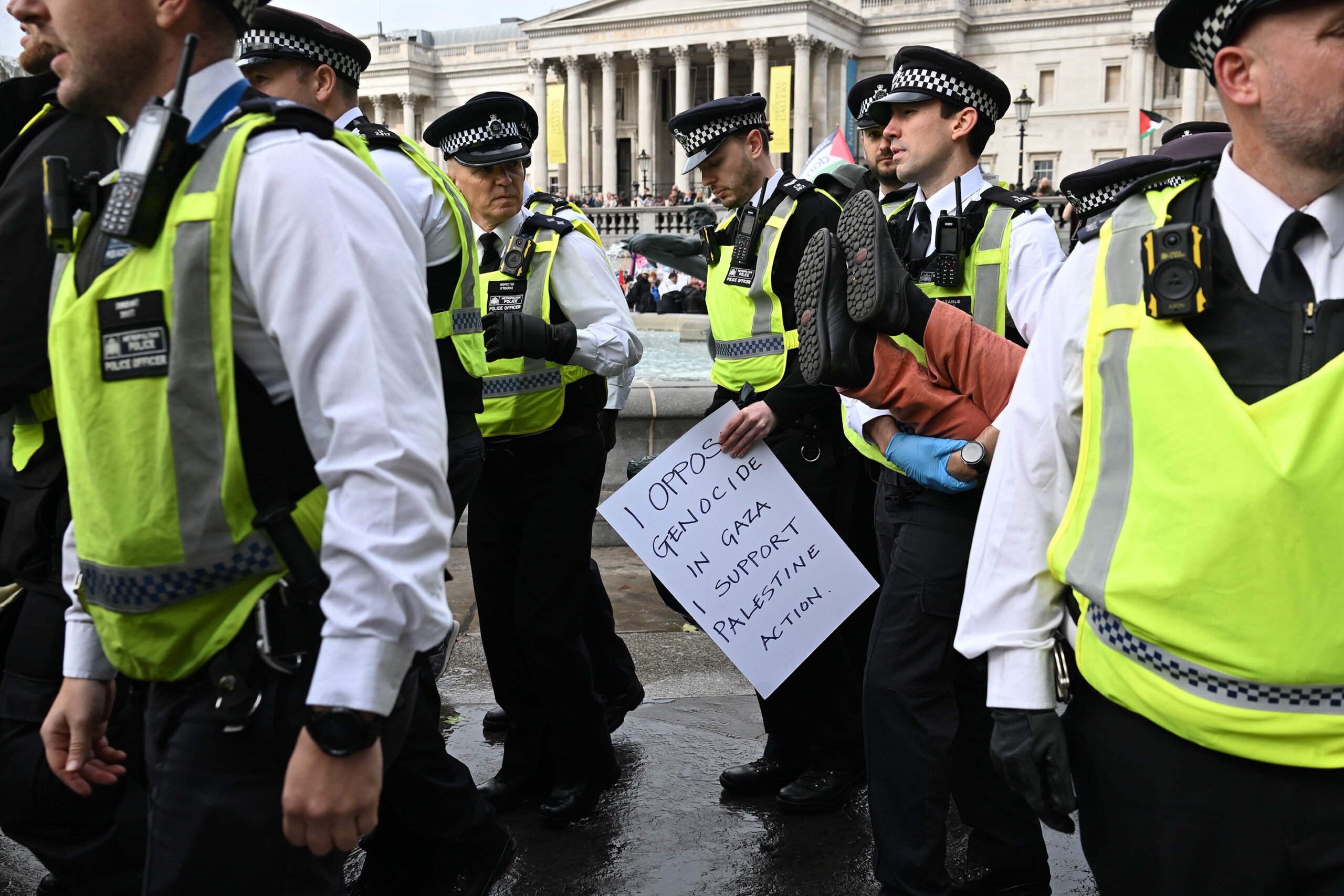
Nowhere is that clearer than in Gaza. Legal language has become ceremonial, recited solemnly over conditions that should signal collapse, not routine.
Official counts miss the full picture. Add indirect deaths (destroyed hospitals, starvation, disease, blocked medicine) and the total exceeds 120,000. Elsewhere, that number would be a rupture of civilisation. In Gaza, it is a disagreement. But scale is not the story. Choreography is. Visibility without action. The world watches live streams. Issues statements. Then proceeds as before.
At some point, this stops being failure. It becomes design. Not authorised. Just uninterrupted.
Lebanon extends the same logic in a slightly different form. Successive waves of Israeli military operations, politically and materially backed by the US, have left thousands dead and over a million displaced. Infrastructure isn’t just damaged; it is repeatedly downgraded into unreliability. Electricity flickers. Water may or may not arrive. Hospitals operate under conditions that would be called collapse anywhere else. Each phase is briefly “noted”, briefly “urged for restraint”, then folded into the permanent architecture of normalised crisis.
Iran, meanwhile, is managed through a different grammar: sanctions. Officially a tool of coercion directed at state behaviour, they function in practice as a sweeping economic constraint system, affecting currency stability, healthcare access, and basic imports. The moral language remains precise. The material effects do not. It is one of the more elegant features of the system: the greater the human impact, the more abstract the terminology becomes.
Iran is also frequently cast in a simplified narrative role, the perennial “outlier”, the central antagonist around which regional tensions are organised. In that framing, everything becomes legible, if not accurate: Iran versus Israel, stability versus disruption, order versus chaos. What this narrative conveniently omits is almost everything else in the region that does not fit a binary script. But simplicity has always been politically efficient. Complexity tends to require accountability.
Then there is rhetoric, which has evolved into its own form of escalation, detached from consequence. Donald Trump’s recent statements on Iran, issued via Truth Social, included references to infrastructure destruction and even civilisational collapse if demands were not met. This is no longer standard deterrence language. It is escalation narrated as inevitability, where the line between threat and intention is deliberately blurred, then later reinterpreted depending on the audience.
International humanitarian law, in theory, is unambiguous: civilian objects are protected unless directly used for military purposes. In practice, it increasingly arrives after the rhetorical groundwork has already been laid to make almost anything sound potentially targetable.
Strategic asymmetry continues to do what it does best: remain structurally invisible while shaping everything around it. Israel is widely assessed to possess nuclear capabilities outside the Non-Proliferation Treaty framework, yet it is subject to markedly different expectations of transparency and inspection than other states in the region. Its military operations across Lebanon, Syria, and the occupied Palestinian territories are rarely treated as departures from an established order, but are instead absorbed into it as recurring features of “security reality”.
But asymmetry is not only about force; it is about interpretation. Nowhere is this more visible than at sea. The waters off Gaza are subject to a tightly enforced blockade, with fishing zones repeatedly reduced and access heavily constrained. Palestinian fishermen operate under constant risk of interception, detention, and the seizure of their vessels, narrowing what was once a basic economic lifeline into a heavily policed space. International attempts to challenge the illegal blockade through flotilla missions have also been intercepted by Israeli naval forces, in some cases through force. The most widely cited example is the 2010 Mavi Marmara incident, in which Israeli forces boarded a flotilla in international waters, resulting in the deaths of nine activists. What is framed in abstract terms of “security” on one side is experienced as sustained restriction and vulnerability on the other.
Elsewhere, the language of principle remains intact but unevenly applied. The doctrine of freedom of navigation is upheld most forcefully when it aligns with strategic priorities, particularly by the US, where naval presence is often justified as the guarantor of a rules-based maritime order. Yet its universality becomes more conditional in practice—invoked with urgency in some contexts, and softened or deprioritised in others where allied actions complicate its consistent application. “Rules-based order” thus operates less as a fixed legal standard than as a flexible language of enforcement.
Nowhere is this contradiction more carefully staged than the Strait of Hormuz. The US frames its openness as essential to global stability and routinely presents its military presence as necessary to preserve it. Iran, despite possessing the capacity to disrupt the waterway, has historically refrained from doing so even under sustained pressure, aware that closure would trigger consequences far beyond the region. The result is a managed tension: a theatre of deterrence in which all sides signal resolve, while relying on mutual restraint to prevent escalation.
The outcome is not the absence of rules, but their selective activation. Legality is not removed; it is distributed unevenly, enforced rigorously when it aligns with power, interpreted flexibly when it does not, and effectively suspended when consistency would produce politically inconvenient conclusions.
Institutionally, the UN Security Council embodies this perfectly: a mechanism designed to produce legal clarity that systematically fails to produce enforceable outcomes. Law continues to be articulated with precision. It is just no longer required to interrupt anything. In that vacuum, international law risks becoming something increasingly familiar: not a constraint on power, but a vocabulary for it. Cited in speeches. Absent in outcomes. Preserved in form. Optional in effect.
This is already reshaping global alignment. The expansion of groupings like BRICS reflects not just economic diversification but a growing recognition that legitimacy is no longer automatically routed through existing Western-led institutions in any meaningful way.
None of this alters the legal texts. The right to self-defence remains, as do the constraints of necessity, proportionality, and distinction. What has changed is the sequence: rhetoric stretches the boundaries first, politics softens them afterwards, and law arrives last, left to interpret and regulate what has already been normalised.
What is emerging is not the collapse of the rules-based order. It is something more carefully maintained, and therefore more uncomfortable: its preservation as language, alongside its erosion as practice. A system where rules are still quoted with conviction, still defended in carefully structured statements, still invoked as if they meaningfully govern behaviour, while their actual application depends less on law than on power, alignment, and convenience.
And so the question becomes harder to avoid: If Gaza can be devastated in real time, Lebanon repeatedly reduced to rubble with intermittent acknowledgement, and Iran constrained through long-term economic pressure, while all of it is still described within the language of rules, what remains of a rules-based order, beyond the increasingly elaborate habit of insisting that it still exists?
Trump’s “praise be to Allah” post sparks outcry amid threats against Iran
Apple denies ‘erasing’ south Lebanon villages as viral Maps claims debunked