Elham Asaad Buaras
Accusations that the BBC is ‘manufacturing consent’ for extreme military escalation have erupted after a report on Iran was quietly altered online. Originally published on April 6, the article’s edits, removing explicit references to atomic attacks, have drawn criticism that the broadcaster is shaping public perception in a way that could normalise catastrophic strikes against Iranian infrastructure.
The original report, titled “’We’re sinking deeper’: Iranians brace for infrastructure strikes as Trump deadline nears” and written by senior journalist Ghoncheh Habibiazad, included comments from a Tehran resident known only as ‘Radin’. In the first version of the story—archived before later edits—Radin came across as surprisingly indifferent to the threat of a major escalation. The report quoted him saying, “About them hitting energy infrastructure, using an atomic bomb, or levelling Iran. My honest reaction is that I’m OK with all of these.”
By the evening of April 6, however, the story had been quietly amended. The explicit reference to an “atomic bomb” was removed from the text and replaced with a significantly softened version: “If attacking targets in the country brings down the Islamic Republic, I’m fine with that…”
The alteration was first flagged by rapper, activist, and political commentator Lowkey (Kareem Dennis), who took to social media to accuse the broadcaster of manipulating public perception. He argued that amplifying a voice seemingly endorsing nuclear destruction risked conditioning audiences to accept extreme military measures, particularly in the context of escalating rhetoric from Washington.
The controversy has since widened, drawing in prominent Iranian commentators. Mohammad Marandi, professor of English and Iranian Studies at the University of Tehran, launched a blistering critique of Western media coverage, singling out the BBC as emblematic of a broader pattern of distortion.
“The BBC is so sinister, so evil, that one of their journalists claimed that people inside Iran are saying you can use nuclear weapons against us. Utterly evil. The BBC is utterly evil,” he said. “It was always like this. I know. I’ve been dealing with the media for all these years. And all of those people who contributed to the lies of Western media over these years and years to demonize Iran, to spread lies, whether it was about Mahsa Amini, who was never murdered, who was never beaten, or the lies about tens of thousands of peaceful protesters being slaughtered by the Iranian police, all lies.”
He continued by questioning the narrative around recent unrest: “And now we see Trump himself admitting that he sent weapons to these protesters. If these were spontaneous protesters, who was he sending the weapons to?”
The byline on the BBC piece has also drawn scrutiny. Habibiazad, a journalist, who joined the broadcaster in January 2024 after covering the 2022 protests, has been accused by some critics—particularly within sections of the Iranian diaspora—of reflecting a “pro-Pahlavi” perspective. Shahab Esfandiary, lecturer in film and media studies and documentary filmmaker, highlighted these concerns on X, noting Habibiazad’s prior work with Marjan TV Network, the parent company of Manoto TV. Esfandiary described the network as “the Pahlavi regime’s whitewashing machine” and criticised the pattern of sensationalised, emotionally charged reporting in Western media as “sham journalism on Iran,” warning that it often reinforces anti-Iran narratives while ignoring context and nuance.
Online commentators have suggested that the inclusion of the “Radin” quote was not incidental, but rather a deliberate editorial decision aimed at reinforcing a regime-change narrative. While Habibiazad maintains a wide network of human rights sources, detractors argue that this instance crosses into advocacy aligned with Western strategic interests.
The timing of the edit has further intensified scrutiny. Just a day earlier, former US President Donald Trump, political figure and businessman, issued what he described as a “Tuesday Deadline,” warning that April 7 would mark “Power Plant Day and Bridge Day” in Iran unless the Strait of Hormuz was reopened.
With strikes already reported at key sites including the Mahshahr Petrochemical Complex and areas near the Bushehr nuclear facility, critics argue that such media framing risks normalising catastrophic escalation—something the International Atomic Energy Agency (IAEA), the UN nuclear watchdog, has warned could trigger severe humanitarian consequences.
The controversy also echoes wider concerns about the BBC’s editorial approach to Middle East coverage. A major study published on June 17, 2025, by the Centre for Media Monitoring, a media research organisation, analysing more than 35,000 pieces of BBC content on Gaza, found what it described as systematic imbalances in language, sourcing, and framing that disproportionately favoured Israeli perspectives while marginalising Palestinian suffering. The report documented stark disparities in how casualties were humanised, the use of emotive language, and the omission of historical context—findings that critics argue lend further weight to accusations that the broadcaster’s Iran coverage may not be an isolated lapse, but part of a broader editorial pattern.
The BBC later issued an update appended to the article on April 7, acknowledging that the original quote from “Radin” had been removed following editorial review. The broadcaster said the remarks were initially included “to illustrate the strength of feeling” among some Iranians opposed to the government but were subsequently deleted due to “concerns over the way in which the speaker expressed his views and the extent to which they reflected wider Iranian viewpoints.” The clarification came only after widespread criticism on social media, with users circulating archived versions of the original article and accusing the BBC of amplifying extreme views before quietly revising them.
Under the BBC’s Editorial Guidelines, any significant alteration to a quote requires a transparent correction or editor’s note. In this case, the sequence of publication, initial silent edit, and post hoc clarification has fuelled accusations not only of editorial inconsistency, but of a broader failure in handling highly sensitive material at a time of escalating geopolitical tension.
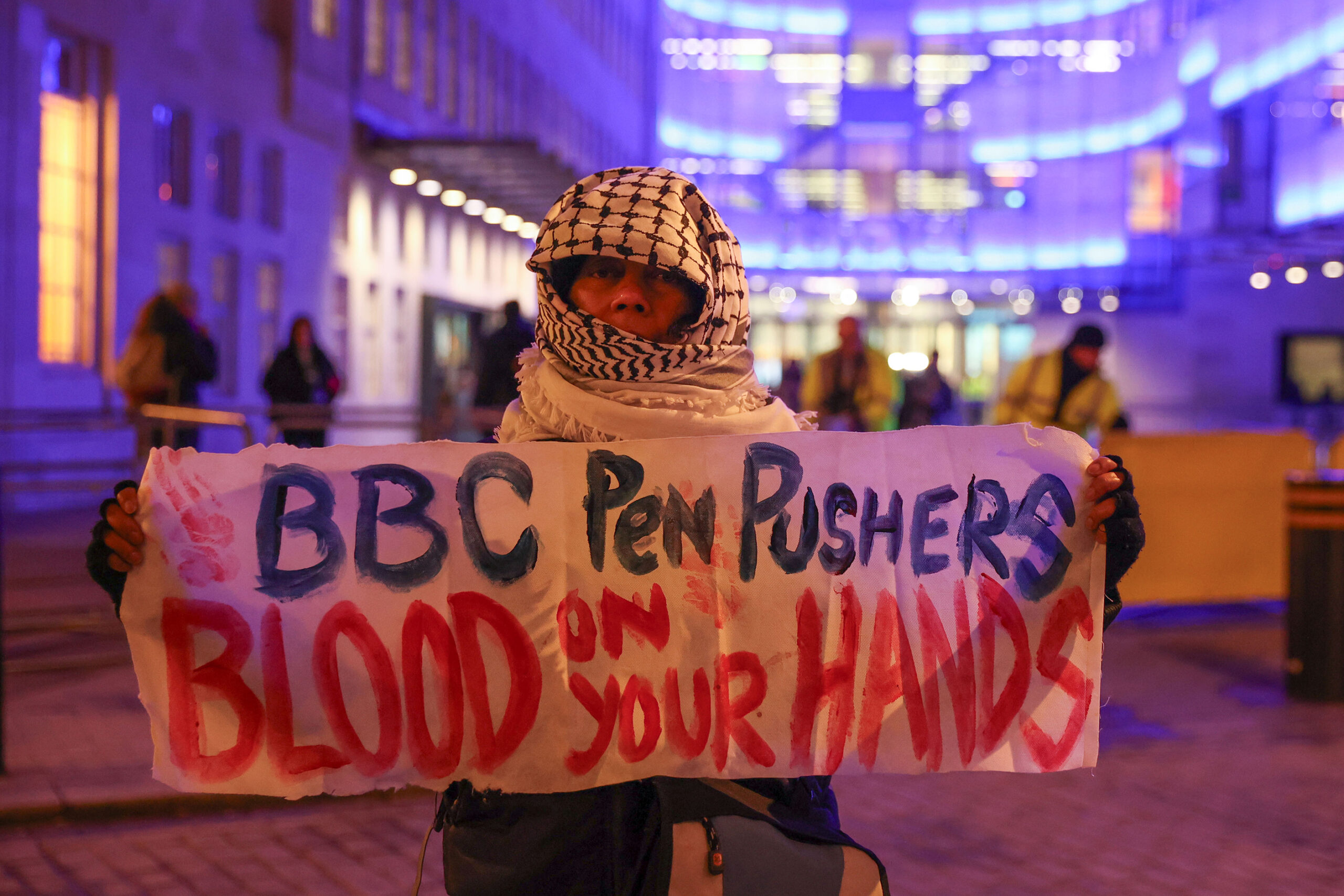
Photo: Demonstrators gather outside the BBC HQ in London in November 2025, to protest over the hunger strike of six pro-Palestinian activists in the UK, has been cited by critics as part of a broader pattern in which the BBC is accused of favouring pro-Western narratives, a concern echoed in recent controversy over edits to a report on Iran’s infrastructure threats. (Credit: Zeynep Demir/CC)