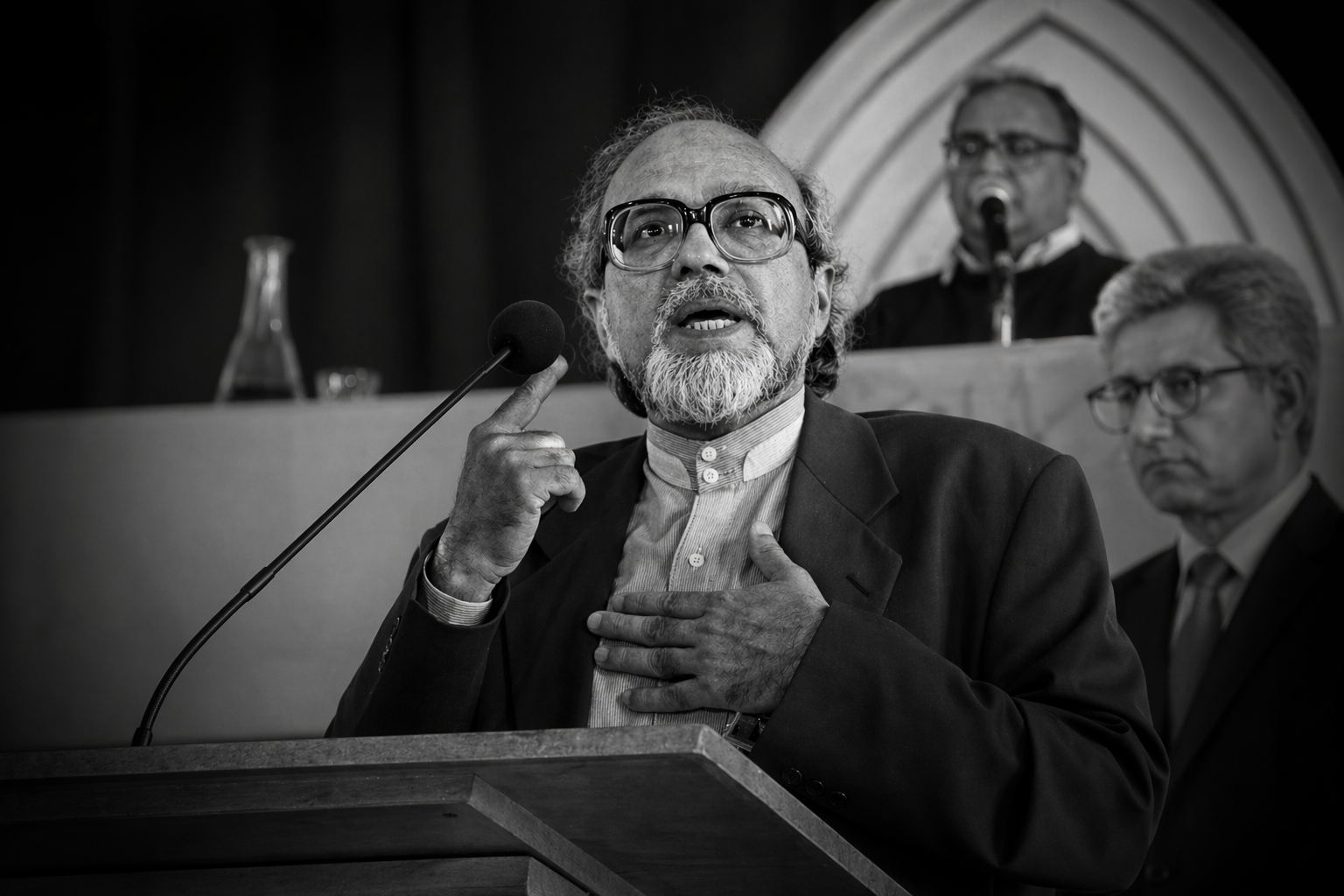
“We are prepared to break the law to bring justice to our community and go to jail if necessary. So far, our commitment to remain the most law-abiding community has been taken as our weakness.
Our essentially peaceful and co-operative nature has been taken advantage of to ensure we remain downtrodden and disadvantaged. We have paid a high price for this attitude but we can no longer accept injustice and discrimination lying down. We are full members of British society”.
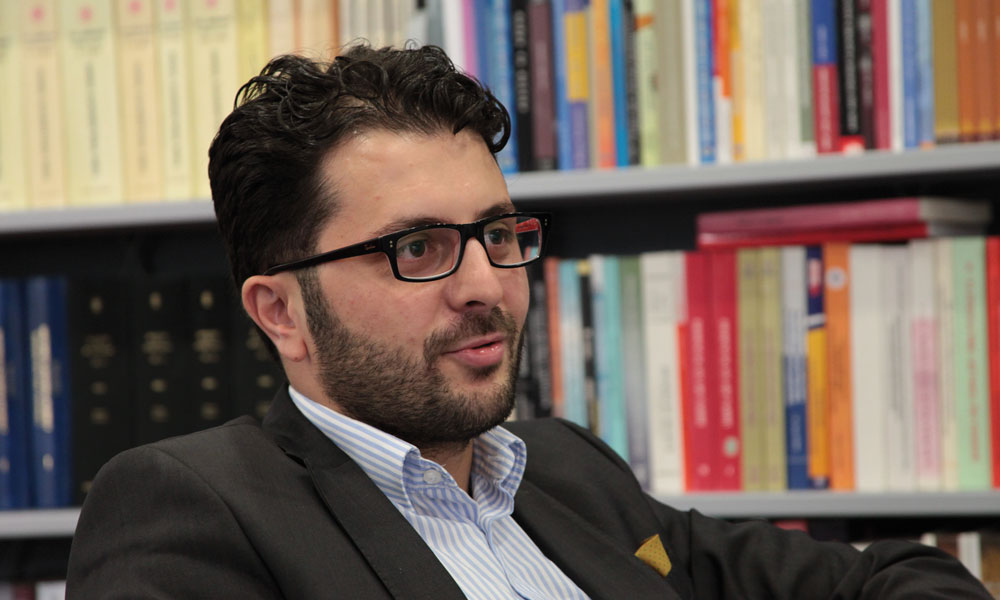
So stated Dr Ghayasuddin Siddiqui upon becoming leader of the Muslim Parliament of Great Britian and Director of the Muslim Institute in May 1996.
Dr Siddiqui died peacefully at his home in Chesham, Buckinghamshire on Saturday April 18, 2026 aged 86 surrounded by family. Over 500 people attended his Janaza (funeral) at Chesham Mosque the following day. He was laid to rest at Chesham Cemetery just outside the mosque.
Born in pre-partition India in 1939, my father would experience the trauma of two migrations. Migrating first as a child to newly created Pakistan, and then as a student to the UK in 1964. A born activist, his life was a pursuit of justice for the oppressed wherever they may be found, irrespective of faith. If a cause was worth fighting for, he would fight for it.
During his student days at Sheffield University, his study room was a hub of activism. As the Assistant Secretary of the newly formed Federation of Student Islamic Societies (FOSIS) he would host thought leaders from across the post-colonial world, culminating in organising the visit of Malcolm X to Sheffield in 1964.
Dr Siddiqui was part of the first generation of Muslim migrants who established roots and community institutions in Britain. Together with fellow pioneer Dr Kalim Siddiqui (no relation) they were trailblazers, establishing a string of bodies that would inspire and clear the path for a new generation of home-grown organisations that would focus on the needs of the growing British Muslim community. Building strength at home would also strengthen Muslim influence abroad was their thinking. These institutions included the Muslim Institute, the Muslim Parliament of Great Britain, the Bait al Mal al Islami (a UK focused welfare fund), the Muslim Women’s Institute and the Halal Food Authority.
Dr Kalim and Dr Ghayasuddin made for a formidable partnership that would command respect from the community and strike fear from the establishment in equal measure for over two decades. My father died 30 years to the day since the death of his compatriot Dr Kalim on April 18, 1996.
The domestic concerns for which my father threatened to initiate a campaign of civil disobedience in 1996 unless equalities legislation was passed included: lack of state funding for Muslim schools, inadequate Islamic education in state schools, Muslim youth unemployment and other economic deprivation, and the absence of legal protection against discrimination. He believed that direct action was necessary. “What happened with the poll tax [in 1990] could happen amongst Muslims. The poll tax was an unjust law that needed to be changed. There is a tradition in this country that if a law is unjust it can be broken. In future, the Muslim community is not going to take injustice lying down” he would tell The Muslim News in May 1996.
In 1994, the Home Secretary, Michael Howard, would encourage other Muslim groups to unite to create a more moderate alternative to the Muslim Parliament that the UK government could engage with. The Muslim Council of Britain was formed in 1997.
Dr Siddiqui had a deep understanding of the principles of justice in Islam. He would often go against conventional Muslim thinking or theology if it made little sense or went against the principles of Islam. A good example of this was the new model of a Muslim Marriage Contract launched in 2008 drafted with his life-long friend Mufti Barkatullah. Going back to the primary sources of Islam, the requirements of a witness having to be Muslim or male was removed, as Islam only requires that they be “sane, adult and reliable”. Later theology would layer on new conditions. He would have the courage to openly and practically challenge theology that developed over a different context if it now hindered the weaker party.
Similarly, the requirement for a wali (guardian/parent) was removed where it was being used to abuse the woman. Muslim groups, including major ones that had initially endorsed the Muslim Marriage Contract, withdrew their support under pressure from some in the community leaving my father and women’s groups to fend for themselves.
Together with his long-time friend Professor Ziauddin Sardar, Dr Siddiqui relaunched the Muslim Institute in 2009 as an independent fellowship society promoting thought, research, creativity, open debate, and community empowerment within the Muslim community and wider society.
Whilst grounded within the community, Dr Siddiqui demonstrated the confidence to hold a mirror up and challenge injustices within, that others preferred to brush under the carpet. He led campaigns against forced marriages, honour killings and religious extremism. He highlighted the risks of child abuse in British madrasahs due to the lack of safeguarding protections and proposed the Child Protection in Faith-Based Environment initiative. Rather than welcoming this protection against genuine vulnerabilities, some Muslim groups and mosques were quick to disassociate themselves from what they saw as negative publicity, preferring the comfort of denial.
His style of leadership and campaigning was hands-on. Despite being a thinker and an academic, not for him was the luxury of leading from behind or indulging in intellectual debates. The campaigns he championed were diverse and often those other Muslim leaders would not touch due to the risks involved. In 1999, a group of young British Muslims were arrested, detained and tortured in Yemen on terrorism charges.
No prominent Muslim group would touch the campaign for them to be released and tried in the UK instead. Dr Ghayasuddin caught the first plane to Aden and stayed there for a few weeks providing the credibility the campaign desperately needed. When Muslim Parliament research found that most meat sold in the UK as halal was in fact haram, he had the courage and dedication to learn a completely new field of expertise and take on the ‘halal’ meat barons establishing the Halal Food Authority in 1994, despite the extensive industry lobbying against the HFA.
His approach to foreign policy was no different. During the Bosnian genocide of the 1990s, the British government imposed an arms embargo on Bosnian Muslims leaving them at the mercy of the better armed Serbian and Croatian armies. Whilst most Muslim groups were sending bandages, the Muslim Parliament would raise funds for arms for the Bosnian government to defend their civilian populations. My father would often skirt close to the law where it was blatantly oppressive.
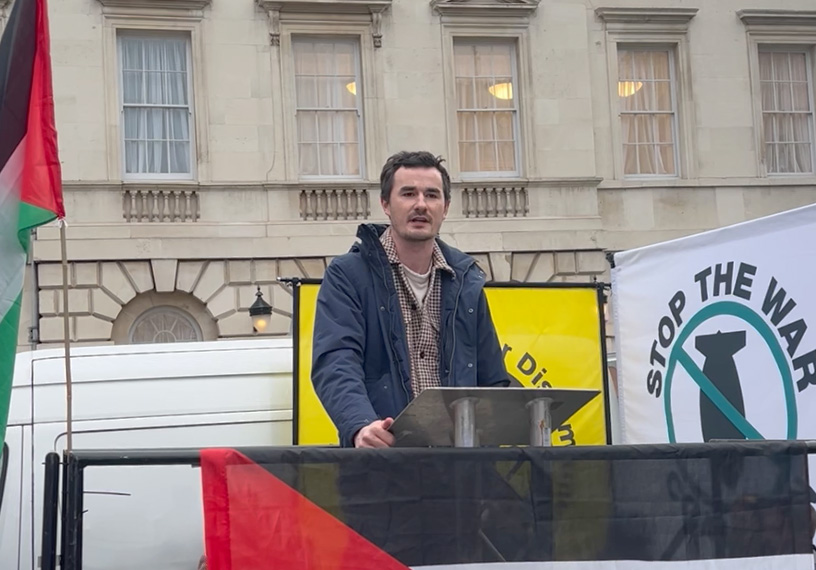
After 9/11, Dr Siddiqui was the first major Muslim leader to call for Muslims to work hand in hand with non-Muslims for common causes at a time when the Muslim community consensus was to march alone. He was a founding member of the Stop the War Coalition in 2001. This innovative and controversial idea is now standard operating model in our community. He was one of the few voices of reason in a confused world left in the wake of the 9/11 attacks and the 7/7 bombings. A regular presence in both newsrooms and at protests, he spoke with clarity and conviction on issues of human welfare and social justice. His voice was a clarion call for the Muslim community.
Our hope now is that the radicalism that my father inspired is not lost and instead galvanises a new generation to take that mantle on. There would be no better tribute to him. Dr Ghayasuddin is survived by his wife Talat and four children, Faiza, Asim, Uzma and Salman.
Asim Siddiqui
(Photo: Courtesy of the family)