Elham Asaad Buaras
GB News remains one of the least trusted major news organisations in the UK, according to the Reuters Institute Digital News Report 2026. Nearly half of the public say they do not trust it. The findings, released on 8 June, show that only around a quarter of people who are aware of the channel say they trust it. This places it near the bottom of national media rankings, despite its growing audience reach.
The findings come from the Reuters Institute for the Study of Journalism at the University of Oxford, which surveyed more than 2,000 adults across the UK as part of a wider global study covering 48 countries and over 97,000 respondents.
At the same time, GB News has expanded its footprint, reaches around 8 per cent of Britons each week on television, with a further 7 per cent engaging via its online platforms. The report notes that this puts it on a similar weekly reach footing to outlets such as the Daily Mail, Channel 4 News, and commercial radio news. This is despite its relatively recent launch in 2021 and rapid rise into mainstream visibility.
Yet the figures for audience trust tell a strikingly different story. As the report states, “only 27 per cent of those who are aware of GB News say they trust it, while 46 per cent actively distrust it.” This creates a clear trust deficit, placing it alongside the Daily Mirror and Daily Mail at the lower end of the credibility spectrum.
By contrast, BBC News commands the trust of 59 per cent of respondents. Channel 4 stands at 57 per cent. ITV News also records 57 per cent. The Financial Times is at 56 per cent. Even Sky News and the Guardian remain comfortably ahead on trust.
The report places these findings in a wider decline in confidence in journalism. It notes that “trust in news overall has fallen five percentage points compared to 2025.”
It adds that just 30 per cent of Britons now say they trust most news most of the time. This is roughly half the level recorded in 2015.
The study also says the UK is among the countries experiencing the sharpest declines in trust. The political context is central to the channel’s growth. The report says, “the insurgent populist party, Reform,” has “made much of the political weather in the UK.” This has contributed to a more polarised media environment.
Attitudes towards established media are increasingly divided. The report highlights a “very significant difference” between groups.
Those on the left are 18 per cent net positive about the effect of public service news on life in the UK. Those on the right are net 36 per cent negative.
This polarisation has helped create conditions for GB News to expand, especially among audiences who feel underrepresented by traditional broadcasters.
The report also notes a wider shift in media habits. “Right-leaning respondents show a somewhat greater preference for news from sources which share their point of view.”
However, most Britons still prefer impartial news.
The study places GB News within a more fragmented media environment. This environment is also increasingly partisan.
It notes that “new entrants are particularly likely to see partisanship as a powerful differentiator.” This reflects dynamics already seen in US cable news and talk radio.
The channel’s rise has coincided with sustained scrutiny of its editorial standards. GB News has been “found in breach of Ofcom’s broadcasting rules on multiple occasions.”
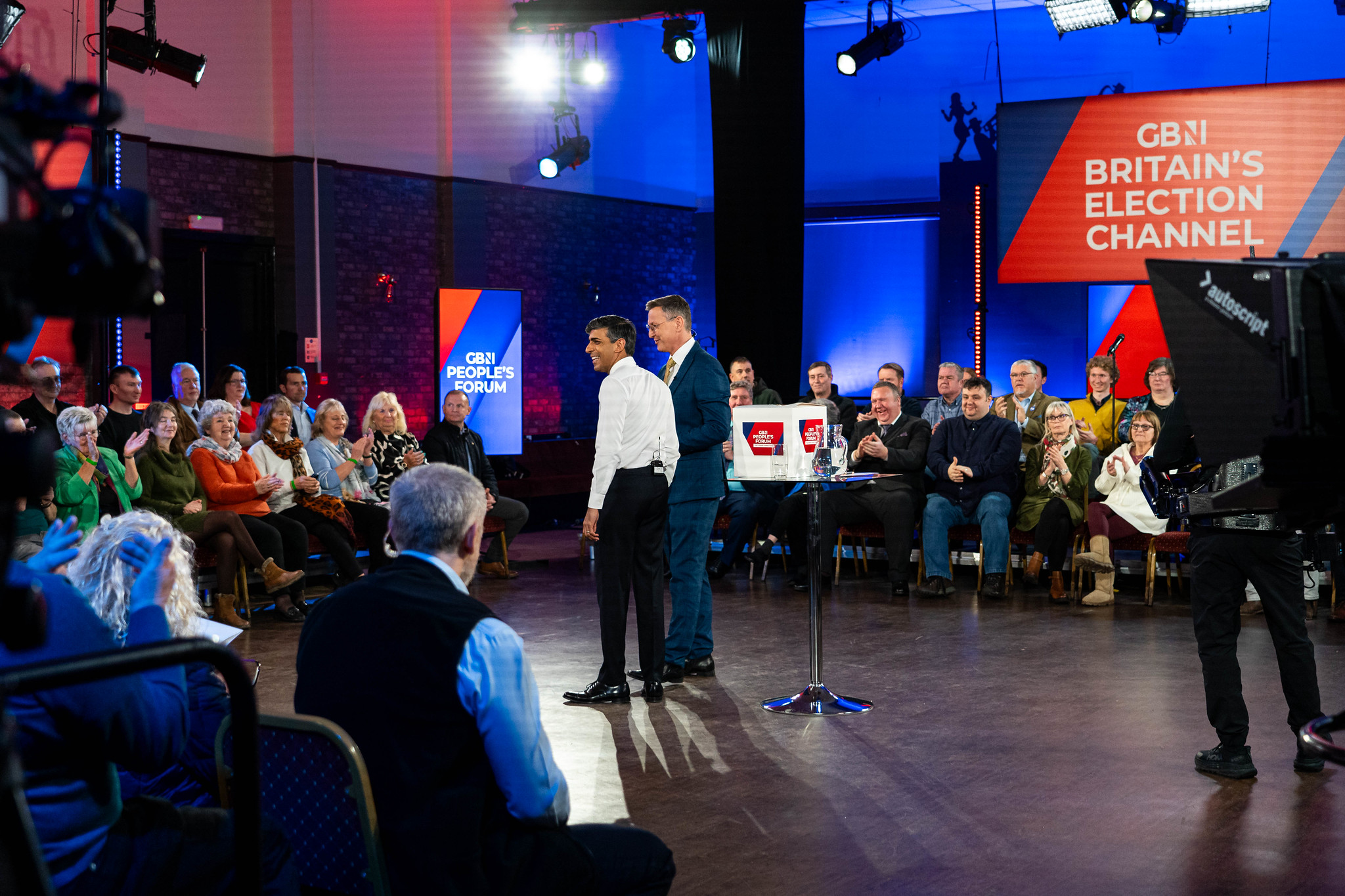
In 2024, it was fined £100,000. This followed a ruling that a programme featuring then–Prime Minister Rishi Sunak failed to maintain due impartiality. The regulator said it did not present sufficient alternative viewpoints, raising concerns about compliance with UK broadcasting rules.
These regulatory issues sit alongside wider turbulence in the UK media landscape, including controversy around the BBC, which the report describes as a factor in undermining trust in public service broadcasting more generally.
The report also highlights rising news avoidance, with half of UK adults now saying they “sometimes or often avoid the news altogether,” alongside high levels of concern about misinformation, with 77 per cent expressing worries about fake news online.
Taken together, these trends frame GB News’s position as a paradox. As the report puts it, the channel has achieved reach that “would have seemed improbable at its launch in 2021,” yet its “trust deficit — with nearly half the population actively disbelieving its output — reveals the limits of an audience strategy built on partisan differentiation.”
Editorial: Rising Islamophobia demands more than words