Elham Asaad Buaras
A group of staff members at the International Criminal Court (ICC) have written to the court’s governing body in support of prosecutor Karim Khan returning to his duties, as a minority bloc of 15 of the ICC’s 124 member states moves to challenge a judicial panel’s finding that cleared him of sexual misconduct.
Khan KC, who investigates war crimes, crimes against humanity and genocide, has taken a leave of absence pending an inquiry into the allegations.
The ICC, the world’s criminal court of last resort, has been rocked by the investigation into Khan, as well as US sanctions over the arrest warrants issued for Israeli Prime Minister Benjamin Netanyahu and Yoav Gallant, the former defence minister, over alleged war crimes.
Two letters sent in late March and early April, reportedly from staff within the Office of the Prosecutor (OTP), urged the Assembly of States Parties (ASP) to respect the findings of an ICC-appointed judicial panel which concluded there was insufficient evidence to establish misconduct against Khan.
The first, sent on March 31, was an anonymous email on behalf of a “sizeable group” of OTP staff supporting Khan’s return following the panel’s ruling.
A second letter, sent on April 1 and attributed to “a majority of staff of the ICC Office of the Prosecutor from different regional and gender backgrounds”, said staff supported respect for the judicial process and would welcome Khan’s return if no misconduct was found.
It stated that Khan’s leadership had delivered “unprecedented successes” and warned of what it described as “concerning signs of political interventions and individual agendas” and “smearing campaigns” targeting the institution.
The letters follow a Staff Union Council submission on March 25 to the Hague Working Group, which said many ICC staff were experiencing heightened anxiety and stress linked to the misconduct proceedings.
The dispute comes amid wider legal concern over the institutional handling of the case. Legal scholars have warned that disregarding or politically overriding judicial findings risks undermining the independence of the court and weakening the rule-of-law framework governing the ICC.
One analysis warned that “political decision-making should not be allowed to replace and displace a legal assessment carried out in accordance with the highest standards of judicial competence, independence and impartiality,” cautioning against “political interference, and abuse of power.”
The same commentary stressed that in politically sensitive cases, strict adherence to due process is essential to preserve institutional credibility, warning that failure to do so could damage confidence in the court’s governing structures.
A separate warning added that such actions could raise “serious questions about the state parties’ credibility and their commitment to the rule of law in governing the court.”
On April 2 , diplomatic sources said a minority bloc of 15 of the ICC’s 124 States Parties — including Belgium, Brazil, Chile, Finland, Italy, Japan, Poland, South Korea and Switzerland — has backed a proposal to continue examining the allegations against Khan, despite the judicial panel’s findings.
The move followed consultations within the Assembly of States Parties (ASP) Bureau in late March , where members were divided over whether to accept the panel’s conclusion or pursue further review of the underlying UN investigation.
The ASP Bureau is expected to issue a preliminary position in April , with the possibility that the matter will be referred to a full vote of the Assembly.
Under ICC rules, any finding of misconduct would require a two-thirds majority of states present and voting. A separate vote would be required to remove the prosecutor from office, requiring an absolute majority of at least 63 states.
The dispute centres on a judicial panel decision issued on March 9, which found there was insufficient evidence to support allegations of misconduct against Khan.
The panel, appointed by the ASP Bureau, reviewed a UN Office of Internal Oversight Services (OIOS) investigation completed in late 2025.
It concluded that the material did not meet the standard of proof beyond reasonable doubt and noted that parts of the UN investigation relied on hearsay evidence and did not resolve key factual disputes.
The OIOS report contained both allegations and responses from complainants and Khan, but did not make definitive factual findings on central issues.
Khan has been on leave since May 2025 and denies all allegations.
Following the judges’ ruling, the ASP Bureau began consultations in late March on how to proceed.
Diplomatic sources said a preliminary decision is expected in April , with the possibility of escalation to a vote of the full Assembly of States Parties in the coming months.
The ICC’s 124 member states would ultimately decide any outcome if the matter is referred to a vote.
Further developments are expected later this month as the Assembly of States Parties continues consultations on whether to uphold the judicial panel’s findings or proceed with further review.
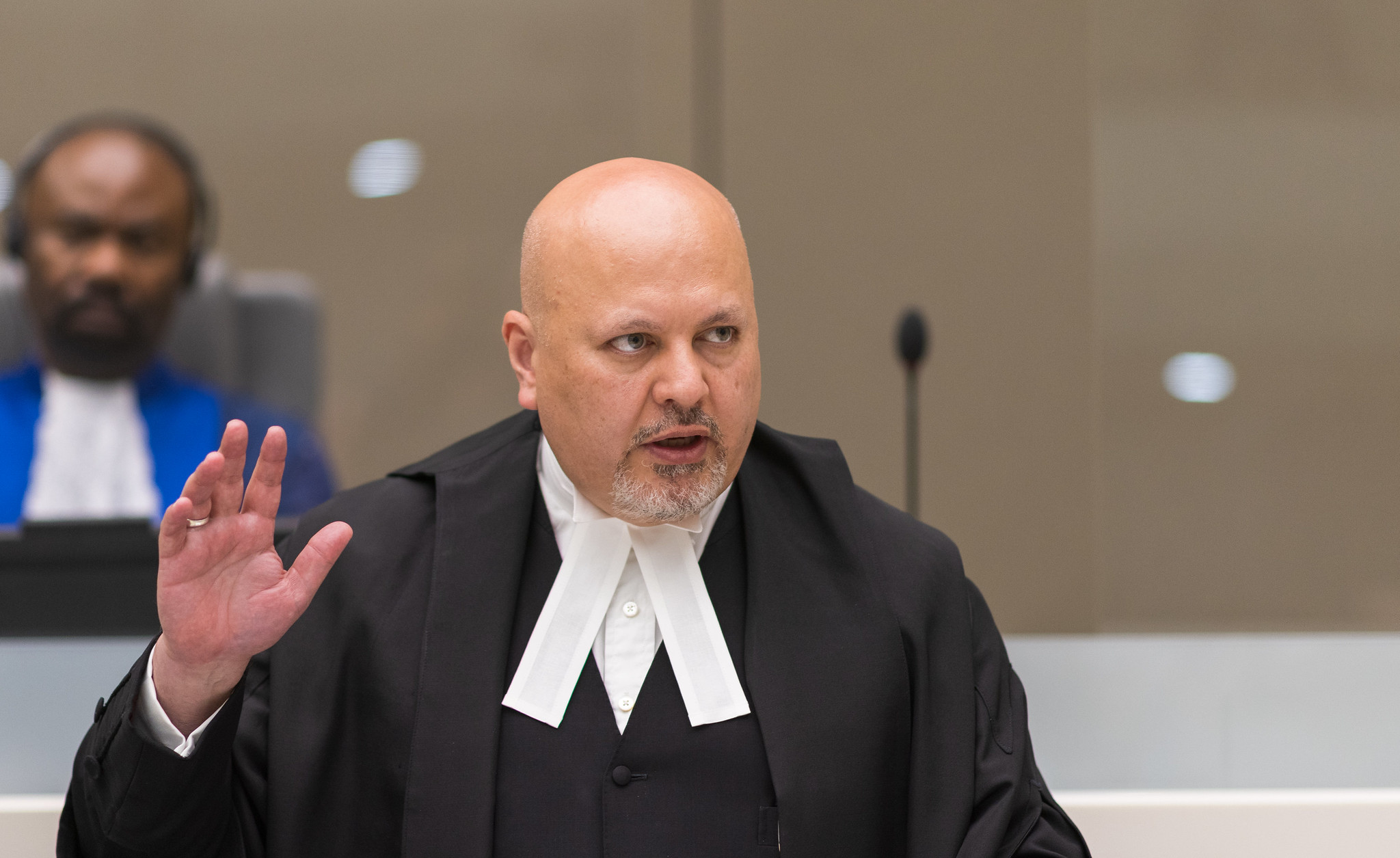
Feature photo: A group of staff members at the International Criminal Court (ICC) have written to the court’s governing body in support of prosecutor Karim Khan (pictured) returning to his duties (Credit: ICC-CPI/Flickr CC)