Nadine Osman
Germany has sensationally pulled its support for Israel at the world’s highest court, just as it faces explosive accusations of breaking international law itself.
The stunning u-turn was confirmed on March 19, when a German foreign ministry spokesperson revealed Berlin would no longer intervene on Israel’s behalf at the International Court of Justice (ICJ) in The Hague.
The move marks a sharp reversal after Germany had previously vowed to stand by Israel against genocide claims brought by South Africa in December 2023. Back in January 2024, Berlin dismissed those allegations as “baseless” and accused South Africa of “political instrumentalisation” of the Genocide Convention.
But when the crucial March 12, deadline passed for countries to formally intervene in the case, Germany was nowhere to be seen.
Germany is now itself under legal fire at the same court, after Nicaragua accused Berlin of violating international law by supporting Israel’s war in Gaza, including through arms exports.
Explaining the abrupt retreat, foreign ministry spokesperson Josef Hinterseher said, “We are now ourselves part of a contentious case before the ICJ and have therefore decided not to make use of this option.”
The case against Germany is already moving forward. While the ICJ rejected Nicaragua’s demand for emergency measures, such as halting weapons shipments, it allowed the broader proceedings to continue.
Among Nicaragua’s demands are that Germany stop supplying arms to Israel and restore funding to UNRWA, the UN agency for Palestinians.
Berlin had previously cut funding after Israel alleged some UNRWA staff were linked to the October 7 Hamas massacre, before later restoring support when a review found insufficient evidence.
Germany’s absence leaves Israel without one of its strongest European allies in court. Berlin is Israel’s second-largest arms supplier after the US and has rarely criticised its conduct in the war.
Pressed on whether Germany still rejects genocide accusations, Hinterseher stopped short of addressing Israel directly, saying, “We categorically reject Nicaragua’s allegations against Germany. All other matters will have to be clarified before the court, and we do not wish to comment further.”
Meanwhile, the US has stepped in to defend Israel, arguing the genocide case is part of a broader campaign “to delegitimize the State of Israel and the Jewish people and to justify or encourage terrorism against them.”
More than 18 countries have now piled into the explosive case, exposing a widening global rift over the war.
Several nations have formally intervened at the ICJ to weigh in on how the Genocide Convention should be interpreted, without becoming direct parties to the case.
A growing bloc, including Iceland and the Netherlands, has taken a more critical tone, raising concerns about Israel’s conduct in Gaza, particularly around humanitarian access, civilian protection and the risk of breaches of international law.
They join a wider group of countries such as Spain, Belgium, Mexico and Chile that have aligned with or supported arguments put forward by South Africa. But the international response is far from unified.
Other nations, including the US, Hungary, Fiji and Paraguay, have intervened in support of Israel, rejecting the genocide allegations outright.The result is a sharply divided global courtroom battle, with rival camps forming around one of the most politically charged cases ever heard at the ICJ.
Israel has repeatedly denied all accusations of genocide and is urging the court to throw the case out, arguing it lacks jurisdiction.
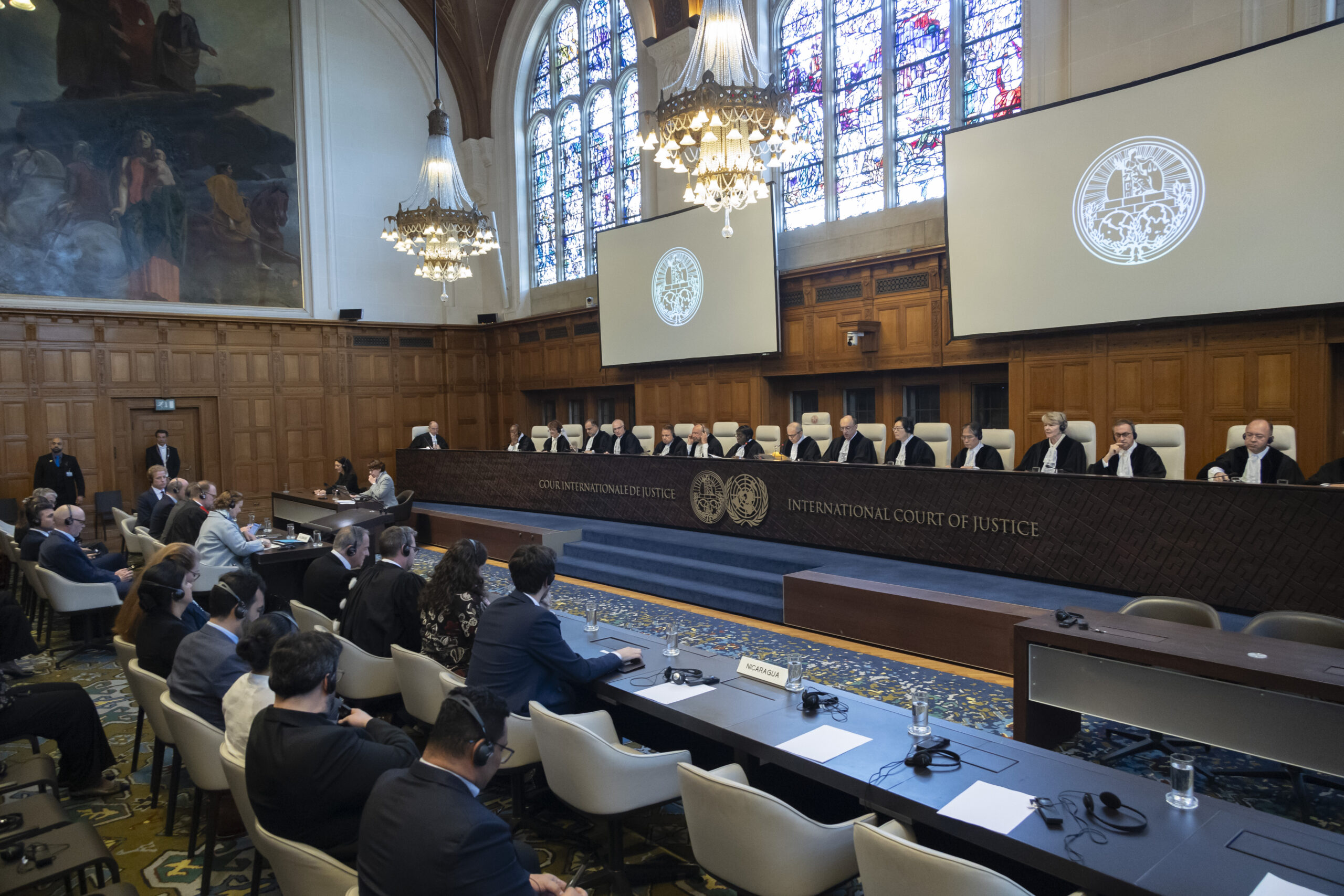
Feature photo: The International Court of Justice in The Hague, where Germany has withdrawn plans to intervene in support of Israel in the genocide case brought by South Africa, as Berlin faces separate legal proceedings over its own role in the Gaza war. (Credit: Nikos Oikonomou/AA)