The war on Iran has exposed countries’ dependence on imported energy sources and reinforced the idea that renewables may be a better option for securing against supply chain disruptions and subsequent price spikes for consumers.
America and Israel’s decision to strike Iran in late February came as a surprise to Western allies, who were not informed of the decision beforehand. Despite the American President’s assurances that the conflict would be a rapid success, it has proved otherwise.
The Iranian government’s immediate response was to blockade the Strait of Hormuz, one of the world’s most traveled shipping lanes.Cargo ships can lose their insurance if they travel through areas with confirmed risks, as both crew and cargo face greater danger on the journey. The situation has caused major supply chain disruptions in oil, liquified natural gas, and fertilizer, which are all vitally important for many countries’ day-to-day operations, as they are needed for driving, cooking, and fertilizing crops. The inflationary consequences have caused consumers to cut back on travel and change their buying habits.
Some policymakers are aiming to make renewable energy options more scalable and available to the public, if even as a supplementary option for their energy needs. The UK government recently announced an option for flat dwellers to use plug-in solar panels on balconies. These can be purchased for around £400 and Lidl plans to start selling them in the coming months. Plug-in solar is heavily used in Germany, and according to an analysis conducted by Carbon Brief, “plug-in solar could provide 400 kilowatt hours (kWh) of electricity each year, enough to meet 15% of demand for a typical household.”
The price spikes for electricity have not affected European countries equally, as each relies on varying mixes of energy. According to The New York Times, Italy suffers a much higher euro-per-megawatt-hour price because gas accounts for nearly half of its energy mix. In Spain, however, the higher share of wind and solar output has insulated it better from gasoline price shocks. Russia’s invasion of Ukraine and the subsequent sanctions already showed European countries the importance of insulating themselves from energy supply chain shocks, and there is greater political openness to scaling renewable energy generation there than in a place like the United States, where the Trump administration has revoked previously approved subsidies aimed at incentivizing renewable energy uptake and even moved to revoke the permits of previously approved wind farms.
The energy crisis caused by the war on Iran will cause more countries to consider how they can produce a greater share of their energy domestically to be less reliant on imports. However, despite the security concerns around fossil fuel imports, which can be greatly impacted by geopolitical issues, relying on renewables is not a silver bullet. Given that China has the most advanced market for renewables, producing around 80–90% of global solar panel supply chain components and over 60% of refined rare earth elements (according to the International Energy Agency and the US Geological Survey),its positioning in the market means that European countries aiming to rely more heavily on renewables will have to turn more towards China.
Addressing the geopolitical consequences of the war, particularly for energy security and China’s dominance in clean energy supply chains, Meghan O’Sullivan, US’s former deputy national security adviser for Iraq and Afghanistan and Director of Harvard University’s Belfer Center for Science and International Affairs said, “This is going to make many more countries and economies, at least in the medium term, susceptible to political and economic pressure from China because China is the country that has real dominance over clean energy supply chains. So again, the energy weapon is back.” Solar panels and electric vehicles require critical minerals that China mines and refines; and it has already used this advantage as a geopolitical weapon, tightening export controls on elements used in chips and electric vehicles in the name of national security.
Still, as countries experience geopolitical volatility, and the strength of their alliances are tested, they are forging new partnerships to safeguard against the worst shocks.
Green Central Banking calls the green transition “a monetary policy imperative,” considering the many fossil fuel price shocks the world has experienced since the 1970s. Insulating an economy that is heavily integrated into the global market will be a long-term project that requires reasonable policies.
Even as the UK has proposed the balcony solar scheme, policymakers still need to implement relevant standards and safety guidance. For decades, scientists have called for a necessary global renewable energy transition. Now, as fossil fuel reliance becomes a greater security issue while hitting the pocketbooks of regular consumers, lawmakers are ready to make moves to accelerate the transition in a hopeful attempt to insulate their economies from non-renewable energy’s inevitable future supply chain shocks.
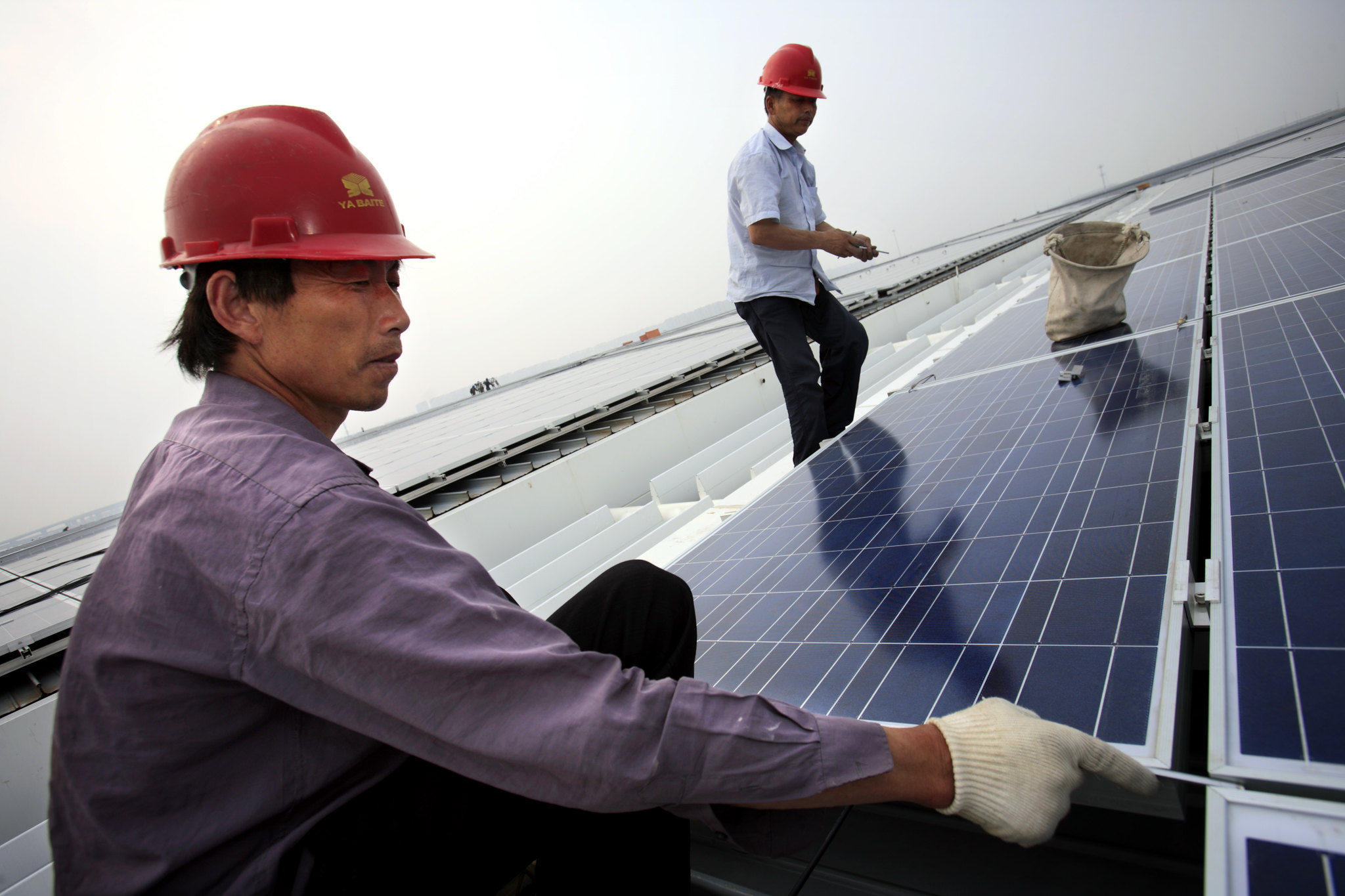
Feature photo: Workers install solar photovoltaic panels on the roofs of the Hongqiao Passenger Rail Terminal in Shanghai, China.(Credit: Jiri Rezac/The Climate Group)Sarah Sakeena Marshall, Consultant, Writer, Editor, Climate Change, National Security