Elham Asaad Buaras
From Belfast to Edinburgh, racist and anti-Muslim violence left families burned out of their homes, healthcare workers intimidated, worshippers trapped inside Glasgow’s largest mosque and five men wounded in knife attacks that Prime Minister Keir Starmer said appeared motivated by anti-Muslim hatred.
The unrest began on June 9, less than 24 hours after the stabbing of 44-year-old Belfast resident Stephen Ogilvie on the night of June 8. The alleged attacker was later identified as Hadi Alodid, a 30-year-old Sudanese national.
Political leaders, anti-racism campaigners, community representatives and the victim’s family condemned attempts to exploit the attack to target migrants, Muslims and ethnic minority communities.
Over the following days, anti-immigration demonstrations escalated into some of Northern Ireland’s worst racist violence in recent years.. By June 13, police had made dozens of arrests, officers and civilians had suffered injuries, and at least 27 people had lost their homes. Entire communities faced intimidation and targeting based on ethnicity, religion, and skin colour. Some politicians and commentators described the violence as a “race-based pogrom,” while others drew comparisons with historical episodes in which families were driven from their homes during sectarian conflict.
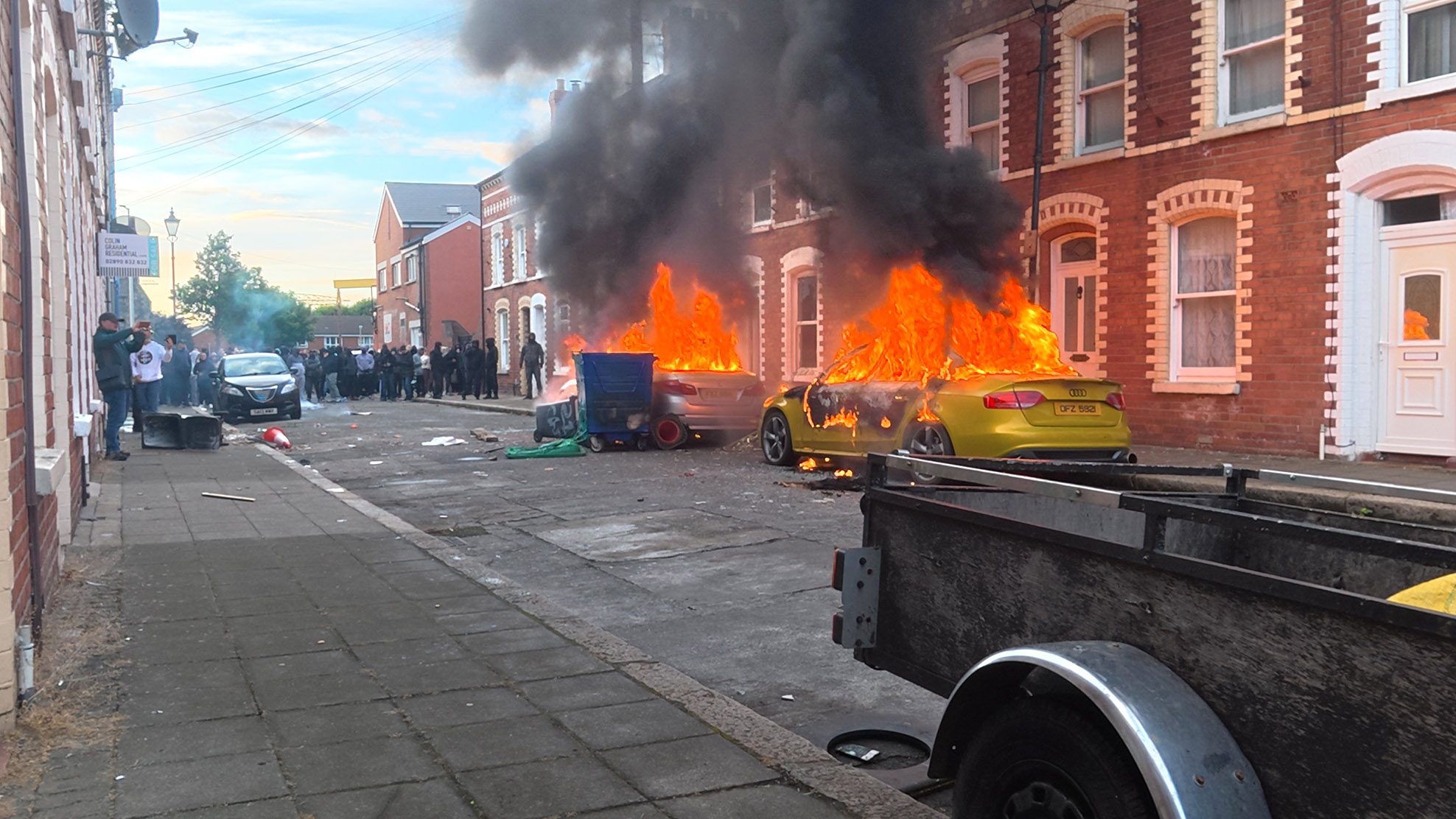
The most serious disorder began on June 9, when anti-immigration protests escalated into violence across several areas of Belfast. Masked men claiming to be “getting the foreigners out” moved through neighbourhoods on the Lower Newtownards Road, kicking in doors, smashing windows, and trying to identify homes they believed were occupied by immigrants.
Attackers set fire to homes, businesses and vehicles, including a Middle Eastern supermarket and a Glider bus, disrupting public transport across the city. Further disorder erupted on the Crumlin Road, while rioters set a police vehicle alight in Portadown. The Fire and Rescue Service responded to 62 incidents.
Witnesses said gangs moved from street to street searching for immigrant households. Ugandan healthcare workers, a Ukrainian family and members of the Romani community were among those targeted. In one incident, neighbours and emergency responders rescued a two-month-old baby from a targeted home.
Rioters reportedly chanted slogans including “foreigners out” and “kill all Muslims”. By the end of the night, dozens of families had been displaced.
On June 10, masked men operated unofficial checkpoints across Belfast. A press photographer said people were allowed through or blocked depending on their skin colour. Healthcare workers reported being stopped and questioned on their way to work.
Healthcare workers travelling to hospitals reported that masked men stopped them en route and questioned them. The Royal College of Nursing said intimidation prevented some staff from reaching work, while at the Ulster Hospital, masked men chased a nurse into the building in what staff described as a racist attack.
PSNI warned about online lists identifying addresses where migrants allegedly lived, describing their circulation as “totally unacceptable” and potentially criminal.
Further violence broke out that evening at Sandyknowes roundabout in Newtownabbey, where rioters set fire to a Department for Infrastructure street-cleaning vehicle. Police deployed water cannons as crowds clashed with officers. Footage showed masked men tearing bricks from walls and smashing paving stones with sledgehammers to create projectiles to throw at police.
Journalists covering the disorder also came under attack. Several reporters and photographers were threatened, while a BBC News crew had a stone thrown through the rear window of their vehicle while filming in Newtownabbey.
As unrest spread beyond Northern Ireland, Scotland experienced its own scenes of racial and anti-Muslim hostility. On June 9, disorder broke out in Glasgow city centre, where police later arrested three men — one aged 31 and two aged 18. Police Scotland said three members of the public and two police officers were injured. Demonstrations were also held in Edinburgh, Falkirk, Perth, Ayr and Paisley.
The climate of hostility intensified on June 19 when a 36-year-old man was charged in connection with a series of knife attacks in Edinburgh that left five men aged between 22 and 39 injured. Police said none of the injuries were life-threatening, although three victims required hospital treatment. Counter Terrorism Policing Scotland launched an investigation into the attacks, some of which took place at shops across the city.
While Police Scotland did not formally declare a motive, Assistant Chief Constable Alan Waddell said there was “no place for racism or faith-based hate in Scotland”, and Prime Minister Keir Starmer said the suspect appeared to have been motivated by anti-Muslim hatred.
The suspect, whom police described as a white Scottish man, was heard in video footage of his arrest making anti-Muslim remarks and telling officers it was time to “protect” the country from Muslims. He also appeared to reference the recent inquiry into organised child sexual exploitation, though investigators have not linked the victims to those issues.
Videos shared on social media showed clashes in Glasgow city centre, where some demonstrators invoked the memory of murdered teenager Henry Nowak and displayed the slogan “white lives matter”.
The most alarming scenes unfolded near Glasgow Central Mosque and Islamic Centre. Speaking to the Press Association on June 10, Scottish Labour leader Anas Sarwar said worshippers had been forced to remain inside the mosque after a group of men wearing black hoodies and balaclavas appeared to be marching towards the building.
Sarwar described the atmosphere as intimidating, particularly for minority communities, and stressed that those sheltering inside the mosque had no connection to the Belfast attack.
“The people inside that mosque who had to be locked in with the doors locked and the gates locked, surrounded by police, what did they have to do with the attacker in Belfast?” he said.
“They would be equally horrified by the knife attack there; they, too, will want justice to prevail.”
Muslim organisations condemned both the stabbing and the subsequent racist violence. The Irish Muslim Council said the actions of one individual must not be used to stigmatise entire communities, warning that collective blame is “unjust and counterproductive” and stressing that “the overwhelming majority of Muslims, migrants, and ethnic minorities are law-abiding citizens who contribute positively to society and… reject violence in all its forms.”
The organisation added in a statement to The Muslim News:: This is a moment for responsible leadership, not division. We encourage all community leaders, public representatives, faith groups, and citizens to reject violence, reject hatred, and reject attempts to exploit a tragic incident to inflame tensions between communities.”
Kashif Akram, a representative of Belfast Islamic Centre, told The Muslim News many minority families were now living in fear following the attacks. “It’s heartbreaking,” Akram said. “At the same time, Belfast is full of a lot of decent people. We’ve had a lot of support from the local community, and the people who are spreading the hate are a minority. They’re very few. A lot of ethnic minority people are living in fear. We’re getting a lot of calls.”
The Muslim Council of Britain urged Home Secretary Shabana Mahmood to take immediate action following the violence in Northern Ireland, warning that it threatened both minority communities and “the values of tolerance, equality, and respect that underpin our society”.
The organisation called for stronger protection against hate crimes and anti-migrant rhetoric, adding: “Every community deserves to live free from fear and in safety.”
As authorities investigated the violence, increasing attention focused on the role of social media and far-right networks in organising and amplifying unrest. Within hours of the June 8 stabbing, far-right activist Tommy Robinson had shared details of planned demonstrations online. Messages circulated on WhatsApp encouraging men to gather, wear dark clothing and prepare for confrontation, while researchers later reported that extremist networks had actively promoted the demonstrations and encouraged supporters to replicate the violence elsewhere.
Reports also linked members of the international neo-Nazi Active Club movement to efforts to encourage participation and spread unrest beyond Northern Ireland. On June 10, Ofcom announced it was monitoring concerns that some of the disorder appeared to have been incited online and reminded technology companies of their responsibilities under the Online Safety Act. The Accountability Project Northern Ireland also revealed that it had repeatedly warned authorities since 2025 about online groups circulating the addresses of migrant families.
Political leaders on both sides of the Irish Sea issued strong condemnations as the violence escalated.
Northern Ireland Secretary Hilary Benn described the scenes as “truly shocking”, saying that immigrant families had been “burnt out of their homes because of the colour of their skin”. “There is no justification for that, and nothing can explain it away, and it’s left a lot of people terrified.”
First Minister Michelle O’Neill called the attacks on migrant families “disgusting cowardice”, adding: “Racism, intimidation and violence are wrong wherever they occur.”
SDLP MP Claire Hanna described the unrest as a “race-based pogrom”, saying groups were going door to door demanding the removal of “foreigners” based solely on skin colour.
PSNI Chief Constable Jon Boutcher warned of online incitement, saying today’s “toxic” digital environment allows people to be driven by “faceless” actors who “know nothing about this brilliant, vibrant place”.
In Scotland, Assistant Chief Constable Alan Waddell said police had responded to demonstrations across the country, stressing that racist violence would not be tolerated. He said officers had dealt with disorder in which members of the public were attacked “because of the colour of their skin”, alongside assaults on police, adding: “There is no place for racism and violence in Scotland.”
First Minister John Swinney called the scenes in Scotland “unacceptable”, while Health Secretary Angela Constance urged those involved to “just go home and behave yourself”, adding that Scotland must stand united against racism and that Police Scotland would treat the matter “very, very seriously”.
Scottish Green co-leader Ross Greer was more direct, describing those involved as “scumbags” and citing reports of people in Glasgow shouting at non-white passersby, including children, to “send them home”.
As the riots intensified, the family of Stephen Ogilvie rejected attempts to use the attack to justify racist violence, saying: “We have many migrants who make a deeply valuable contribution to our country, including in our healthcare system and hospitality sector, and we depend on them to make our country work. We do not want this terrible tragedy to be used to divide people or fuel hostility.”
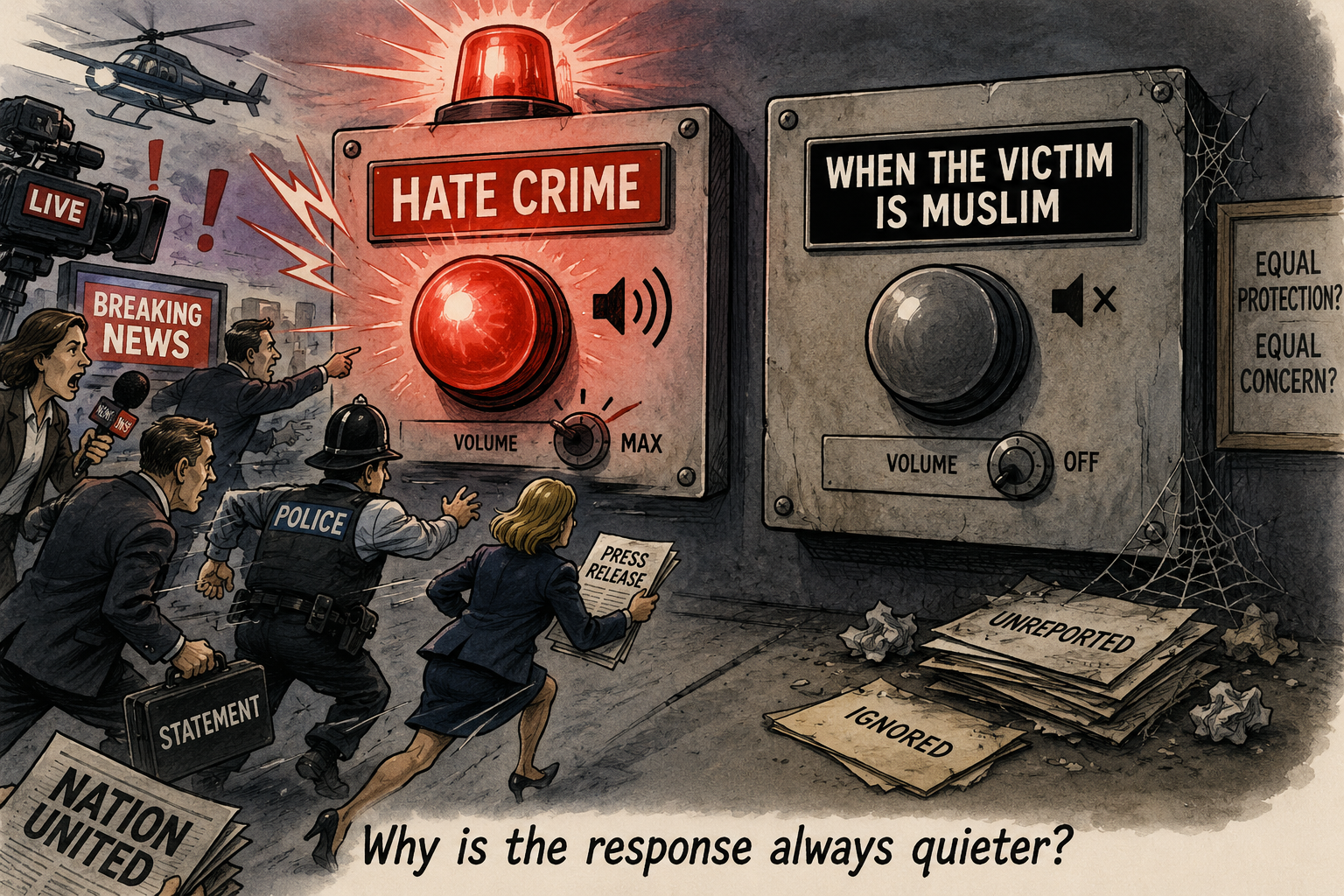
Editorial: Rising Islamophobia demands more than words