Home Affairs Correspondent
More than 5,000 religious hate crimes targeting Muslims were recorded by police in England and Wales in the year ending March 2026, a 15 per cent increase on the previous year, according to Home Office figures published on October 8.
The 5,132 offences made Muslims the most targeted religious group by the number of recorded offences. Jewish-targeted religious hate crimes rose by 10 per cent to 3,162, while religious hate crime overall increased by 13 per cent to 11,419.
Of the 11,142 religious hate crimes for which information on the targeted religion was provided, Muslims accounted for 5,132 offences, or 46 per cent. However, the targeted religion was recorded as unknown in 1,309 cases.
“These figures confirm what British Muslims already know – and far too many experience. Anti-Muslim hatred is high and rising – up 15 per cent in the last year,” said British Muslim Trust (BMT) chief executive Akeela Ahmed.
“Our research reveals more than half of Britain’s Muslims experience some form of prejudice in the last year.
“This is an emergency, and we cannot allow these figures to be swept under the carpet. It requires urgent action; it affects us all and undermines the fabric of our whole society.
“Finding a solution must not be left to British Muslims alone – and indeed our polling shows a clear majority of the British public support government action against anti-Muslim prejudice.
“The rising tide of hatred in this country requires a whole society response. Politicians and those with the loudest voices need to take greater care in what they say, social media platforms have to do more to tackle hate, the authorities must act quickly and decisively, and the rest of us must rebuild the social norms that make clear any form of hatred and prejudice is not acceptable, and it is not British.
“The British Muslim Trust will continue to do everything we can to support victims, monitor and report on anti-Muslim hostility, and develop the solutions to help combat hatred in all its forms.”
The Muslim Council of Britain said the figures represented only part of the scale of anti-Muslim hostility, citing under-reporting and the overlap between racism and Islamophobia, which it said could mean some incidents were missed in official statistics.
In a statement the MCB said: “These figures tell only part of the story.” It also highlighted that the Home Office figures covered England and Wales, rather than the whole of the UK, and raised concerns about the exclusion of Metropolitan Police data from some longer-term comparisons.
The organisation criticised what it described as the normalisation of anti-Muslim rhetoric in mainstream political discourse. It said: “Political leaders cannot credibly condemn anti-Muslim hate crime while contributing to the climate of suspicion and hostility in which it flourishes.”
Public-order offences were the most common type of hate crime targeting both Muslims and Jewish people. Across all recorded hate crime, public-order offences accounted for 53 per cent, while violence against the person accounted for a further 40 per cent.
Monthly figures showed increases in racially or religiously aggravated offences during periods of heightened public tension. Recorded offences rose sharply between May and October 2025 and increased again in March 2026, following the start of the US-Israel attacks against Iran on February 28. The figures show the timing of these increases but do not establish what caused them.
Muslim-targeted hate crime followed a similar pattern. In a dataset covering 33 police forces, September 2025 and March 2026 recorded the second and third highest monthly totals in the latest period.
The sharpest monthly increase came in August 2024, following the July 29 murder of three girls in Southport and the disorder and protests that followed. The Home Office identified August 2024 as the largest monthly spike in Muslim-targeted religious hate crime. The precise total of 10,158 racially or religiously aggravated offences requires confirmation against the relevant monthly data table before publication.
The latest annual figures also stand out over a longer period. Excluding the Metropolitan Police Service, Muslim-targeted religious hate crime reached 3,660 offences, its highest annual level since comparable records began in the year ending March 2018. The Home Office cautions that changes in recording practices affect comparisons over time, particularly following changes to the Metropolitan Police’s crime-recording system in February 2024.
Previous increases in recorded anti-Muslim hate crime have coincided with major national and international events, including the start of the Israel-Hamas conflict in October 2023, protests and counter-protests in summer 2020, terrorist attacks in 2017 and the period around the EU referendum. The figures do not, by themselves, establish that these events caused the increases.
The pattern also extends online. An online element was identified in 1,040 religious hate crimes recorded by 35 police forces, representing 11 per cent of religious hate crimes in that dataset. Across all hate crimes in the online analysis, 8,028 offences had an online element. Stalking and harassment accounted for 43 per cent, while malicious communications accounted for 39 per cent.
The figures follow the Government’s introduction of a non-statutory definition of anti-Muslim hostility in March 2026, amid concerns about discrimination and hatred directed at Muslim communities.
The Government’s guidance cited 4,478 Muslim-targeted religious hate crimes in the year ending March 2025. The latest Home Office statistical series gives the previous-year figure as 4,479, compared with 5,132 in the year ending March 2026. The one-offence discrepancy reflects different published figures and should be distinguished when referring to the respective publications.
The British Muslim Trust, appointed by the Government in 2025 as its partner for monitoring and tackling anti-Muslim hatred, has also reported incidents beyond those captured in police statistics.
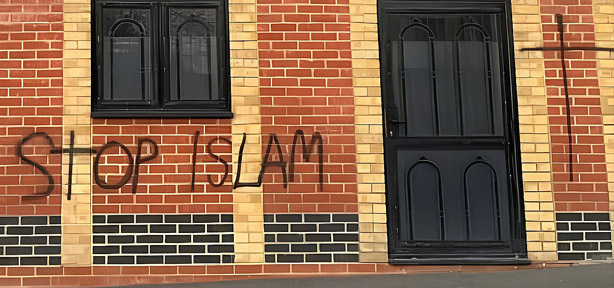
On October 8, the Trust said it had recorded 78 attacks and incidents involving mosques and buildings belonging to Muslim organisations across the UK and Channel Islands in the year to July 2026. It said this amounted to an average of one incident every five days.
The Trust said the severity of incidents had increased, including cases involving arson, weapons, threats to kill and alleged plots capable of causing mass casualties.
Separate research by British Future and the BMT, published in June 2026, found that 56 per cent of Muslims in Britain had experienced prejudice based on their religion during the previous year. The study found that 34 per cent had experienced anti-Muslim prejudice on social media, while 27 per cent had encountered prejudice in a public place, such as a street or public transport.
The Home Office’s Crime Survey for England and Wales provide a different measure of people’s experience of religious hate crime. Across the combined surveys for the years ending March 2023 to March 2025, an estimated 0.8 per cent of Muslims experienced a religious hate crime each year on average, compared with 0.4 per cent of Jewish people.
These survey estimates cannot be directly compared with police-recorded offences. The survey excludes public-order offences and measures whether people experienced at least one crime, rather than counting the total number of offences recorded by police.
The Home Office also warns that changes in reporting, recording and identification practices can affect police-recorded hate crime figures. The statistics measure offences recorded and identified by police, rather than the full extent of hostility experienced by communities.
Separately, Home Office Data Hub analysis covering 38 police forces, representing 85 per cent of all police-recorded hate crime, found that 10 per cent of hate-crime-flagged offences resulted in a charge or summons. The figure covers hate crime overall, not specifically offences targeting Muslims.
Editorial p2