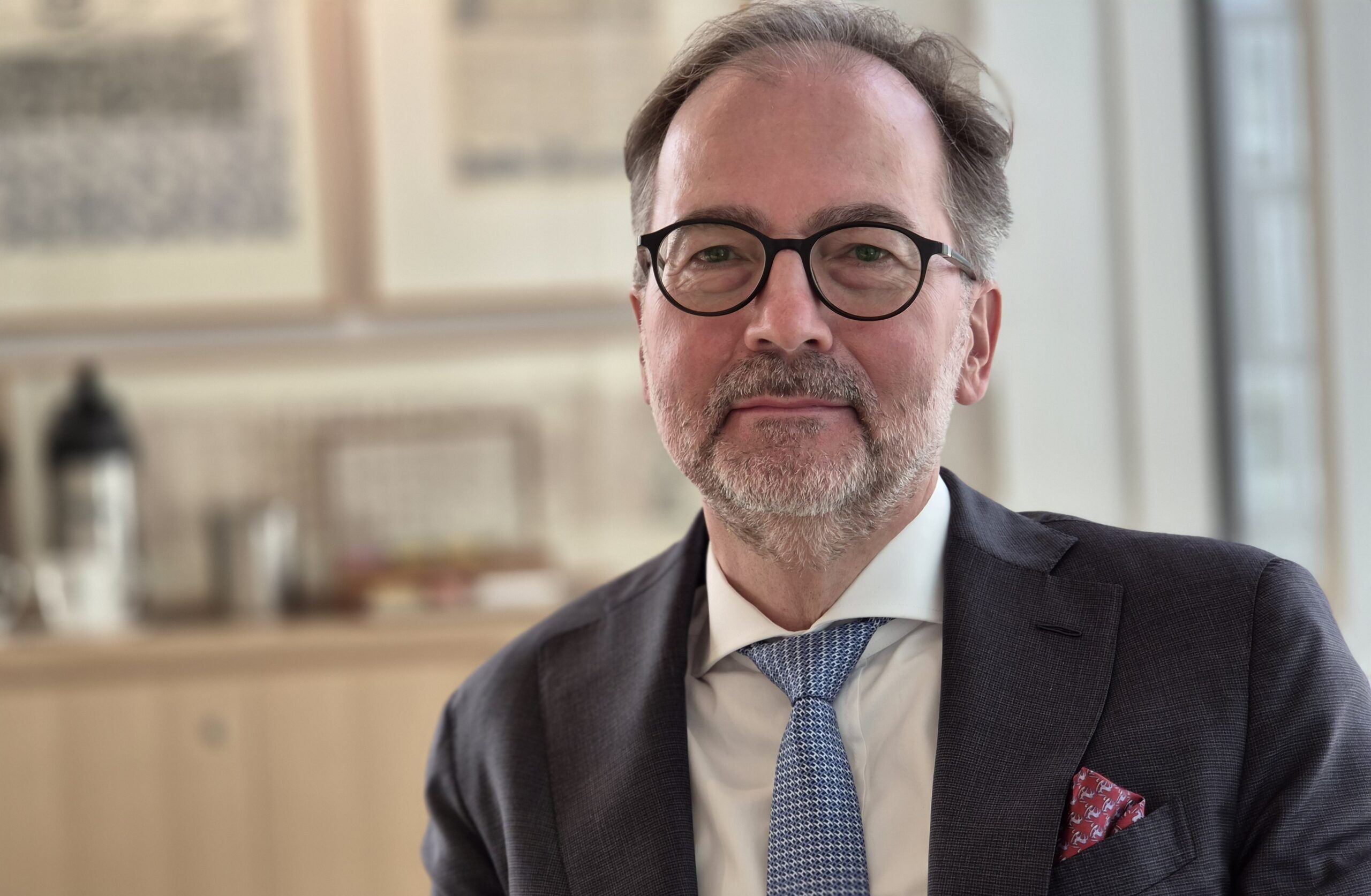
Dr Christophe Bernasconi, Secretary General of the Hague Conference on Private International Law, discusses the push for greater Muslim-majority representation, the compatibility of international conventions with different legal traditions, and the limits of international legal cooperation.
Ahmed J Versi
Families, businesses and legal disputes increasingly cross borders, raising questions domestic legal systems cannot always resolve alone: which country’s law applies, which court has jurisdiction, and whether a foreign judgment can be recognised and enforced.
The Hague Conference on Private International Law (HCCH) develops common rules to help states resolve cross-border legal disputes. Its Secretary General, Dr Christophe Bernasconi, argues that the organisation’s ability to fulfil its international role depends partly on giving countries with different legal traditions a meaningful voice in shaping its work.
The HCCH began in 1893 as a series of conferences and became a permanent intergovernmental organisation in 1955. Bernasconi described it as “the oldest of all the many legal organisations and institutions based in The Hague” and the only one there with a legislative mandate.
It does not adjudicate individual disputes. “You cannot come with a legal issue to the Hague Conference on Private International Law,” he said. Its statutory task is “the progressive unification of the rules of private international law”. The HCCH pursues this mandate mainly by developing international Conventions to which States and, where appropriate, Regional Economic Integration Organisations, may become parties.
Private international law concerns legal relationships that cross national boundaries; it does not replace countries’ domestic laws with a single international legal system.
“Our legal systems remain largely national. While these legal systems are national, our lives are not.”
The HCCH addresses these difficulties through international conventions and state cooperation, which Bernasconi described as a fourth dimension of private international law, alongside jurisdiction, applicable law, and the recognition and enforcement of decisions. “Legal friction is economic friction,” he said, explaining that the conventions aim to provide people and businesses with “legal certainty and predictability”.
The challenge, however, is not simply to establish common rules. It is also to ensure that countries with different legal traditions participate in developing them.
Speaking to The Muslim News at the Aga Khan Centre in London, where he addressed an event bringing together representatives of different communities and faiths, Bernasconi made the case for greater participation by Muslim-majority countries.
“My main message to the Muslim-majority countries is our extended hand. Both hands are extended welcoming these communities to our dialogue,” he said. “I would really like to see the HCCH become a truly global inclusive organisation, and that will not be the case for as long as we don’t have a meaningful representation of Muslim-majority states.”
For Bernasconi, the issue is not simply the number of countries belonging to the organisation. It is whether their legal expertise and concerns are adequately represented in international discussions.
“It would be a win certainly for us as an organisation to become more universally inclusive, but it would be a win also for the Muslim-majority states to have a seat at the table,” he said. Their participation would allow their concerns to be addressed and enable them to “ share their own expertise, because there is a lot of expertise in Muslim-majority states that is not heard yet at the table, and that is a gap.”
The HCCH has 95 members: 94 states and the European Union. A further 65 states are party to one or more of its conventions without being members.
Bernasconi cited Egypt, Indonesia, Jordan, Malaysia, Morocco, Qatar, Saudi Arabia, Tunisia and Türkiye among the HCCH’s Muslim-majority members, noting Qatar’s recent accession. He said he hoped Bahrain and Lebanon would also complete their membership processes.
He also referred to engagement with Algeria, Nigeria and Pakistan, contact with the Palestinian ambassador in The Hague, and ongoing cooperation with the Gulf Cooperation Council and the League of Arab States. “So we really want to increase the number of Muslim-majority states and have their voice around the table,” he said.
The appeal raises a broader question for international institutions: whether formal equality between participating states is sufficient to ensure that different legal traditions and regional perspectives meaningfully influence the rules being developed.
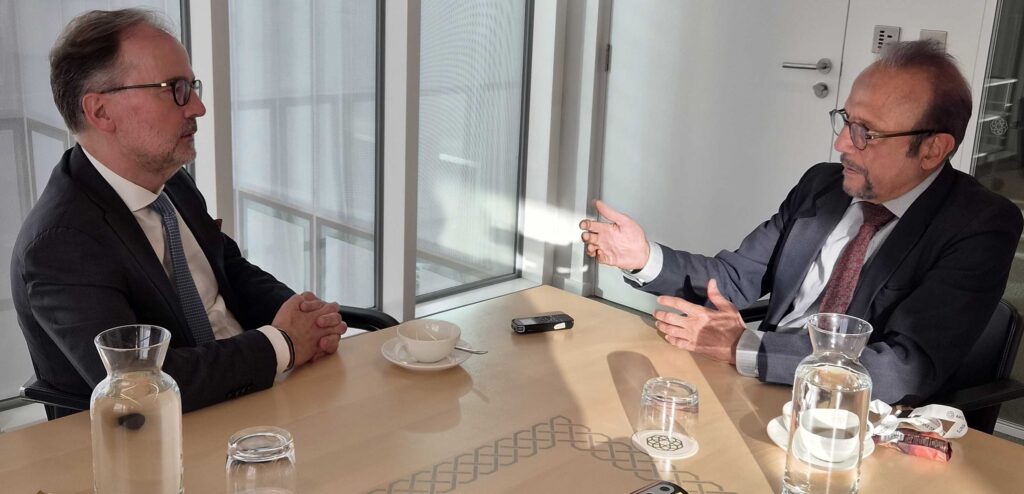
Photo: Dr Christophe Bernasconi, Secretary General of the HCCH speaks to Ahmed J Versi, Editor of The Muslim News. (Photo: Ahmed J Versi/The Muslim News)
A central part of Bernasconi’s argument is that international cooperation need not require countries to abandon their domestic legal systems, cultural traditions or religious principles.
“Think of private international law as a bridge that connects different legal systems, but the beauty of that bridge is that at both ends the substantive domestic law, the family law rules, the commercial rules, the civil rules, they remain largely unchanged,” he said. “It’s unification while respecting diversity.”
The distinction is between agreeing on rules governing cross-border legal relationships and adopting identical substantive laws. Countries can cooperate on jurisdiction, the recognition of judgments or the handling of international disputes while retaining different approaches to family law, commerce and civil matters.
Bernasconi was sceptical of the idea that international cooperation should seek to impose a single substantive law across jurisdictions.
He emphasised the importance of legal diversity: “The law is always an expression of values: social, economic, political, indeed religious values. And that diversity to me is something to respect and frankly cherish.”
This does not mean that substantive harmonisation has no place: in some areas, including commercial law, it can be useful. As a general approach, however, he prefers private international law, which enables legal systems to cooperate while respecting the diversity of values underlying their substantive rules.
Cooperation nevertheless has limits. Recognition of a foreign decision is not necessarily automatic, and legal frameworks may provide safeguards where fundamental principles are at stake. “Not everything can cross the bridge,” he said. Where a decision violates fundamental principles of justice, another state may refuse to recognise it under the applicable legal framework.
“When public policy is manifestly being violated, then you have a filter that says no.” The challenge for international legal cooperation is therefore to establish common procedures without assuming that differences between national laws can, or should, be eliminated.
The HCCH’s Child Abduction Convention provides a practical example of how states with different legal traditions might find common ground.
In cases of parental child abduction, the Convention generally seeks the prompt return of a child who has been wrongfully removed to, or retained in, another country by one parent in breach of the other parent’s rights of custody. Its underlying approach is that questions concerning the child’s welfare should ordinarily be decided by the competent authorities in the state of the child’s habitual residence, rather than being determined through the act of removing the child across borders.
Bernasconi illustrated habitual residence in everyday terms: “where the child goes to school, where they have friends, where they live, and the activities they enjoy, such as playing football”.
The Convention also provides exceptions to return. Under Article 13(1)(b), a court is not bound to order a child’s return where there is a grave risk that doing so would expose the child to physical or psychological harm, or otherwise place the child in an intolerable situation. Allegations of domestic or family violence may be relevant where the circumstances meet this threshold.
How such an approach could operate in countries influenced by Sharia law was among the questions addressed through the Malta Process, a dialogue involving experts from different legal traditions, including Sharia law expert Dr Mohamed Keshavjee.
The participants stressed, Bernasconi said, that the issue should be seen “not so much driven by the concept of an abduction or a kidnapping, but by the child’s right to have continuing access to both parents”.
On that basis, returning the child so that a judge in the home jurisdiction could decide the matter was “perfectly compatible also with Sharia law principles”.
Bernasconi said the dialogue “must continue”. He argued that more states influenced by Sharia should “not just be engaged in this dialogue but also join these conventions, because they are in the best interest of the child, which is a common principle across different legal systems”.
The example illustrates both the potential and the limits of legal harmonisation. Identifying a shared objective can help bridge differences between legal traditions, but the practical application of an international convention still depends on its provisions, the circumstances of individual cases and the decisions of competent authorities.
The question is not whether every legal system interprets family relationships identically, but whether states can agree on procedures that protect children while respecting the legal frameworks within which those procedures operate.
International conventions are negotiated and adopted by states, but the rules they establish can have direct consequences for families and communities whose legal or religious perspectives may differ from those of their governments.
I put it to Bernasconi that governments could sign up to conventions that sections of their own populations, guided, for example, by Sharia on matters such as adoption, might not accept and might not have been consulted about.
He placed responsibility on the participating states. “It is the responsibility of every participating state to make sure that its position at the negotiating table is a reflection of the reality in the state,” he said. Governments must then explain the convention and ensure that it is properly applied.
He acknowledged the difficulty of communicating international legal rules to those affected by them.
“There is a challenge of explaining the content and the mechanism and the operation of a convention to those who are the end users,” he said.
The HCCH supports this process through guides, handbooks and brochures, but “the main responsibility is with the states”.
Pressed on whether consultation takes place, he said: “The key word there is consultation, internal consultation, including all communities with a voice”.
He said consultation should begin before states enter negotiations and continue while negotiations are under way. Where possible, community representatives should also be included in national delegations.
After a convention has been adopted, governments should “continue this dialogue with all the communities inside the state. Absolutely.”
He added that “no member is forced to join any convention”.
His answer places the responsibility for domestic consultation primarily on national governments, rather than on the international organisation negotiating the rules. It also highlights the distinction between a state’s decision to participate in a convention and the process through which that decision is explained, debated and implemented at home.
For countries considering accession, the practical question is how consultation can ensure that international commitments take account of the legal and religious concerns of affected communities before those commitments become part of the state’s obligations.
The distinction between the HCCH’s international mandate and domestic political responsibilities becomes more pronounced when considering the treatment of Muslim and other minority communities in Western countries.
Asked how the organisation could help such communities in the UK, Europe and the US amid hostile political or societal attitudes, Bernasconi distinguished international legal cooperation from domestic debates about immigration, integration and minority rights.
“Our organisation is not directly involved in those types of situations. That is largely a societal political discussion as to how to welcome any foreign community coming into one’s state.”
The response establishes a clear limit to what the organisation can do. Its work concerns the development of rules of private international law, not the resolution of domestic political disputes over migration, integration or discrimination.
Asked how the HCCH could win over a Global South that has lost trust in the West, he pointed to the principle of sovereign equality. States join, he said, “on an equal footing with equal sovereignty”.
He described inclusion as “a joint responsibility”: the HCCH must welcome countries, “but it’s also for them to seize the opportunity and to come to the table”.
He said the organisation’s work was “first and foremost technical. We try to keep politics out of the door as much as possible.”
Bernasconi also cited efforts to raise the HCCH’s profile and engage with ambassadors, alongside its regional offices in Buenos Aires, Hong Kong and Rabat. Further regional offices “could and most likely should be opened”. Decisions on establishing additional offices, however, rest with the HCCH’s Members. Wider participation, however, would give more countries an opportunity to contribute to decisions about the organisation’s future geographical reach and priorities.
The emphasis on technical cooperation reflects the HCCH’s particular role. Unlike political bodies concerned with questions of international security or relations between governments, it develops legal frameworks intended to address practical problems across jurisdictions.
Yet technical work does not remove questions of representation. Decisions about which problems receive attention, how conventions are framed and which countries participate in negotiations can all affect the reach and legitimacy of the resulting rules.
For the HCCH, widening participation is therefore both an institutional objective and a test of whether its work can command confidence across different regions and legal traditions.
Bernasconi described his approach as “practical, effective multilateralism that makes a difference in people’s lives”, grounded in equal sovereignty, inclusivity and “an open, respectful dialogue where we first listen to each other”. He contrasted this with decisions taken at the highest political multilateral levels that may seem abstract to people, particularly when their practical relevance to everyday life is not apparent.
With the rule of law and international institutions “under pressure”, he said, “we need at least to make sure that the technical multilateralism like the one that we develop continues to operate effectively.”
For Bernasconi, international rules must do more than establish common procedures. They must also reflect the people and legal traditions they are intended to serve.
Without inclusion, international rules risk becoming “a solution that’s imposed and that may have been developed by technicians, but with no respect for humanity”. They would not make a difference to people’s lives, “and then it’s a waste of time and resources”.
The challenge for the HCCH is to translate its commitment to equal participation into a broader membership and sustained engagement with countries whose legal expertise and perspectives it wants to bring into its work. “The voice of Washington, Berlin, Paris and Tokyo, whatever, is not worth more than Riyadh, Jakarta, Nairobi or Pretoria.”
Feature photo: Dr Christophe Bernasconi, Secretary General of the HCCH (Photo: Ahmed J Versi/The Muslim News)