Harun Nasrullah
A UN resolution recognising the transatlantic slave trade as the “gravest crime against humanity” was adopted on March 25, marking a significant step in global efforts to address historical injustice, despite opposition from the US and unease among European nations.
The Ghana‑spearheaded resolution received 123 votes in favour, while the three votes against came from Argentina, Israel, and the US. Although not legally binding, the measure carries considerable political weight and signals growing international momentum behind calls for reparatory justice.
Ghana argued the resolution was necessary because the legacy of slavery, which saw at least 12.5 million Africans forcibly taken between the 15th and 19th centuries, continues to shape modern racial inequalities.
Ghana’s Foreign Minister, Samuel Okudzeto Ablakwa, said the resolution was ultimately about accountability, adding, “History does not disappear when ignored, truth does not weaken when delayed, crime does not rot… and justice does not expire with time.”
Legal scholars and advocates described the vote as a watershed moment. Justin Hansford said, “This marks the first vote on the floor of the UN,” adding, “I cannot overemphasise how large of a step that is.”
He noted that the resolution represents the furthest the UN has gone in formally recognising transatlantic slavery as a crime against humanity while explicitly raising the issue of reparations.
Addressing the General Assembly, UN Secretary-General António Guterres called for stronger global action, “Far bolder action” is required from states to confront historical injustices, he said.
The resolution urges member states to engage in dialogue on reparations, including formal apologies, the return of stolen cultural artefacts, financial compensation, and guarantees of non-repetition. It also reflects a broader push led by the African Union, which has been working to establish a unified framework for reparations among its 55 member states.
However, the vote also exposed deep divisions.
The US opposed the resolution, with its representative Dan Negrea criticising what he described as the “cynical usage of historical wrongs as a leverage point … to reallocate modern resources to people and nations who are distantly related to the historical victims.”
The EU, while acknowledging the scale of the atrocity, abstained. Its representative Gabriella Michaelidou cited “legal and factual” concerns, particularly around the retroactive application of international law and the risk of creating a hierarchy among crimes against humanity.
Historians and commentators have pushed back against such arguments. Speaking from Badagry in Nigeria, once a major hub in the slave trade, historian Babatunde Mesewaku argued that the transatlantic slave trade stands apart due to its scale and duration. Lasting more than 500 years and involving tens of millions of people, including those who perished during the Middle Passage, he said it resulted in lasting “destruction and stagnation” across Africa and beyond.
The resolution comes amid renewed global debate over reparations. While calls for justice have gained traction in recent years, particularly across Africa and the Caribbean, resistance has also intensified. Some Western leaders argue that present-day states should not be held accountable for historical crimes.
At present, the Netherlands remains the only European country to have issued a formal apology for its role in slavery.
Despite these divisions, Ghana maintains that the resolution could serve as a foundation for future action, including the possible establishment of a UN-backed reparations tribunal.
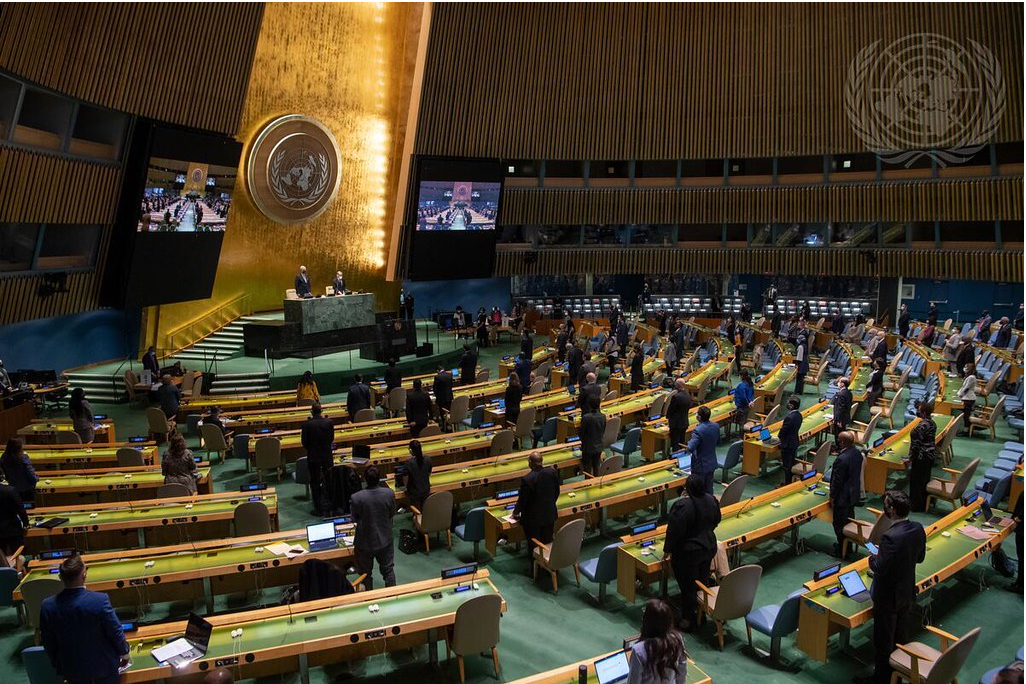
Feature photo: General Assembly holds a commemorative meeting marking the International Day of Remembrance of the Victims of Slavery and the Transatlantic Slave Trade, observed with a moment of silence in New York, USA. (Credit: Eskinder Debebe/UN)