International Relation Correspondent
Military links between Saudi Arabia, Türkiye and Pakistan and Sudan’s army have come under renewed scrutiny after the three countries took their first formal steps to implement a new defence pact.
Foreign and defence ministers and military chiefs from the three countries met in Istanbul on August 31 for the first meeting of the Strategic Political and Defence Committee established under the Makkah Joint Defence Agreement.
The three governments agreed to establish a permanent secretariat in Saudi Arabia, initially headed by a Pakistani secretary-general for a three-year term.
They also agreed to strengthen defence cooperation through joint activities, defence-industry cooperation and the development and production of military technologies.
The meeting came days after Le Monde reported that Saudi Arabia was financing Sudanese military purchases from Türkiye and Pakistan as the Sudanese Armed Forces (SAF) continue their war against the paramilitary Rapid Support Forces (RSF).
The French newspaper reported on August 26 that Riyadh was financing the purchase of Turkish drones and Pakistani military equipment for the SAF. It also reported that a Pakistani contract worth about $1.5 billion involved fighter aircraft, armoured vehicles and drones.
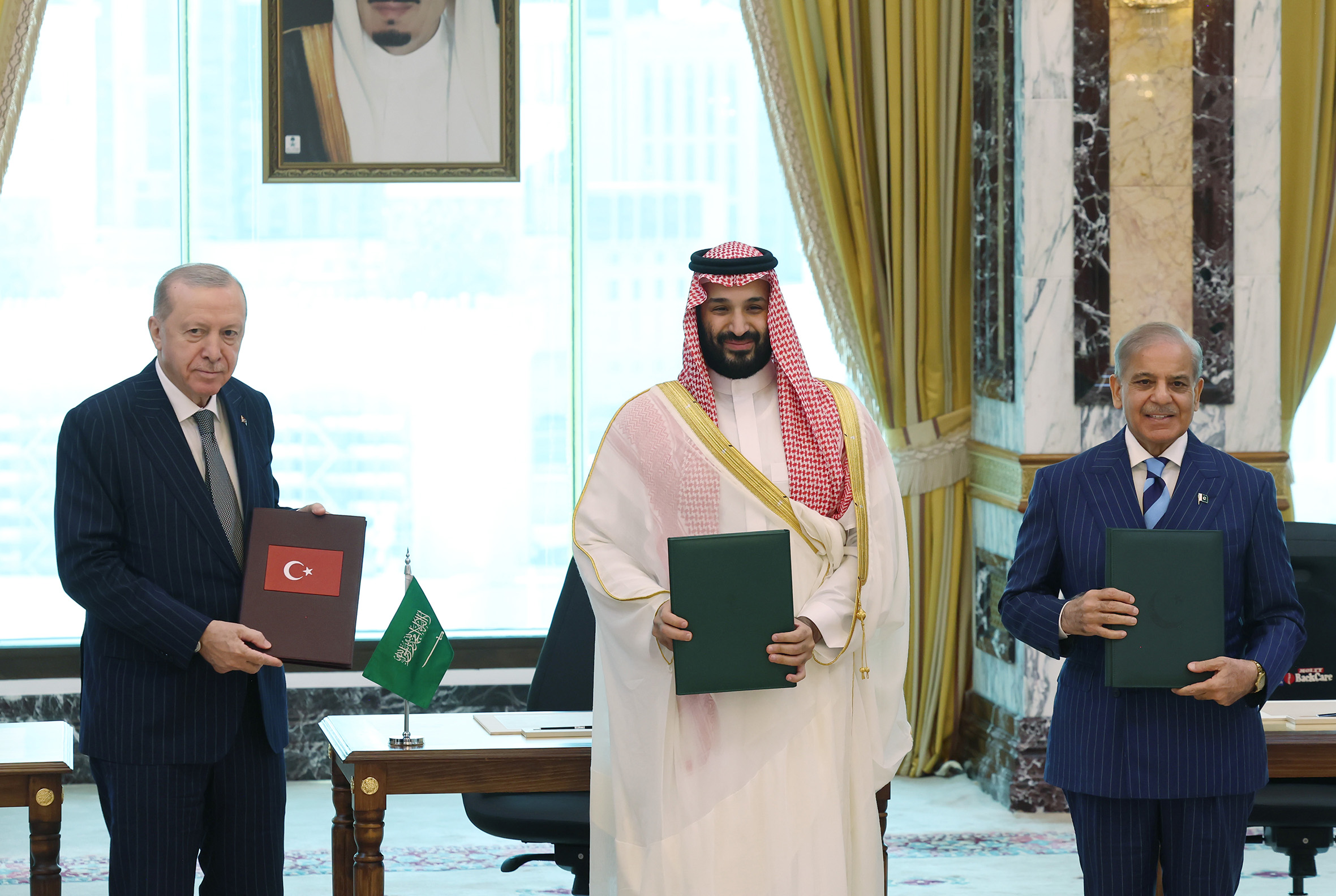
The reported military links between the three countries and the SAF predate the Makkah agreement, which was signed in Makkah on August 7 by Saudi Crown Prince Mohammed bin Salman, Turkish President Recep Tayyip Erdoğan and Pakistani Prime Minister Shehbaz Sharif.
The agreement states that an armed attack against any one of the three countries will be regarded as an attack against all three.
The three governments have described the pact as defensive and have not said that it is directed against a particular country. Pakistan’s Foreign Minister Ishaq Dar said the agreement was “purely defensive in nature”, while Turkish Foreign Minister Hakan Fidan said it was not aimed at Iran or any other country.
The agreement has nevertheless been closely watched because it brings together Saudi Arabia’s financial resources, Türkiye’s expanding defence industry and Pakistan’s large military and defence-production capacity.
In Sudan, those capabilities have already been linked to the SAF through separate agreements and military relationships.
Reuters reported in January that Pakistan was nearing a $1.5 billion agreement to supply weapons and aircraft to Sudan. Sources said the deal included attack aircraft and drones.
The Washington Post reported in March 2025 that Turkish defence company Baykar had supplied at least $120 million worth of drones and missiles to the Sudanese army.
Its investigation, based on contracts, flight records, messages and other documents, reported that the equipment included Bayraktar TB2 drones and that Turkish personnel had provided technical support.
Le Monde subsequently reported that Saudi Arabia was helping finance the procurement of Turkish and Pakistani equipment for the SAF.
The newspaper described Türkiye as the Sudanese army’s most important military partner since the war began and reported that Turkish-made Bayraktar TB2 and Akıncı drones had been supplied to the SAF.
The reports have emerged as drone warfare has become increasingly important in Sudan’s conflict, with both the SAF and RSF using unmanned aircraft.
The war has also raised concerns about the conflict spreading beyond Sudan’s borders.
Chadian authorities accused Sudanese military aircraft and drones of striking targets inside Chad in August. One reported incident involved a convoy in eastern Chad that Sudan said was carrying RSF reinforcements.
The US condemned the reported SAF strikes.
“The United States condemns the SAF’s recent air strikes inside Chad,” US Senior Adviser for Arab and African Affairs Massad Boulos said. “The violence must stop in Sudan and beyond. There is no military solution to this conflict and absolutely no justification for expanding the violence beyond Sudan’s borders.”
Washington has also called for the United Nations arms embargo currently covering Darfur to be expanded across Sudan.
Addressing the UN Security Council on August 24, Boulos said continued external financial, military and political support was helping to drive the conflict.
He said the US was proposing a resolution that would extend the arms embargo across Sudan and explicitly cover drones and related technologies.
The issue has added international scrutiny to the flow of weapons into Sudan, where the army and RSF have continued to receive military support from outside the country.
The Makkah agreement itself does not establish a joint military operation in Sudan, and there is no indication that its collective-defence clause has been invoked in relation to the conflict.
Instead, the military links involving Saudi Arabia, Türkiye and Pakistan were established separately and, in the case of the reported Pakistani and Turkish deals, before the August 7 agreement.
The Istanbul meeting on August 31 was the first formal institutional step since the pact was signed. The three countries said they would continue working to strengthen their collective defence capabilities and defence industries while supporting “lasting peace and stability” in the region.