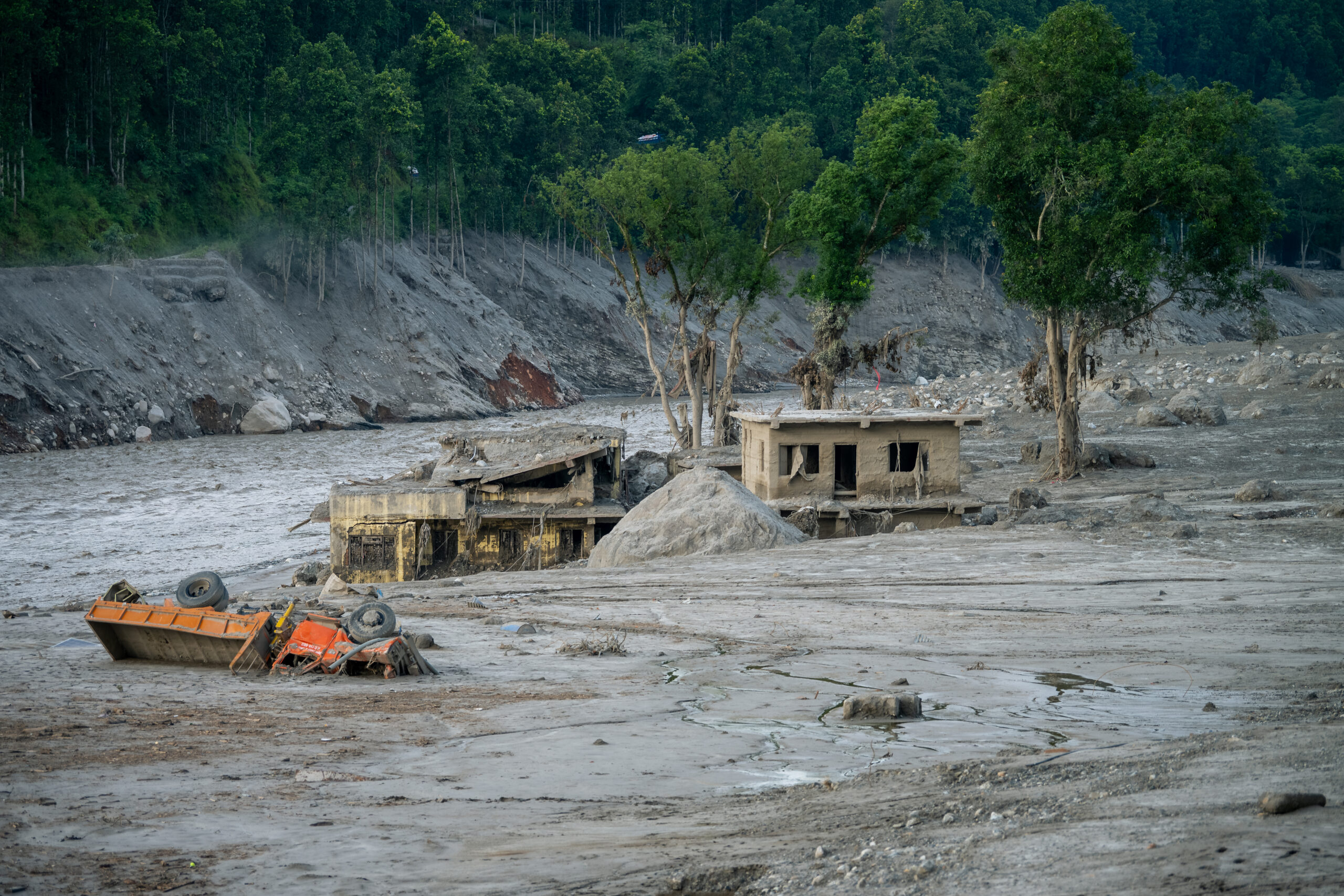
On the morning of August 26, extreme flooding caused by a glacial avalanche decimated the Nepali town of Betrawati and continued for over 100 kilometres.
The disaster, which was initiated near the border of Tibet and Nepal, happened so quickly that there was no time for early warning systems to alert residents to the danger. As of this writing, close to 1,400 people have been confirmed dead and over 5,000 remain missing.
Initial reports of the incident cited an earthquake, which spurred an avalanche because its magnitude registered on seismometers.
Others assumed a glacial lake outburst flood, or GLOF, in which a lake that has formed beneath a slowly melting glacier bursts through its temporary frozen dam and rapidly floods downstream areas.
However, satellite imagery found that this ice avalanche was caused by a huge portion of glacier, over 600 metres wide, that snapped off a mountain, fell more than a kilometre and crashed down. The pulverised ice picked up speed along the steep Himalayan terrain, gathering debris and decimating everything along the Bhotekoshi/Upper Trishuli River corridor. Experts state that by the time the flood hit the nearest town, it was the consistency of wet concrete.
The UN’s Food and Agriculture Organization’s (FAO) preliminary assessment estimates that around 1,800 hectares of crops have been damaged, thousands of livestock lost and fishponds swept away.
The remoteness and difficult terrain in the area make navigating humanitarian aid a struggle. Rescue workers continue to search for survivors, but the threat of another disaster makes search and rescue operations even more dangerous.
Matt Bevan of Australia ABC’s “If You’re Listening” radio show questions whether the weeks following this type of disaster can be called an “aftermath”, because that term refers to a period when the initial threat is gone. However, “when a glacier collapse happens, the initial disastrous flood can create the conditions for floods to happen again and again”.
The nature of the disaster—the fact that glaciers continue to melt, the already-sloping landscape, and the loss of protective infrastructure that could hold back such forces—means that rebuilding in some areas may not be an option. Many survivors’ livelihoods are gone; houses along hillsides were swept away, along with crops and marketplaces. Infrastructure that had been decimated by a GLOF incident in the previous year had only just been rebuilt, and other upstream glacial lakes have residents worried that another disaster may be imminent.
Now, Nepali officials are calling on the global community to contribute loss and damage funds to the recovery effort, as these incidents are almost certainly increasing because of climate change. Despite Nepal contributing only 0.1% of global emissions, the small Asian nation is disproportionately suffering the damage that climate change is inflicting. The Nepali government, which caused the prime minister to resign amid violent student uprisings last year, is asking for $20 million, despite the cost to rebuild likely reaching into the billions of dollars.
Nepal already has World Bank and IMF loans, which often come with extensive requirements that the government must meet to secure funds. Given how many international travellers visit the country, which boasts eight of the world’s 14 tallest mountains, Nepal’s funding plea may garner more traction from wealthier nations whose ecological footprint is much higher and who have already committed to contributing to loss and damage funds at global climate conferences.
COP31 will take place in Türkiye this November, and Nepal intends to have its delegation fight for access to loss and damage funds to help people rebuild their lives and vital community infrastructure.
Nearby regions are bracing for an increase in similar disasters. India’s north-eastern region includes part of the Himalayas, and Pradeep Singh of the Geological Survey of India called for integrating monitoring data and increasing vigilance. He stated: “A single instability at high elevation can initiate a sequence involving an avalanche, landslide or glacier failure, river blockage, dam-break type release, debris flow and downstream flooding. Such processes can interact and amplify one another.”
As permafrost at high elevations begins to melt, rainfall intensifies and glacial conditions continue changing, there is an increased likelihood of similar landslide disasters in mountainous regions. Some governments have prioritised investment in projects that would better protect populated areas from such disasters, and despite their initial cost and the difficulty of accessing some of the terrain, investing in early mitigation efforts will likely cost far less than rebuilding in the aftermath of a catastrophe.