Britain says Israeli settlements are illegal. It says their expansion is destroying the possibility of a Palestinian state. It has sanctioned settlers, companies and organisations involved in the settlement enterprise. Now it intends to restrict trade in goods produced in those settlements.
All of this is welcome. But there is an awkward question at the heart of it. If the settlement enterprise is illegal, why is Britain sanctioning some of the people and businesses involved in it while continuing much of its economic, technological and military relationship with the state that finances, administers and builds the infrastructure on which the settlements depend?
This is not a theoretical question.
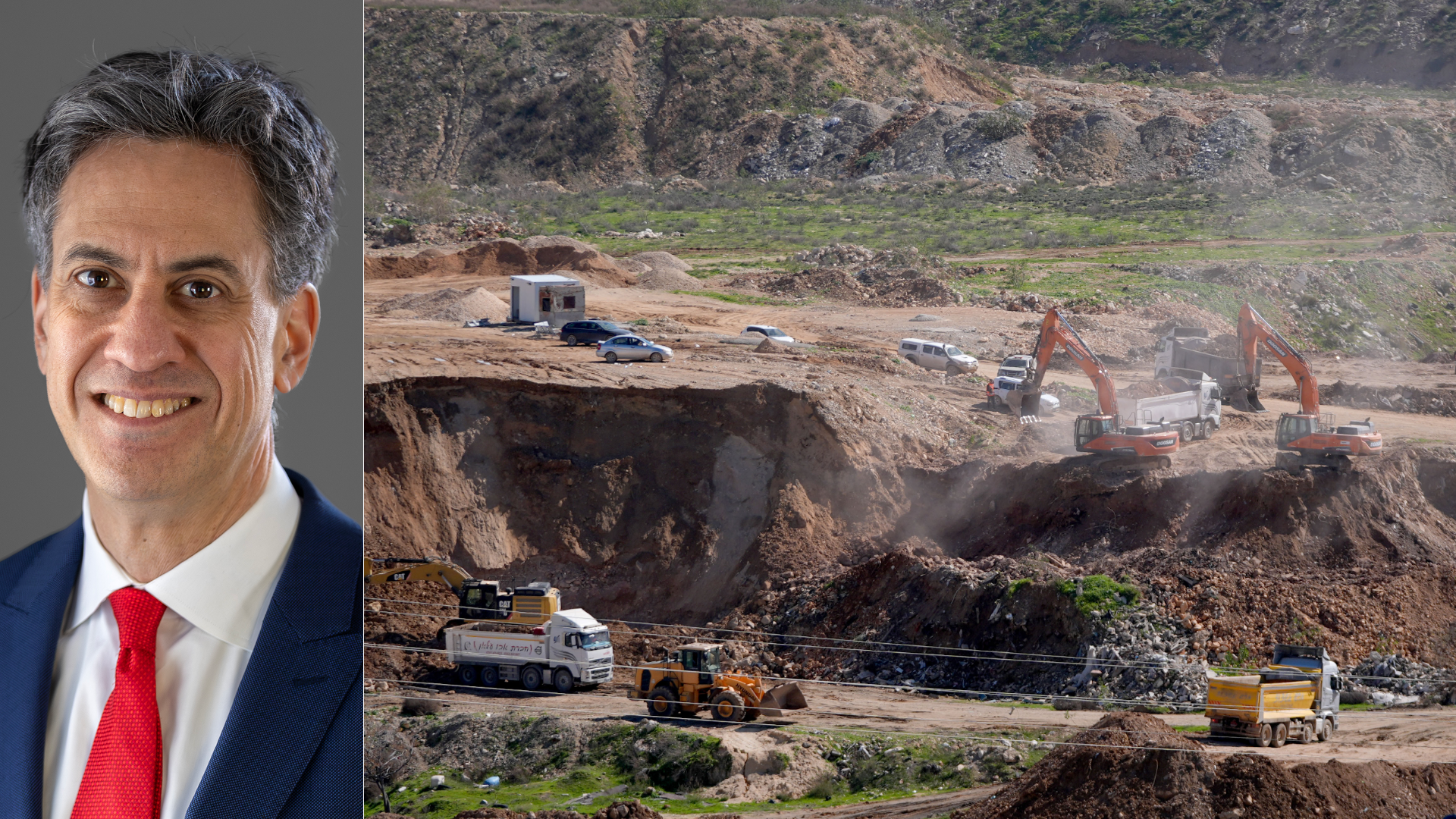
On September 8, Foreign Secretary Ed Miliband and the foreign ministers of 11 other countries said Israel’s actions in the occupied West Bank were “undermining the possibility of a two-State solution”, pointing to unprecedented settler violence and settlement expansion. The ministers announced plans for restrictions on trade in settlement goods, while Britain also moved to sanction individuals and companies supporting or profiting from settlement activity.
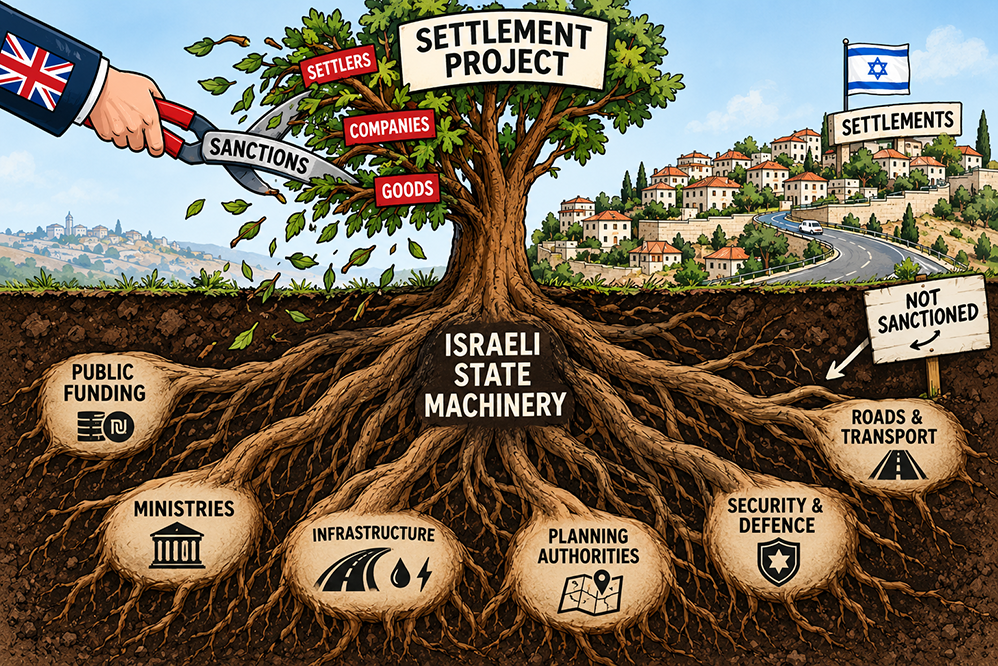
But look more closely at what a settlement is. It is not a red-roofed house on a hill, occupied by a private Israeli family. It is not merely a settler with a bank account, a farm or a construction company. Behind the house there are roads, water systems, electricity, security arrangements, planning authorities, government departments and public money. And, crucially, there is the Israeli state.
The international legal position is hardly obscure. UN Security Council Resolution 2334 declared that Israeli settlements in territory occupied since 1967, including East Jerusalem, have “no legal validity” and constitute a “flagrant violation under international law”.
Then came the International Court of Justice.
In its July 2024 advisory opinion, the Court concluded that Israel’s continued presence in the Occupied Palestinian Territory is unlawful and said Israel must “immediately cease all new settlement activity”.
But the Court did not stop there. It placed obligations on other states, too. States, it said, must not recognise as lawful the situation created by Israel’s unlawful presence. They must distinguish, in their dealings with Israel, between Israel itself and the Palestinian territory occupied since 1967. And they must not render aid or assistance in maintaining the situation created by Israel’s unlawful presence.
There, then, is the uncomfortable question for Britain: where exactly does the settlement enterprise end and the Israeli state begin?
For years, British governments have condemned settlement expansion, calling it illegal or contrary to international law and warning that it threatens the two-state solution. Yet the settlements have continued to grow, while condemnation has continued too. The difference is that condemnation costs very little. The settlement project does.
Amnesty International reported in June 2026 that substantial Israeli government resources had been channelled into the settlement enterprise and major infrastructure projects. Among the ministries involved were Settlement and National Missions, Defence, Transport and Agriculture.
The figures are not small. In 2023, the Israeli Government allocated NIS 3.5 billion to the Transport Ministry for a five-year programme to upgrade and develop roads for settler use in the West Bank. In December 2025, another NIS 2.75 billion was allocated for a five-year programme to strengthen and develop settlements and related infrastructure. Amnesty also reported that the annual budget of the Ministry of Settlement and National Missions grew by 122 per cent during the first three years of the current government, reaching NIS 764 million in 2026.
So the picture is rather different from that of a few rogue settlers building illegal homes while an otherwise uninvolved government looks on. The Israeli state is not standing at the edge of the settlement project. It is inside it. Its ministries allocate money. Its institutions facilitate expansion. Public funds pay for infrastructure. Government agencies build and maintain the roads on which the settlement enterprise depends.
And this is where Britain’s sanctions begin to look rather curious.
Britain can sanction the settler. It can sanction the company. It can restrict the goods. But what happens when the money comes from a government ministry? What happens when the road is a government road? What happens when the infrastructure is financed from the public budget of the state whose settlement policy Britain says is illegal?
Sanction the branches of the tree, in other words, while continuing to deal with the trunk.
That does not mean sanctions on individuals, companies and settlement products are meaningless. They can impose costs. They can send a political signal. They can make clear that settlement activity is not regarded as ordinary commercial activity. But they are not the same thing as confronting the state machinery that makes the enterprise possible.
And that distinction matters because Britain is not merely trading with an assortment of private Israeli businesses. It maintains diplomatic, economic, technological and military relations with Israel itself.
Consider the arms trade. In September 2024, Britain suspended 29 licences after concluding that there was a clear risk that the equipment could be used to commit or facilitate serious breaches of international humanitarian law in Gaza. Six further licences were subsequently suspended or amended.
But this was not an arms embargo. As of February 28, 2026, the Government reported 203 non-suspended military licences involving Israel, as well as 192 non-military licences. The military licences included equipment for training, submarines and the multinational F-35 programme.
The Government has its legal criteria. It says licences are not issued where equipment is assessed as potentially being used in military operations in Gaza, subject to the arrangements governing the F-35 programme. Those distinctions are important. But they leave another question hanging: if Britain considers Israeli settlement activity sufficiently serious to justify sanctions, what standard does it apply to the rest of its relationship with Israel?
And if the ICJ says states must not assist in maintaining an unlawful situation, what does that mean in practice when the state involved is itself financing the infrastructure of that situation?
Britain has confronted a related question before. After Israel invaded Lebanon in 1982, Margaret Thatcher’s government withheld approval for licences for British military equipment to Israel “until further notice”. The restrictions were later eased, with certain non-lethal components permitted, and the embargo was finally lifted in 1994, after which applications were considered case by case.
History does not dictate present policy. But it does dispose of one argument: that broader restrictions on military exports to Israel are somehow unimaginable or unprecedented in British foreign policy. They have happened before.
The present Government has chosen a narrower path. It can argue that its arms regime distinguishes between equipment that could contribute to unlawful conduct and equipment that cannot. It can argue that trade with Israel as a whole is not the same thing as supporting settlements. Those are distinctions Britain is entitled to make.
But they do not answer the central problem.
The settlement project is not a foreign body growing independently of the Israeli state. The state finances it. The state builds the roads. The state provides the ministries. The state provides the public money.
So when Britain sanctions a settlement-linked company while continuing extensive relations with the government institutions that finance settlement infrastructure, the question is not whether Britain has done something. It is whether its measures address the state structures that make the settlement enterprise possible.
The ICJ has already supplied the vocabulary. Distinguish between Israel and the territory it occupies. Do not recognise as lawful the situation created by the unlawful presence. Do not render aid or assistance in maintaining it.
Britain should therefore explain what those words mean beyond the customs declaration, the sanctions list and the prohibition on a particular product. Does the obligation stop at a settlement vineyard? At a construction company? At an individual settler? Or does it reach the government ministry that pays for the road leading to the settlement?
And if settlement expansion continues, what happens then? Will Britain impose further economic restrictions? Will it examine investment, procurement, financial services, technology, infrastructure or military cooperation? Or will each new measure continue to be carefully confined to the edges of the settlement project, leaving the state behind it largely untouched?
There is a danger here of confusing activity with leverage. A government can announce sanctions. It can publish names. It can prohibit selected goods. But sanctions have leverage only when the target has something to lose that the sanctioning state is prepared to withhold.
If the settlement enterprise continues to receive billions of shekels in government funding while Britain restricts selected commercial activity around its edges, then Britain may impose costs without substantially altering the machinery that sustains the enterprise. That is the uncomfortable arithmetic of sanctions.
The settlement business may be sanctioned while the government that finances the settlement infrastructure remains a partner. The settler may be sanctioned while the ministry paying for the road remains untouched. The product may be restricted while the system producing it remains in place.
This is why Britain’s latest measures should be welcomed — but not mistaken for the end of the argument.
If Britain believes settlements are illegal, it must eventually confront the more difficult question of how a settlement project so closely intertwined with the Israeli state can be isolated from the state itself. And if Britain accepts the ICJ’s finding that states must not assist in maintaining the unlawful situation created by Israel’s presence in the occupied territory, it should explain precisely how its wider economic, financial, technological and military relationships comply with that principle.
The Government deserves credit for moving beyond another expression of concern and imposing concrete restrictions on settlement activity. But international law is not strengthened simply because governments quote it. It is tested when obeying it becomes inconvenient — when it costs money, when it complicates an alliance, and when it requires a government to examine not only the people at the end of the chain but the institutions at the beginning of it.
Britain has taken a step against the settlement enterprise. The question is whether it is prepared to follow that step to its logical destination.
Because if the settlement project is being built with state money, state ministries and state infrastructure, sanctioning the settlement while leaving the state behind it largely untouched risks becoming something rather less than a challenge to the system.
It risks becoming a sanction against the symptoms — while the machinery keeps running.
UK approved £5.3m in military export licences to Israel in first three months of 2026