Nadine Osman
The Government’s plans for new vocational GCSEs and 200,000 additional work-experience placements have prompted warnings that schools need more resources and pupils without family or professional networks could miss out.
The reforms have implications for Muslim communities. Social Mobility Commission research has identified limited careers guidance and professional networks as barriers for young Muslims entering employment. The new qualifications will apply across England and are not specifically aimed at Muslim pupils.
The Department for Education announced the reforms on September 23 as part of a wider overhaul of technical education. The changes will give 14–16-year-olds more choice between academic and vocational subjects, with clearer routes into further study, apprenticeships and employment.
Prime Minister Andy Burnham said the reforms would end a “one-size-fits-all” education system.
Reflecting on his own experience, he said, “school wasn’t really for me”. He said young people should be able to choose academic or technical routes without their prospects depending on whether they attend university.
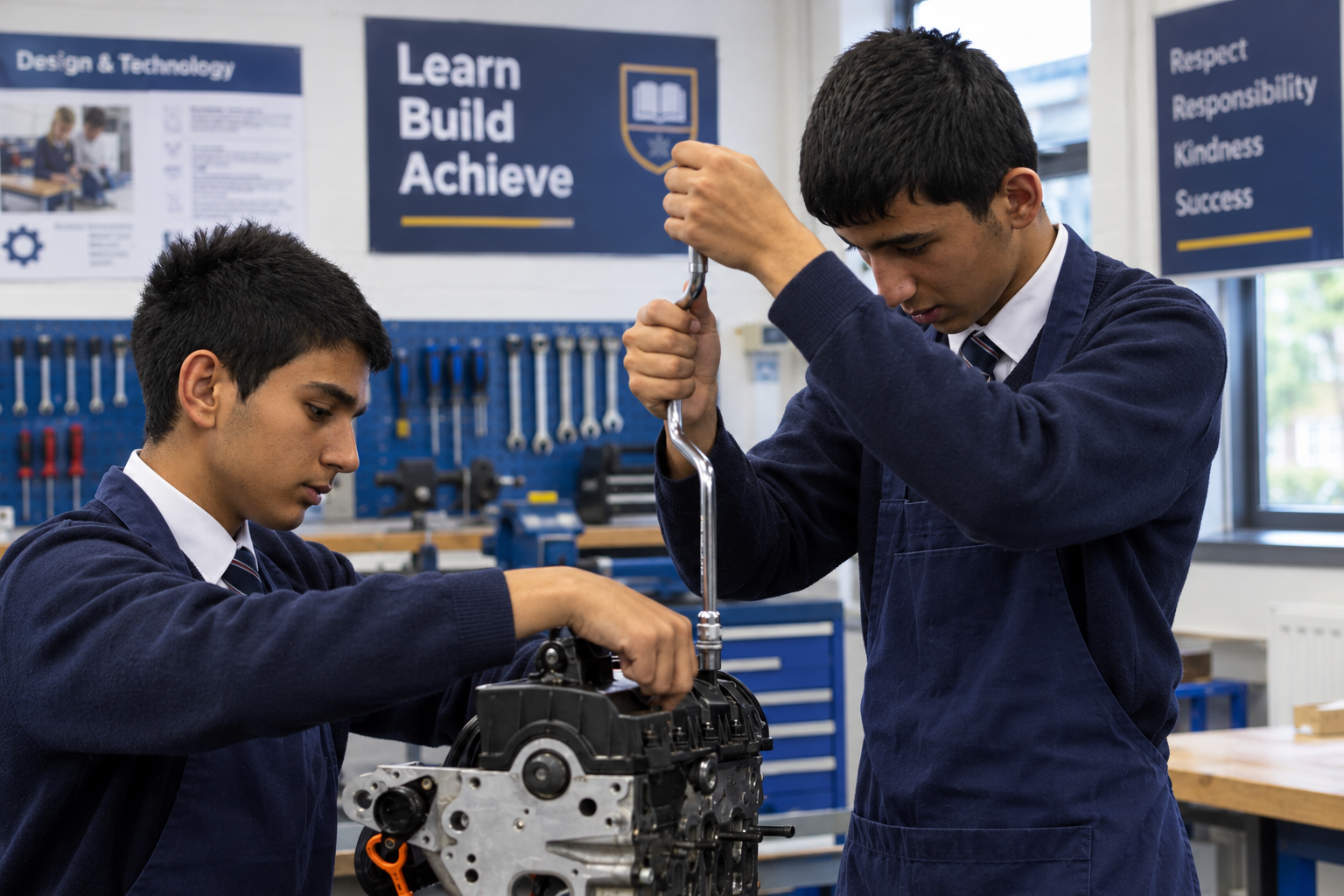
Unlike traditional GCSEs, which generally focus on academic subjects, the new vocational GCSEs will cover specific occupations and industries.
Proposed subjects include Business Management and Finance, Creative Media Production, Digital Technology, Child Development, and Building and Construction.
The qualifications will be equivalent in size to traditional GCSEs. Their content will be set nationally, while Ofqual will regulate assessment and grading.
The new qualifications will replace existing Technical Awards, not traditional GCSEs. The Government says current awards vary between providers and lack consistent routes into further study.
Vocational GCSEs will sit alongside traditional GCSEs. English, maths and science will remain a common entitlement, while pupils will be able to combine vocational and academic subjects.
Education Secretary Lucy Powell said the reforms would better connect education with industry and employment while maintaining a “rich, ambitious education”.
The qualifications are intended to provide progression into A Levels, T Levels and new V Levels, as well as apprenticeships, employment and university.
The Government says the reforms will help reduce the number of young people leaving education without employment or further training.
Alan Milburn’s interim report on young people not in education, employment or training warned of a “lost generation” of around 1 million young people. It also found that practical learning could help those at risk of becoming NEET.
The White Working Class Inquiry identified weaknesses in technical and vocational education, noting that many white working-class families valued these routes. It called for an overhaul.
However, teaching unions and school leaders have questioned whether changing qualifications will be enough to address existing inequalities.
The Association of School and College Leaders said the reforms would require adequate staffing, resources and greater public understanding of technical education.
The National Education Union said schools and teachers would need sustained investment, resources, time and capacity to deliver the changes.
NASUWT has questioned how the Government will ensure work-experience placements are safe and meaningful for all pupils, particularly those without industry contacts or needing additional support.
Former Department for Education policy adviser Sam Freedman warned that steering poorer pupils towards vocational qualifications while wealthier peers retain broader academic options could deepen inequality.
These concerns echo findings from the Social Mobility Commission, whose research into young Muslims identified inadequate careers guidance, limited professional networks and concerns about discrimination as barriers to employment.
The commission found that 46 per cent of Muslims lived in the 10 per cent most deprived local authority districts, based on data available at the time.
The research did not portray Muslim pupils as uniformly educationally disadvantaged. It highlighted rising educational attainment among young people from Pakistani and Bangladeshi backgrounds, particularly girls, but found that these gains did not always translate into equal labour-market outcomes.
More recent Department for Education research found that disadvantaged pupils can have less access to professional networks and other forms of social capital.
The research found that high-quality careers provision was associated with an approximately 8 per cent reduction in the likelihood of becoming NEET. The impact was twice as great in schools with the highest proportions of disadvantaged pupils.
Alongside the new qualifications, the Government is launching a National Mission on Work Experience to secure 200,000 additional placements for 14–16-year-olds.
Employers, mayors and local authorities will help deliver the scheme, with placements potentially available in accountancy, digital media and construction.
The Government says the placements will expose young people to workplaces, develop their skills and broaden their understanding of careers.
The first vocational GCSEs could be available in some subjects from September 2029, while broader new technical pathways are due to begin in September 2028.
The Government is introducing V Levels and Occupational and Further Study Pathways, while expanding T Levels. The first V Levels, in Education, Finance and Digital, are due in September 2027, followed by new T Levels in Sports, Fitness and Exercise Science, and Care Services, in 2028.
School performance measures will be adapted to support the new qualifications and encourage schools to offer them.
Sir Hamid Patel, Chief Executive of Star Academies, said nationally agreed content, stronger regulation and clear progression routes would help the new vocational GCSEs “command the confidence of parents, employers, colleges and universities alike”.
The Government is expected to consult later this year on the content of the new vocational GCSEs. Local leaders, employers, schools and colleges will be invited to identify subjects that reflect regional skills needs.