Nadine Osman
Saudi Arabia, Pakistan and Türkiye have signed a mutual defence pact under which an armed attack on any one of the three countries will be treated as an attack on all three.
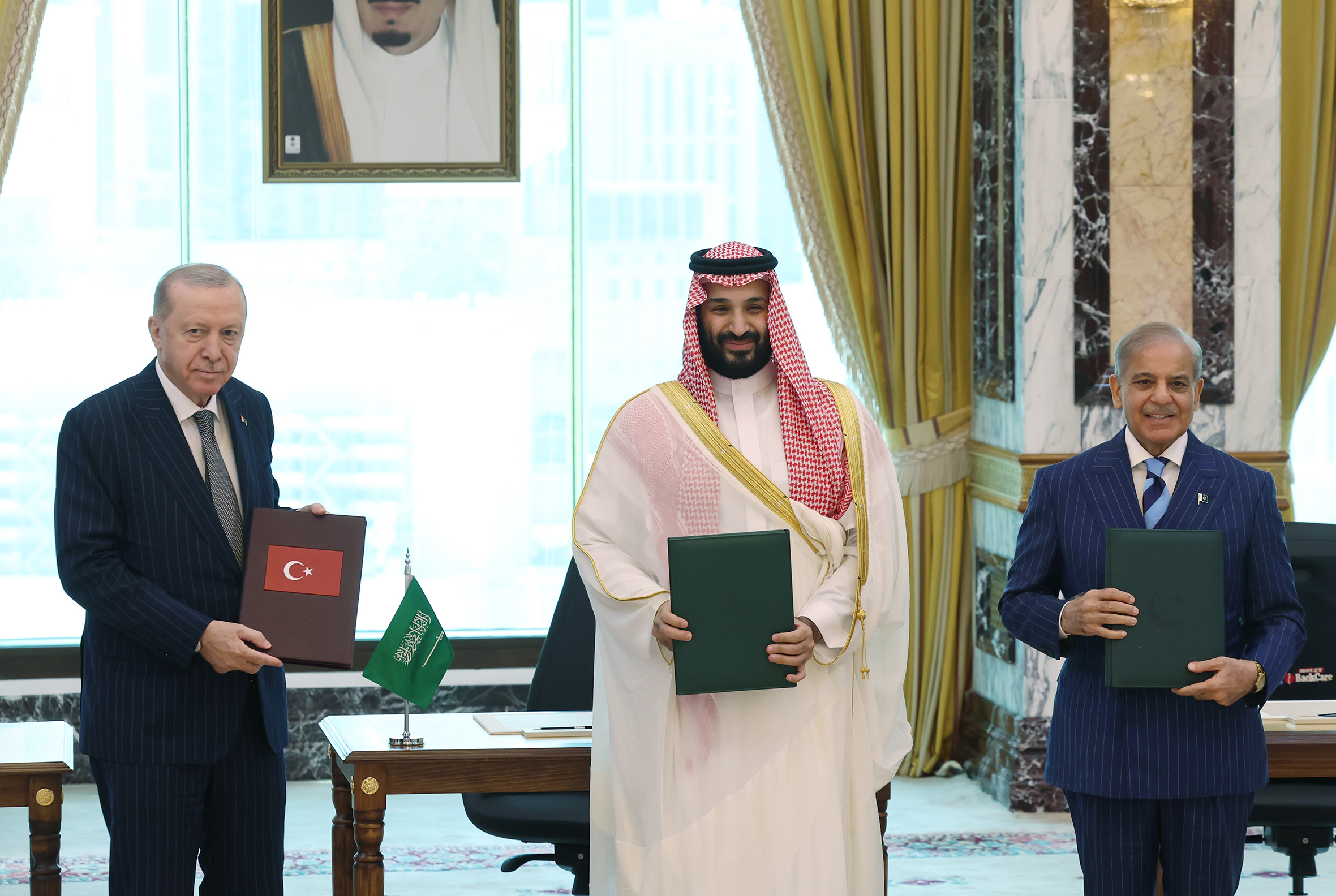
The Makkah Joint Defence Agreement was signed in Makkah on August 7 by Saudi Crown Prince and Prime Minister Mohammed bin Salman, Turkish President Recep Tayyip Erdoğan and Pakistani Prime Minister Shehbaz Sharif.
Some commentators have dubbed the pact a “Muslim NATO” because of its collective-defence provision, which has been compared with NATO’s Article 5.
The three countries said the agreement would strengthen security cooperation and provide mutual defence guarantees. It does not identify a specific adversary.
Turkish Foreign Minister Hakan Fidan said the pact was not directed against Iran or any other country. However, its timing, following the recent conflict involving Iran and the United States, has raised questions about whether regional powers are seeking greater independence from Washington’s security role.
Under the agreement, an armed attack on one signatory will be treated as an attack on all three. Turkish Defence Minister Yaşar Güler said the provision was technically comparable to NATO’s Article 5, which requires members to assist an ally under armed attack.
The pact establishes a framework for closer military and security cooperation, although details of how the mutual-defence commitment would work in practice have not been made public.
The agreement brings together three influential Muslim-majority countries with significant military capabilities. Pakistan has one of the world’s largest armed forces and possesses nuclear weapons. Türkiye is a NATO member with a growing defence industry, while Saudi Arabia is one of the Middle East’s largest military spenders and has longstanding defence ties with Washington.
The three countries have also cooperated on defence for decades through military training, exercises and defence-industry partnerships.
For Pakistan, the agreement builds on its existing strategic relationship with Saudi Arabia. The two countries signed a Strategic Mutual Defence Agreement in September 2025, under which aggression against either country would be treated as aggression against both. The new pact brings Türkiye into that framework.
The signing in Makkah also carries symbolic weight, bringing together three Muslim-majority states at one of Islam’s holiest sites.
The agreement comes as the United States’ longstanding security role in the Middle East faces renewed scrutiny. US military action against Iran has prompted questions about the reliability of American security commitments and whether regional powers should develop stronger collective defence arrangements.
Saudi Arabia remains closely linked to the US economically and strategically, but Riyadh has increasingly sought to diversify its international partnerships. Türkiye, meanwhile, remains a NATO member while pursuing a more independent foreign and security policy. Pakistan maintains close defence ties with both Saudi Arabia and Türkiye.
The pact could give the three countries a framework for coordinating their response if one comes under attack. However, its practical military obligations remain unclear, including whether the other two signatories would be required to provide military assistance.
Its significance will ultimately depend on how the collective-defence clause is interpreted and whether the three governments are prepared to act on it in the event of an attack.