Harun Nasrullah
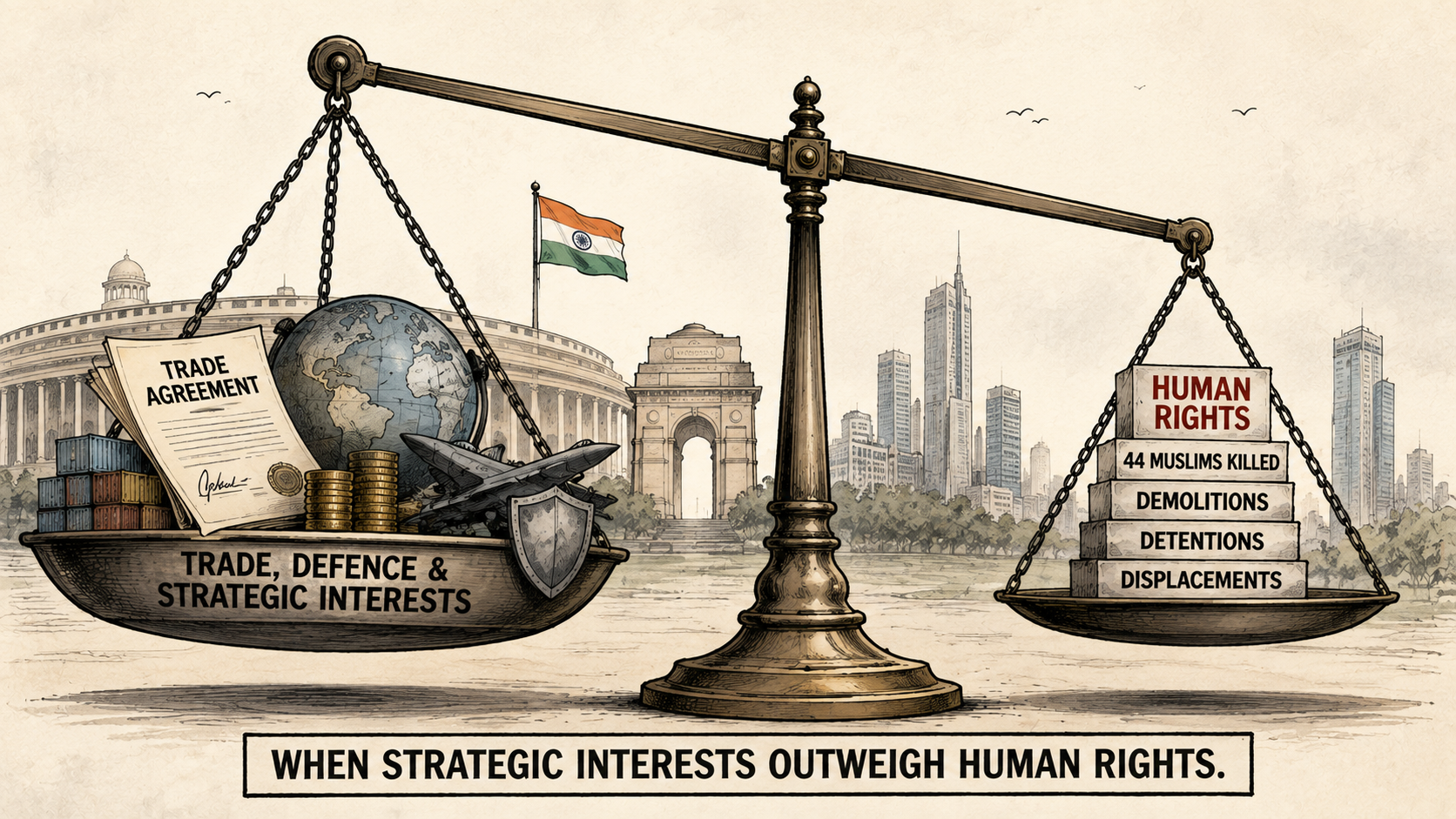
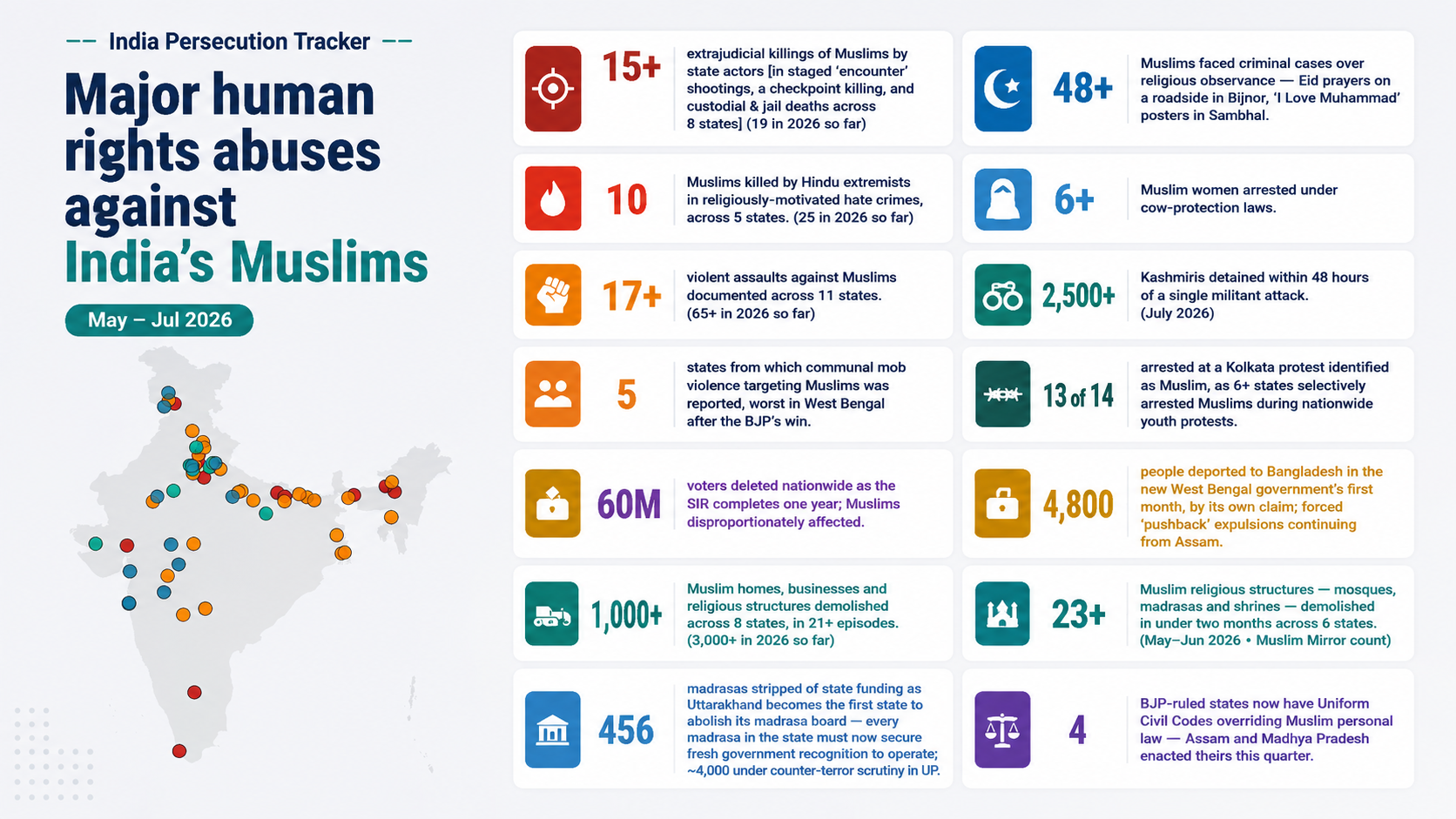
At least 44 Muslims were killed in India during the first seven months of 2026, including 19 in cases involving police, security forces or other state actors and 25 in killings attributed to Hindu extremist actors, according to the South Asia Justice Campaign’s India Persecution Tracker.
The figures combine cases documented from January to April with those recorded from May to July. The tracker says they cover only reported and verified incidents and are not exhaustive.
Between May and July, at least 15 Muslims were killed in cases involving police or security personnel, bringing the state-actor toll for 2026 to 19. The tracker also recorded 10 Muslims killed in religiously motivated hate crimes attributed to Hindu extremist actors, bringing that total to 25.
The organisation said 2026 was on course to record the highest number of Muslims killed by Hindu extremist actors since it began documenting such cases in 2022.
The tracker identified Uttar Pradesh, Assam and Kashmir as the areas where the most serious abuses involving state actors remained concentrated. It also identified West Bengal as a new area of concern following the BJP’s first victory in the state assembly election.
The documented abuses included alleged staged police encounters, custodial deaths, mass detentions, forced expulsions and the demolition of Muslim homes and places of worship. The tracker also documented arrests, detentions and restrictions on Muslim religious worship.
At least 23 Muslim religious sites were demolished between May and late June across Delhi, Gujarat, Haryana, Maharashtra, Rajasthan and Uttar Pradesh. They included mosques, madrasas, mazars, dargahs and graveyards.
Authorities generally justified the demolitions on grounds including alleged encroachment, redevelopment and infrastructure needs. The tracker, however, documented allegations from residents and Muslim organisations that some demolitions were carried out without adequate notice or due process.
In Uttar Pradesh, the tracker reported demolitions of mosques and other Muslim religious structures in Varanasi, Sambhal, Saharanpur, Deoband and Moradabad.
In Rajasthan, more than 50 mosques, madrasas and dargahs reportedly received demolition notices, while at least seven religious structures were demolished, according to a civil-society fact-finding report.
The Supreme Court subsequently stayed the Rajasthan demolitions for two weeks and directed related challenges to the Rajasthan High Court. In separate proceedings, the Supreme Court declined to hear contempt petitions alleging violations of its November 2024 safeguards on demolitions, referring the cases to the High Courts.
In Indian-administered Kashmir, security forces detained more than 2,500 people within 48 hours of a militant attack in July, according to the tracker. It also reported that security forces demolished the homes of two families using explosives.
Police in at least six states were accused of selectively arresting Muslims during nationwide student protests. In Kolkata, 13 of the 14 people arrested at one demonstration were Muslim, according to the tracker.
Those killed by Hindu extremist actors during the May–July period included an 11-year-old girl and a 16-year-old boy.
The tracker identified West Bengal as the state where communal violence targeting Muslims was most severe during the reporting period.
The violence followed the BJP’s first victory in a West Bengal assembly election. The tracker reported attacks on mosques, Muslim-owned businesses and settlements housing Muslim hawkers, leaving at least two people dead. One was killed while trying to defend a mosque.
The report also documented measures introduced by the new BJP government that it said disproportionately affected Muslims.
The government removed 77 Muslim communities from the Other Backward Classes (OBC) reservation list and cut the OBC quota from 17 per cent to 7 per cent.
It also reduced funding for the Minority Affairs and Madrasah Education Department by 62 per cent, from ₹57.14 billion (£438 million) to ₹21.75 billion (£167 million).
The budget also cut funding for minority scholarships and the school bicycle scheme.
The state government ordered a statewide survey of madrasas, followed by visits by an 18-member panel to review unrecognised Islamic schools. The tracker also reported that the government made Vande Mataram compulsory in madrasas.
The tracker said the government claimed about 4,800 “deportations” in its first month in office. It also reported that police were instructed to hand suspected “infiltrators” to border forces rather than produce them before a court.
The report linked the treatment of Bengali-speaking Muslims to the Special Intensive Revision (SIR) of electoral rolls, which has resulted in millions of voter names being removed nationwide. UN Special Rapporteurs warned that official rhetoric portraying Indian Muslims as “infiltrators” risked conflating citizens with foreign nationals and contributing to discrimination.
The tracker also reported that 14 people were arrested following protests in Kolkata over an alleged NEET examination paper leak, 13 of them Muslim. West Bengal Chief Minister Suvendu Adhikari referred to the protesters as “those Friday people”, according to the report.
In Assam, authorities continued what the tracker described as “pushbacks” of people accused of being undocumented migrants.
The state’s chief minister claimed that 1,679 people had been “sent back” over a two-year period. The tracker also cited Human Rights Watch documentation alleging that Indian forces took families, including children, through gaps in the border fence and into Bangladesh at night.
The South Asia Justice Campaign said the practice, combined with political rhetoric referring to Muslims as “infiltrators”, raised concerns that Indian Muslims were being treated as foreigners in their own country.
The report also highlighted a Madhya Pradesh High Court ruling concerning the disputed Bhojshala-Kamal Maula complex in Dhar.
The court ruled that the complex was a Hindu temple dedicated to the goddess Saraswati and ordered that only Hindu worship take place there, ending the previous arrangement under which Hindus worshipped on Tuesdays and Muslims offered Friday prayers.
The Muslim side challenged the ruling in the Supreme Court. In July, the Supreme Court declined to restore the previous arrangement but directed the state to provide an open space next to the complex for Friday prayers between 1pm and 3pm while the legal challenge remains pending.
The tracker also highlighted legislation concerning India’s national song.
On July 29, the Rajya Sabha passed the Prevention of Insults to National Honour (Amendment) Bill, 2026, giving Vande Mataram the same legal protection as the national anthem. The legislation provides for imprisonment of up to three years for intentionally insulting or obstructing the song’s rendition.
Critics have argued that the measure could infringe freedom of speech and freedom of conscience. The tracker noted that some Muslims decline to sing the song because its later stanzas personify the nation as a goddess.
The tracker highlighted several court cases involving alleged violence against Muslims.
On May 7, the Bombay High Court upheld the acquittal of all 22 accused, including 21 police officers, in the alleged staged-encounter killings of Sohrabuddin Shaikh, his wife Kauser Bi and witness Tulsiram Prajapati in 2005–06.
The Gujarat High Court also upheld the acquittal of five men accused of throwing a Muslim man, Samsuddin alias Kasamkhan, into a fire during the 2002 anti-Muslim violence in Vadodara.
The tracker said the cases highlighted continuing difficulties in securing accountability for past violence against Muslims, while noting that the acquittals followed the prosecution’s failure to establish individual responsibility. It also criticised what it described as failures to independently investigate more recent deaths in custody and police operations. The tracker said at least six Muslim men died in police or judicial custody across six states during May–July. Authorities recorded causes of death other than killings, while families alleged torture, extortion or medical neglect.
The tracker further said that public calls for the genocide of Muslims at a mass gathering near Delhi received no police action. It also said the central government blocked a legislative attempt in Karnataka to strengthen hate-speech laws.
The tracker highlighted the conviction of 14 cow vigilantes for the lynching of a Muslim man as one of the period’s significant judicial developments.
According to the tracker, the Muslim judge who sentenced the men to life imprisonment later required police protection after receiving threats from Hindu extremists.
The South Asia Justice Campaign said the case demonstrated both the possibility of judicial accountability and the risks faced by officials handling cases involving alleged Hindu extremist violence. The tracker said the wider developments had fuelled international concern over the treatment of Muslims and other minorities in India. It cited statements and communications from UN bodies and experts concerning alleged discrimination, voter-roll deletions, treatment of protesters and forced expulsions.
Editorial: India’s partners look away as Muslims face mounting persecution