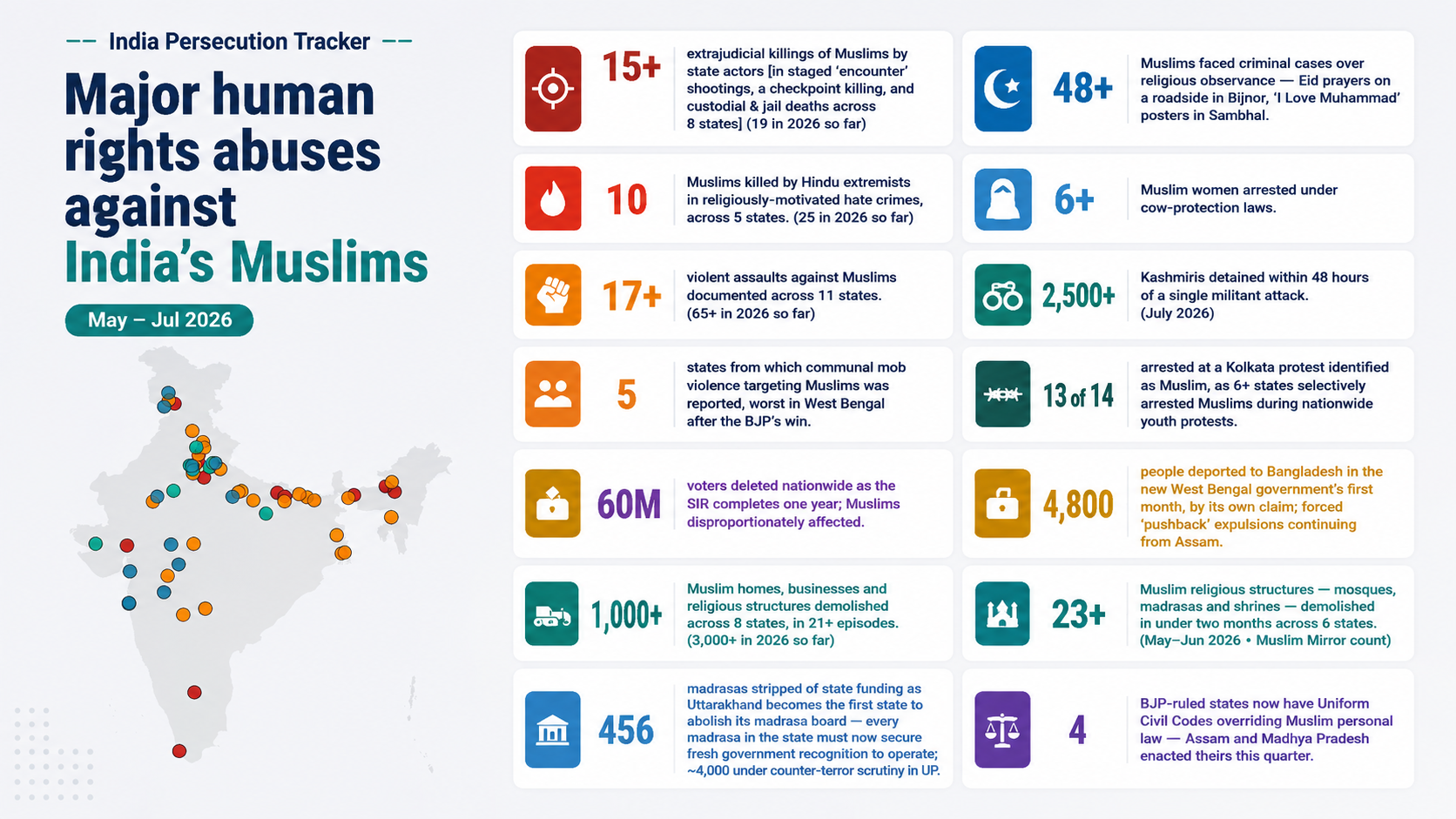
At least 44 Muslims were killed in India between January and July 2026, according to the South Asia Justice Campaign’s India Persecution Tracker. Nineteen deaths involved police, security forces or other state actors, while 25 were attributed to Hindu extremist actors.
The organisation says the figures cover only reported and verified cases and are therefore incomplete. If the assessment holds, 2026 is on course to record the highest number of Muslims killed by Hindu extremist actors since the tracker began in 2022.
But the numbers alone do not capture the wider concern. The issue is not simply how many people have died, but what these deaths reveal about the treatment of India’s largest religious minority—and whether its institutions are willing to protect Muslims when political, security or majoritarian pressures arise.
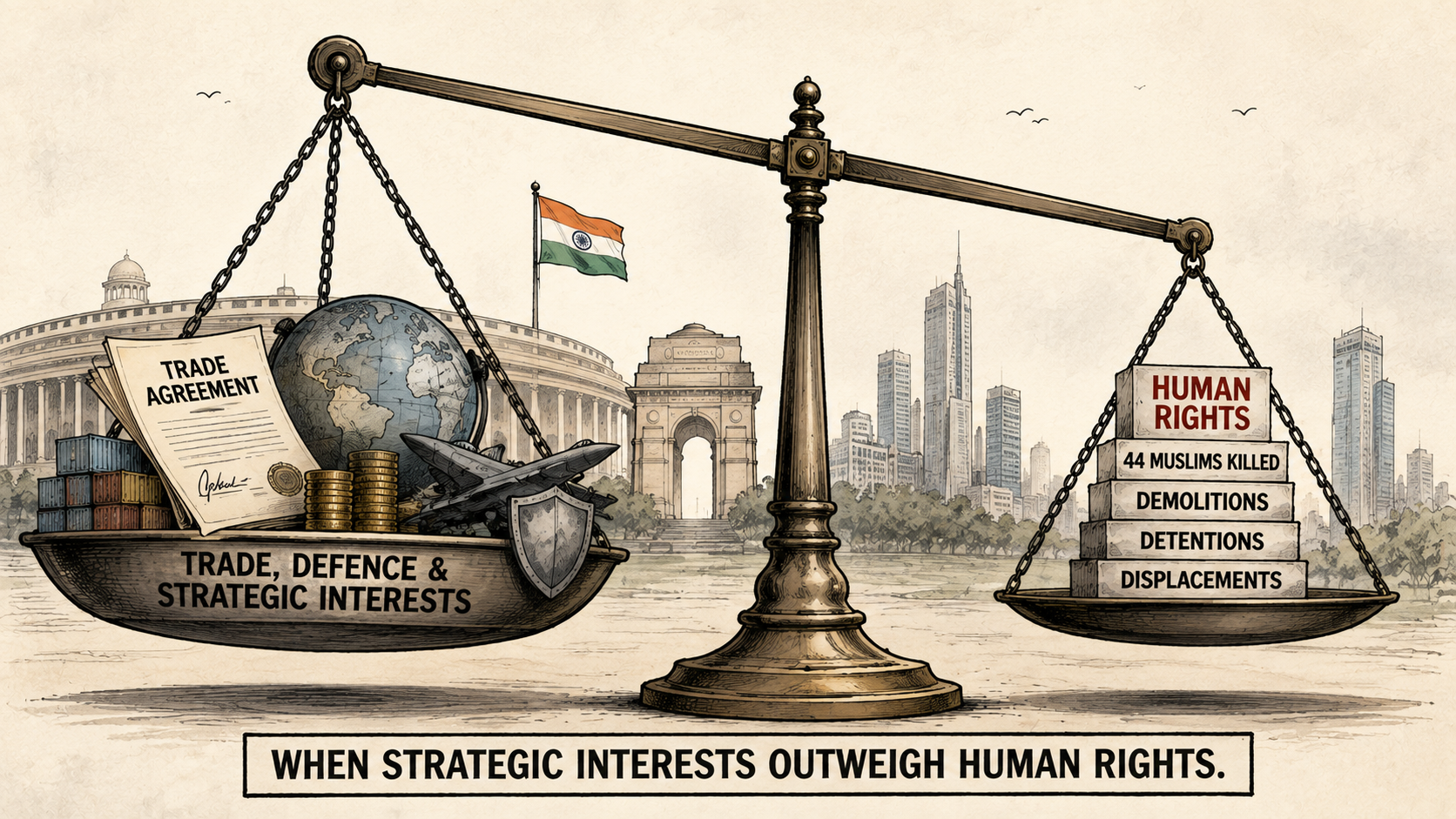
That question is harder to ignore because India matters so much to the rest of the world. Governments that routinely invoke human rights are also competing for Indian trade, investment and strategic influence.
Britain has recently concluded a trade agreement with New Delhi, while Arab and other Muslim-majority states continue to deepen commercial and political ties with India. Western powers increasingly view India as an essential partner in trade, defence and efforts to counterbalance China’s influence.
There is nothing contradictory about maintaining relations with a country while criticising its domestic policies. Diplomacy is most useful when difficult conversations remain possible. The problem arises when strategic importance makes those conversations less likely.
The allegations documented by the South Asia Justice Campaign point to a problem extending well beyond individual acts of communal violence.
The tracker documents alleged staged police encounters, custodial deaths, mass detentions, forced expulsions and demolitions of Muslim homes and religious sites.
At least 23 Muslim religious sites—including mosques, madrasas, mazars, dargahs and graveyards—were reportedly demolished between May and late June across six states and Delhi.
Authorities generally cited encroachment, redevelopment or infrastructure needs. Muslim residents and organisations alleged that some demolitions were carried out without adequate notice or due process. That distinction matters.
Governments have a legitimate interest in enforcing planning and property laws. But when enforcement repeatedly targets one religious community, questions of selective enforcement become unavoidable.
Rajasthan offers one example. More than 50 mosques, madrasas and dargahs reportedly received demolition notices, while at least seven religious structures were demolished, according to a civil-society fact-finding report.
The Supreme Court subsequently intervened and stayed the demolitions for two weeks. The issue therefore goes beyond whether individual buildings complied with planning rules: are laws being applied consistently, or are legal powers being used to pressure a particular minority?
The question becomes more serious when the state itself is involved.
In Indian-administered Kashmir, more than 2,500 people were reportedly detained within 48 hours of a July militant attack. The tracker also reported that two family homes were demolished using explosives.
Elsewhere, police were accused of selectively arresting Muslims during nationwide student protests. At one demonstration in Kolkata, 13 of the 14 people arrested were Muslim, according to the tracker.
Among those killed by actors classified by the tracker as Hindu extremists between May and July were an 11-year-old girl and a 16-year-old boy.
None of these allegations, individually, establishes a systematic policy of persecution. But together, they raise a recurring question: whether security measures, policing and administrative powers are being used in ways that disproportionately burden Muslims.
The concern is particularly acute when security measures become entangled with questions of citizenship.
That tension is particularly stark in Assam, where authorities have continued what the tracker describes as “pushbacks” of people accused of being undocumented migrants.
The state’s chief minister says 1,679 people were “sent back” over two years. Human Rights Watch, cited by the tracker, has documented allegations that Indian forces took families, including children, through gaps in the border fence into Bangladesh at night.
India has the right to control its borders and remove people who are unlawfully present. But that right is subject to due process. A person cannot be treated as a foreign national merely because officials suspect they are one.
This is where political language matters. The tracker says the government claimed about 4,800 “deportations” during its first month in office and that police were reportedly instructed to hand suspected “infiltrators” to border forces rather than produce them in court.
UN Special Rapporteurs have warned that calling Indian Muslims “infiltrators” risks conflating citizens with foreign nationals and fuelling discrimination.
The danger is clear: when religious identity and citizenship become intertwined, immigration can become a question of belonging. That question of belonging also extends beyond borders and policing into India’s political and cultural institutions.
West Bengal offers another example of communal tensions becoming embedded in public policy.
The tracker identifies West Bengal as the site of the most severe communal violence targeting Muslims during the reporting period. It reports attacks on mosques, Muslim-owned businesses and settlements housing Muslim hawkers.
At least two people were killed, including one who reportedly died while attempting to defend a mosque.
The tracker also accuses the state government of introducing measures that disproportionately affect Muslims. It says 77 Muslim communities were removed from the Other Backward Classes reservation list and that the OBC quota was reduced from 17% to 7%.
Funding for the Minority Affairs and Madrasah Education Department was reportedly cut by 62%, from ₹57.14 billion to ₹21.75 billion. Minority scholarships and a school bicycle scheme also faced reductions.
The government also ordered a statewide survey of madrasas and appointed an 18-member panel to inspect unrecognised Islamic schools. The tracker further reported that Vande Mataram was made compulsory in madrasas.
Such policies should be judged by their legal basis and practical effect, not simply their political symbolism. But the symbolism is difficult to ignore when policies affecting education, public funding and religious institutions disproportionately affect one minority.
The dispute over Vande Mataram illustrates the tension clearly.
Parliament has moved to give the song legal protection similar to that afforded to the national anthem. The Prevention of Insults to National Honour (Amendment) Bill, 2026, passed the Rajya Sabha on July 29 and proposes imprisonment of up to three years for intentionally insulting or obstructing the song’s rendition.
For some Muslims, the issue is not patriotism but religious conscience: later stanzas of the song personify the nation as a goddess.
The question is whether respect for a national symbol can be separated from compulsory participation in a practice some citizens regard as religiously objectionable. A plural democracy should be capable of accommodating that distinction.
The same principle applies to disputes over places of worship.
At the Bhojshala-Kamal Maula complex in Madhya Pradesh, the Madhya Pradesh High Court ruled that the site was a Hindu temple dedicated to Saraswati and ordered that only Hindu worship take place there.
That ended an arrangement under which Hindus worshipped on Tuesdays and Muslims prayed on Fridays.
Muslim parties appealed to the Supreme Court. In July, the court declined to restore the previous arrangement but directed the state to provide an open space nearby for Friday prayers between 1pm and 3pm while the legal challenge continues.
When courts resolve competing religious claims over historic sites, the legitimacy of their decisions depends not only on the outcome but on confidence in an impartial process.
That brings the issue back to the central question: accountability.
The South Asia Justice Campaign argues that India’s record in cases involving violence against Muslims shows how difficult accountability can be.
On May 7, the Bombay High Court upheld the acquittal of all 22 accused, including 21 police officers, in the case concerning the alleged staged-encounter killings of Sohrabuddin Shaikh, his wife Kauser Bi and witness Tulsiram Prajapati.
The Gujarat High Court also upheld the acquittal of five men accused of throwing a Muslim man, Samsuddin alias Kasamkhan, into a fire during the 2002 anti-Muslim violence in Vadodara.
An acquittal is not evidence of a cover-up or judicial failure. Courts must decide cases on evidence, and defendants are entitled to the presumption of innocence.
But repeated allegations of violence followed by contested or inconclusive outcomes raise questions about whether victims have effective access to justice.
The same concern applies to deaths in custody. The tracker recorded at least six Muslim men dying in police or judicial custody across six states between May and July.
Authorities attributed the deaths to other causes, while relatives alleged torture, extortion or medical neglect.
The tracker also alleges that police took no action over calls for the genocide of Muslims made at a mass gathering near Delhi.
In another case cited by the organisation, a judge who sentenced 14 cow vigilantes to life imprisonment for the lynching of a Muslim man reportedly required police protection after receiving threats from Hindu extremists.
The significance of these cases lies not only in the allegations but in what they reveal about confidence in institutions.
If victims believe police will not protect them, or judges require protection to perform their duties, the damage extends beyond individual cases. It becomes a question of whether the state can guarantee equal protection under the law.
That is where the international dimension becomes unavoidable.
The UN and its experts have raised concerns about discrimination, the treatment of protesters, voter roll deletions and forced expulsions.
At the same time, governments continue to pursue closer economic and strategic ties with New Delhi.
Britain wants greater access to India’s enormous market. Arab states have extensive commercial and political interests in the country. Western governments see India as an important partner in defence, technology, supply chains and the broader effort to balance China’s power.
Those interests are substantial. Nor does every allegation in a civil-society report constitute an established fact. That is precisely why engagement matters.
India’s partners do not have to choose between trade and human rights. They can pursue both.
They should reject the assumption that criticism of India’s domestic record must undermine the broader relationship.
A mature relationship should make candid criticism easier, not harder. Selective defence of human rights turns a universal principle into a geopolitical convenience.
If violations by an adversary provoke outrage while similar allegations involving a strategic partner are met with silence, the double standard is difficult to miss.
The same standard should apply to Muslim-majority governments. Commercial and diplomatic interests are legitimate, but they should not prevent governments from asking how India’s Muslim citizens are being treated.
The figures reported by the tracker are stark: 44 Muslims killed in seven months, thousands reportedly detained, religious sites demolished, families displaced, children among the dead and allegations that Indian citizens have been treated as foreign “infiltrators”.
Not every allegation will withstand scrutiny. Some may be challenged or disproved. Others may require further investigation.
The appropriate international response is therefore neither automatic condemnation nor diplomatic silence. It is scrutiny.
India is too important to isolate—and too important to indulge. Its growing economic and strategic weight makes it more important, not less, that its institutions meet the standards India expects others to meet.
The question for India’s partners is not whether to trade with New Delhi, cooperate with it or deepen ties. They should. The question is whether they can do so while still demanding answers about the treatment of India’s Muslims.
A partnership that cannot withstand scrutiny is not a strong partnership. And a commitment to human rights that disappears when commercial interests take precedence was never much of a commitment at all.