Elham Asaad Buaras
Kosovo’s former president Hashim Thaçi is to appeal his 25-year prison sentence for war crimes, as thousands of supporters protested his conviction in Kosovo and the Netherlands.
Thaçi, 58, was convicted at The Hague on September 16 following a three-year trial before the Kosovo Specialist Chambers. His defence team said the judgment contained “significant errors of law and fact” and would be challenged on appeal.
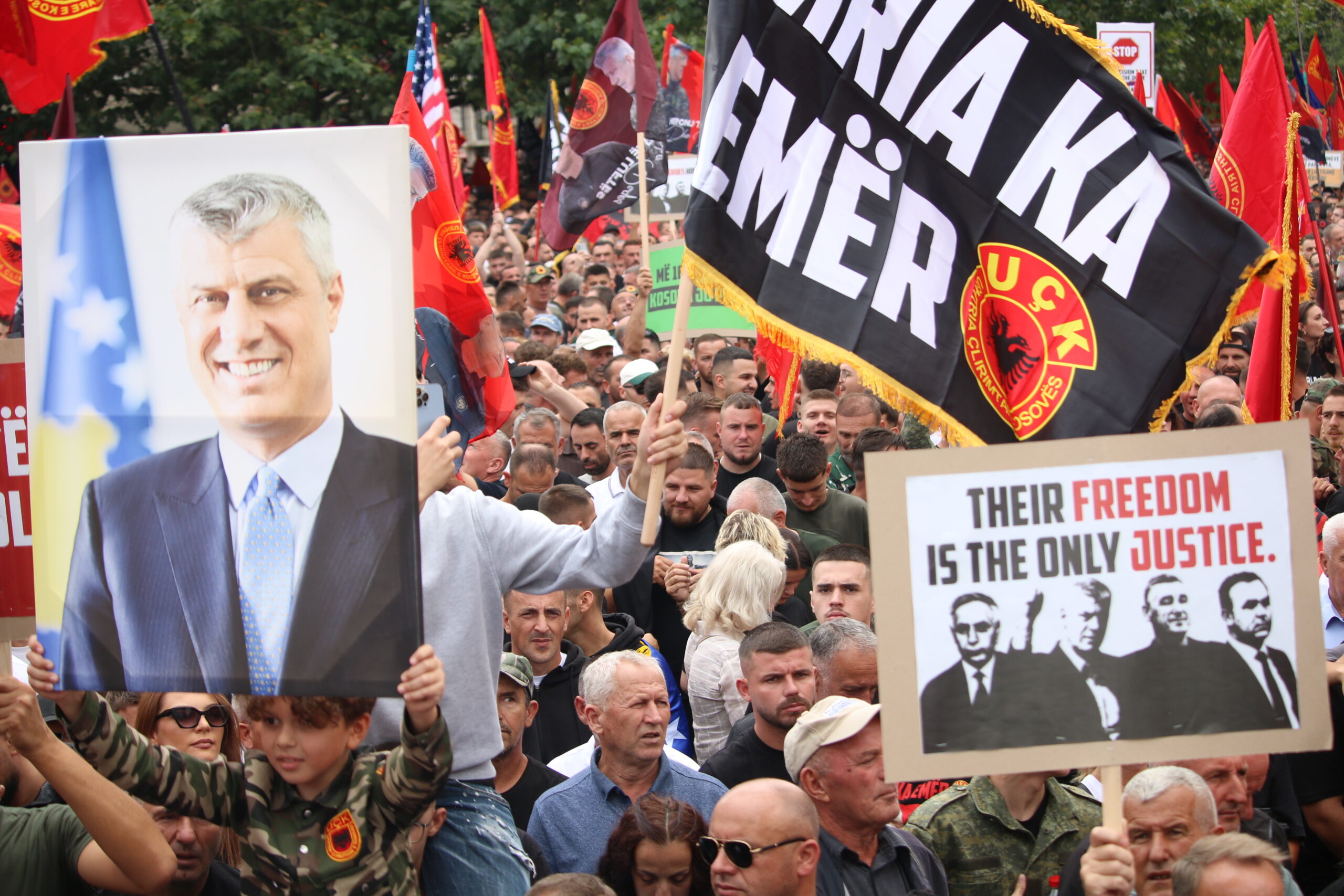
The verdict triggered protests in Kosovo and the Netherlands. Thousands gathered in central Pristina on September 16 to watch the proceedings on large screens, waving Kosovo Liberation Army (KLA) and Albanian flags. After the convictions were announced, some protesters marched towards the headquarters of the European Union Rule of Law Mission in Kosovo (EULEX), where clashes with riot police were reported and objects were thrown at the building.
Protests were also held outside the Kosovo Specialist Chambers in The Hague, where Dutch police used water cannon to disperse supporters. Reports said some protesters climbed onto police vehicles and two people were arrested, while a police officer was slightly injured.
A further demonstration was held in Pristina on September 17 under the slogan “Not in My Name”, with thousands gathering in support of the four former KLA leaders.
The demonstrations followed a larger rally in Pristina on September 12, when thousands called for the defendants to be acquitted ahead of the verdict.
Thaçi was found guilty of murder, arbitrary or unlawful arrest and detention, torture, and cruel treatment. The court found that 96 people were murdered, 385 were unlawfully or arbitrarily arrested and detained, 303 were subjected to torture and 49 to cruel treatment.
It found that Thaçi and three other former KLA commanders made significant contributions to a joint criminal enterprise involving the detention, mistreatment and killing of people regarded as political opponents or collaborators.
However, the Trial Panel acquitted the four men of six charges of crimes against humanity, finding that prosecutors had not proved beyond reasonable doubt that the crimes formed part of a widespread or systematic attack against a civilian population.
Thaçi stood trial alongside former KLA commanders Kadri Veseli, Rexhep Selimi and Rexhep Krasniqi. Veseli was sentenced to 18 years, while Selimi received 13 years and Krasniqi 25 years. All four were given credit for time already spent in detention.
Kosovo Prime Minister Albin Kurti described the judgment as “an unacceptable injustice, a grave and harmful punishment” and said it “must be changed and corrected on appeal”.
The convictions have also been welcomed by victims’ rights groups. Esther Major, Amnesty International’s Deputy Regional Director for Europe, said the convictions “give hope that the victims and relatives of the missing will finally see justice”.
Thaçi was a senior political and military figure in the KLA, the ethnic Albanian armed group that fought Serbian and Yugoslav forces during the Kosovo war. More than 10,000 people were killed during the conflict, while hundreds of thousands were displaced.
The KLA was also accused of attacks and abuses against Kosovo’s ethnic Serb minority and other civilians during and after the conflict. The Kosovo Specialist Chambers was established to investigate and prosecute alleged crimes linked to the KLA.
Thaçi became Kosovo’s prime minister in 2008, the year the territory declared independence from Serbia, and later served as president. He resigned in 2020 after being indicted by the Kosovo Specialist Chambers and was transferred to detention in The Hague.
The case is among the most significant prosecutions arising from the Kosovo war and has brought renewed attention to allegations of crimes committed by KLA members alongside abuses committed by Serbian and Yugoslav forces during the conflict.
The first-instance judgment is not final. The appeals process will determine whether the convictions and sentences are upheld, amended or overturned. The Kosovo Specialist Chambers has also begun proceedings concerning reparations for victims of the crimes established in the judgment.