Elham Asaad Buaras
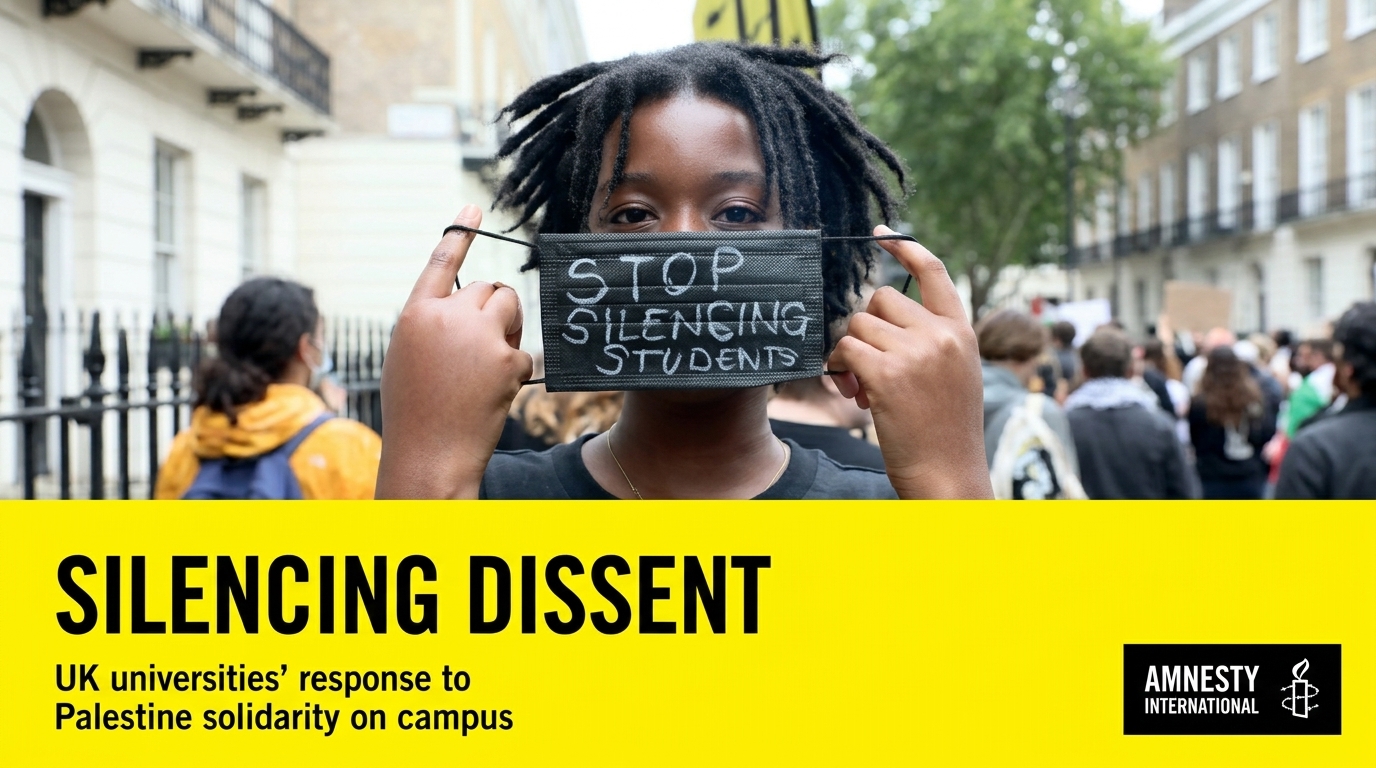
UK universities have restricted Palestine solidarity protests, disciplined student activists and, in some cases, threatened international students’ immigration status, according to a new Amnesty International report documenting what the human rights organisation describes as an “infrastructure of control and repression”.
Published on October 20, Silencing Dissent: UK universities’ response to Palestine solidarity on campus examines universities’ responses to protests following Israel’s assault on Gaza in October 2023. Drawing on 40 interviews, Freedom of Information disclosures and legal evidence, the report documents cancelled events, campus bans, disciplinary proceedings and restrictions on demonstrations.
It assesses whether universities have met their obligations to protect freedom of expression, peaceful assembly, non-discrimination, academic freedom, privacy and education.
“Instead, institutions have prioritised risk-managed securitisation over their legal duties,” the report said.
Amnesty warned that restrictive protest policies and disciplinary measures risk deterring students and academics from expressing political views or taking part in peaceful demonstrations.
Some universities introduced advance notification or authorisation requirements, while others cancelled events, dismantled encampments or sought civil injunctions to restrict campus protests.
The University of Birmingham introduced a 14-day advance notification requirement for campus demonstrations under its 2024 Code of Practice. The University of Cambridge sought a broad civil injunction in March 2025 covering demonstrations at prominent campus locations.
By May 2025, at least 28 universities had initiated formal misconduct proceedings against 113 students involved in protests, the report found.
International students faced additional consequences, as disciplinary action could jeopardise their ability to remain in the UK.
At King’s College London, Egyptian student Usama Ghanem was indefinitely suspended in 2025 over his involvement in Palestine solidarity activism. Amnesty said the university’s actions threatened his ability to continue his studies and put his immigration status at risk.
Ghanem had previously been detained and tortured in Egypt, according to the report, raising concerns about the consequences of a possible return.
“I left an authoritarian regime in Egypt to find one at King’s College London,” Ghanem said. “For protesting a genocide our university was funding and demanding divestment, I was indefinitely suspended, monitored, and threatened with deportation to the very authoritarian regime I had fled.”
His suspension was lifted in September following a 15-month dispute, subsequent reporting said.
The report also examined the treatment of seven students at the London School of Economics (LSE), who received precautionary campus bans after a protest on July 7, 2024, calling on the university to divest from companies supplying arms to Israel.
The students said the gathering in the Student Services Centre foyer lasted about 15 minutes, although the university put its duration at 25 minutes. Participants wore keffiyehs and T-shirts bearing red handprints, used a megaphone and chanted slogans.
The university subsequently restricted their access to campus, including in-person wellbeing support.
Internal correspondence obtained through subject access requests showed senior officials describing the gathering as a “temper tantrum by children” and referring to students wearing keffiyehs as “dressed as terrorists”, Amnesty said.
Amnesty also raised concerns about universities employing private security and intelligence companies to monitor Palestine solidarity activism.
At least nine universities had contracted private firms to monitor student demonstrations, according to the report. Intelligence assessments obtained through Freedom of Information requests assigned high security risk ratings to some protests.
University security teams also collected photographs and CCTV images to identify activists.
At the University of Sheffield, IT administrators traced student device and account identifiers to identify participants in an online protest targeting corporate links to arms manufacturer BAE Systems, the report said.
Amnesty said the treatment of Muslim students raised concerns about discrimination and inadequate safeguards against Islamophobia.
The report documented cases in which visible expressions of Muslim identity and Palestinian solidarity, including hijabs, keffiyehs and Arabic signage, were treated as potential indicators of extremism.
It also criticised the absence of an equivalent regulatory framework specifically addressing Islamophobia in higher education, despite Muslims making up a significant proportion of the UK student population.
At Newcastle University, students established an encampment outside the Northern Stage theatre in May 2024. University authorities called police to clear the protest, and students reported confrontational policing during the operation.
Amnesty’s investigation covered events between October 7, 2023, and September 30, 2025, alongside an examination of the preceding 18 months.
The organisation called on universities to adopt its Defend Dissent Charter, review restrictive protest policies, remove disciplinary records imposed on students for peaceful advocacy and protect international students from disproportionate threats to their immigration status.