Elham Asaad Buaras
A mosque near Paris has been ordered to remain closed for six months after French authorities objected to Qur’anic verses, Islamic religious texts and sermons delivered by imams and guest preachers.
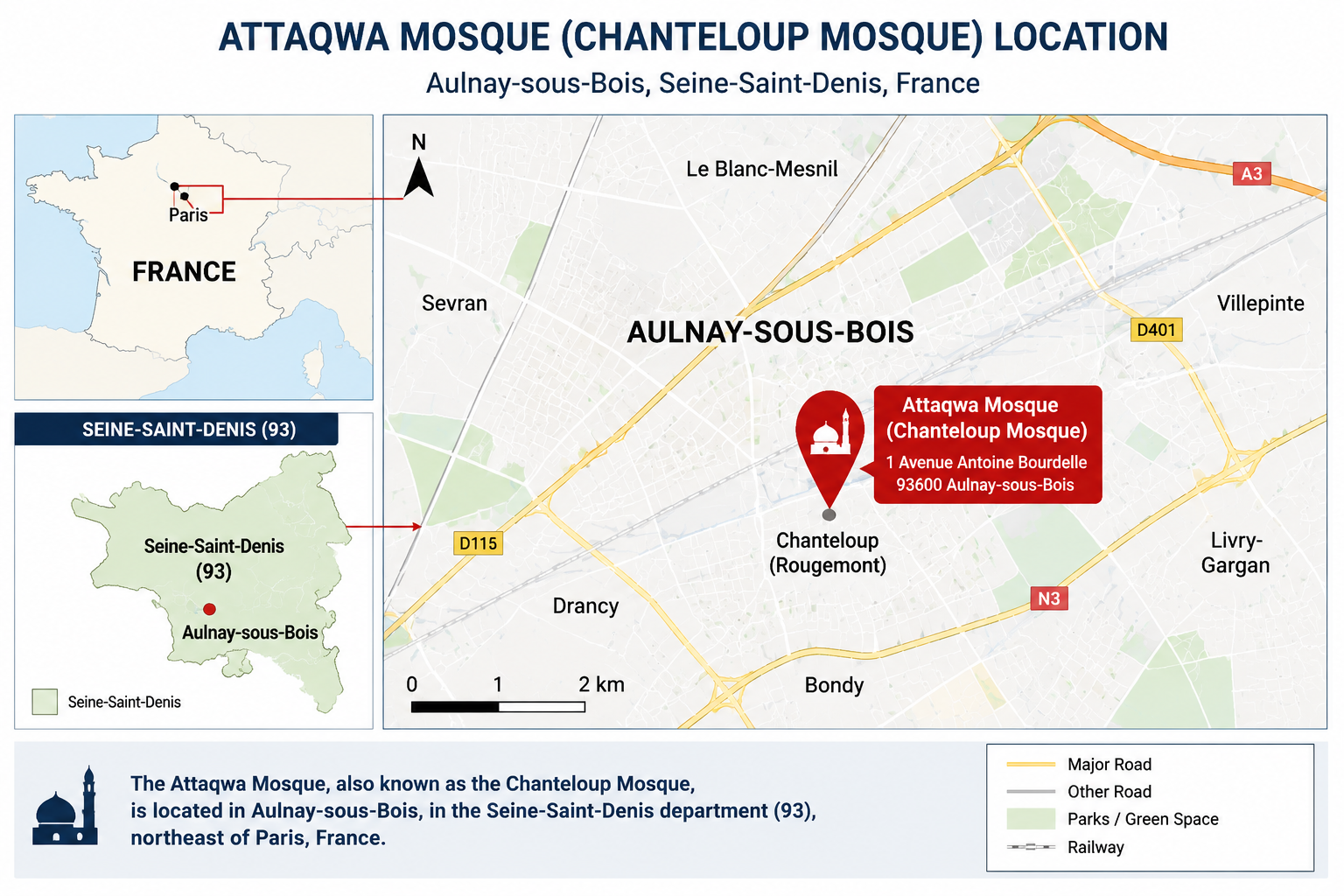
The Montreuil Administrative Court on August 7 rejected a challenge to the closure of the Attaqwa Mosque, also known as the Chanteloup Mosque, in Aulnay-sous-Bois.
The decision means the mosque will remain closed following a closure order issued by the Seine-Saint-Denis prefect, Julien Charles, on July 27.
But the mosque’s lawyer has warned that the case raises fundamental questions about freedom of worship and whether Islamic religious teachings can be freely quoted inside French mosques.
Rafik Chekkat said authorities had cited seven passages from the Qur’an, as well as references to major works of Islamic tradition, including The Garden of the Righteous and The Forty Hadiths.
“In France, can an imam still quote the Qur’an in the mosque where he preaches?” Chekkat said.
The works cited by the authorities are associated with Imam al-Nawawi, the influential 13th-century Syrian Muslim scholar whose writings remain widely studied by Muslims.
Authorities also objected to sermons referring to “hell” and the “punishments of the grave” for “unbelievers”.
Chekkat said the mosque would appeal to France’s highest administrative court, the Council of State.
“We will file an appeal before the Council of State to defend religious freedom, freedom of expression and the principle of secularism,” he said.
French authorities say the closure was not based simply on the use of Qur’anic verses or traditional Islamic texts.
The prefecture said the mosque had been used to disseminate what it described as a “radical Islamist ideology”, including rhetoric echoing terrorist organisations, the legitimisation of jihad and the glorification of martyrdom.
It also accused sermons and material circulated on social media of provoking violence, hatred or discrimination and of glorifying terrorist acts.
Among the material cited by authorities was a video in which an imam who had spoken at the mosque was reported to have encouraged Muslims to hit children aged 11 and over if they did not pray.
The closure was imposed under Article L.227-1 of France’s Internal Security Code, which allows authorities to temporarily close places of worship in circumstances involving speech considered to incite violence, hatred or discrimination, or to justify terrorism. The maximum period is six months.
The mosque’s management disputes the authorities’ interpretation of the material.
On July 28, the day after the closure order was issued, Chekkat announced that he had challenged the decision before the Montreuil Administrative Court.
He argued that the prefecture’s case relied on insufficient and imprecise evidence, reasoning by analogy and what he described as misinterpretations of Qur’anic verses.
The court ultimately rejected the request to suspend the closure.
Judges ruled that the prefect had not committed a “serious and manifestly illegal infringement” of either freedom of worship or freedom of expression.
Chekkat said he was “very disappointed” and “very surprised” by the decision.
“We will obviously go before the Council of State,” he told AFP, saying parts of the ruling went “totally against religious freedom”.
He added that he believed the Council of State would provide a better opportunity for the mosque’s arguments to be considered.
The case is not the first time the Chanteloup Mosque has faced closure.
It was previously shut in 2019, although that closure concerned public-safety requirements rather than the allegations behind the current order. Authorities at the time said the building did not meet the conditions required to receive members of the public safely.
The latest case comes amid years of heightened scrutiny of Muslim institutions in France.
By April 2022, French authorities had closed 22 mosques over an 18-month period, according to figures cited in previous reporting.
Authorities have also dissolved Muslim organisations, including the Collective Against Islamophobia in France and the charity BarakaCity.
The measures have prompted criticism from Muslim organisations and rights advocates, who argue that France’s security laws can place disproportionate restrictions on Muslim religious institutions and expression.