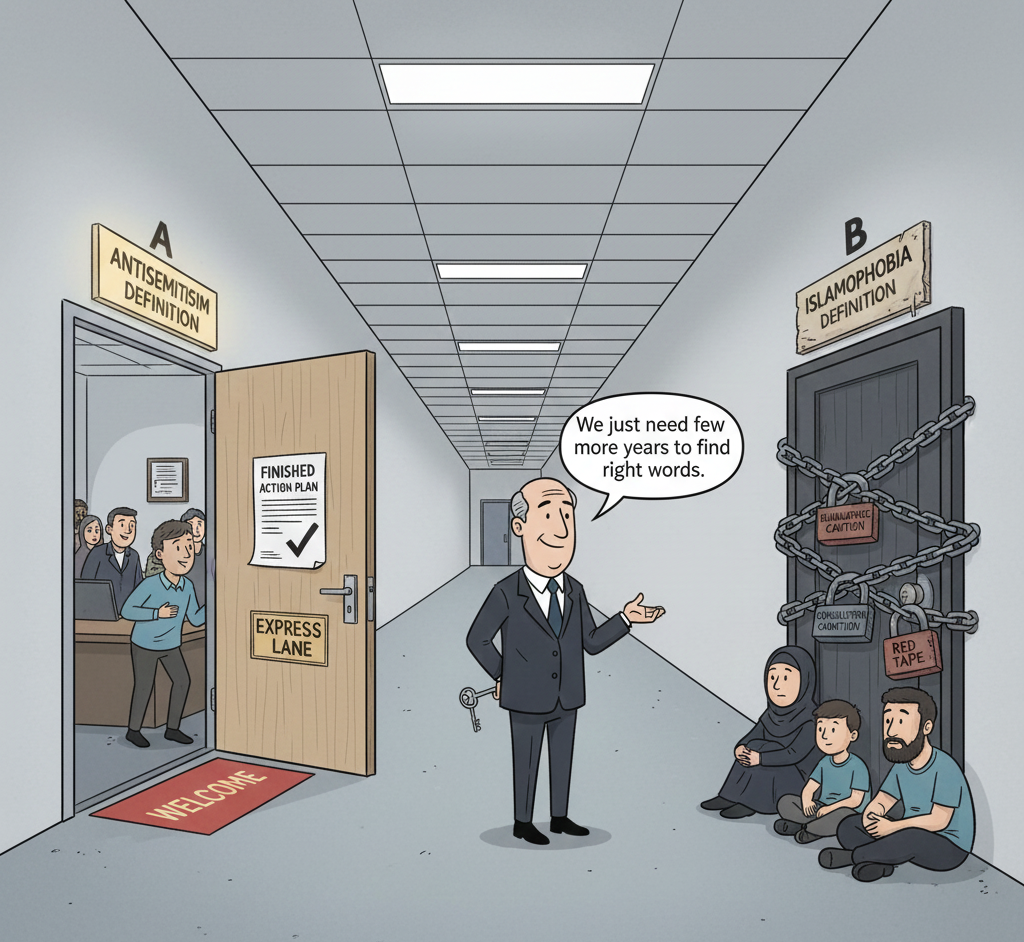
Islamophobia in the UK is neither marginal nor isolated — but you wouldn’t know that from the way the mainstream media and political establishment handle it. The response from those in power remains tepid, fragmented, or merely symbolic.
Data from the Islamophobia Response Unit shows a 236 % rise in reported incidents between January and April 2024 compared to earlier months, and a ~300 % increase in incidents overall. A University of Birmingham study found Muslims are the second most disliked group in the UK, right after Travellers. Muslims make up over 6% of the UK population — yet are still seen by many as ‘others’ rather than full shapers of British life.
The hard truth is this: Islamophobia is not being taken seriously by those in power in part because we, as a community, are not yet powerful enough in the places where influence is shaped. Even the widely-used MCB definition of Islamophobia — as racism “that targets expressions of Muslimness or perceived Muslimness” — has been politicised into controversy.
We all know this. We feel it. But knowing isn’t enough.
Islamophobia isn’t just “online hate” or a few hateful headlines; it is a structural problem. And structural injustices do not end simply because people protest them. They end when those who have been ignored become too visible, too competent, and too indispensable to ignore.
This is where young Muslims — especially professionals — must step forward. You are the generation that can shift the conversation from complaint to capacity, from “why don’t they listen?” to “we can lead ourselves.”
And leadership here is not confined to politics. It is about voice and visibility in every space that shapes the national story:
When we show up — confidently, consistently, positively, creatively — and become a force for good, Islamophobia loses its silent permission.
It sounds basic — but it is transformative. Many young Muslims do not vote out of cynicism, laziness, or apathy. Yet politicians count votes.
Register. Vote in every election — local, mayoral, general, even student union. Volunteer in campaigns that mirror your values and social ethics. Influence is learned and earned by doing.
Start local: councils, assemblies, mayors. Local confidence builds national momentum.
Prepare yourself and apply to be a school governor, youth councillor, or charity trustee. Run for your student union. If you don’t see Muslims in leadership, be the presence that’s missing.
Leadership isn’t perfection. It’s consistency. Confidence nourishes courage — and courage grows through participation — and participation brings collective benefit.
Mainstream media often frames Muslims as “issues” rather than contributors. Flip that narrative. Create content that shows who we really are — podcasts, short films, TikToks, blogs, newsletters. Confront stereotypes with facts, creativity, and dignity, not just frustration. Let the world know that Muslims are woven into the everyday fabric of rich British life.
Follow platforms that remain rooted in the community and contribute to them. Writers, designers, activists, and storytellers together can shape a movement.
Islamophobia hides in systems: education, policing, hiring, housing. To change systems, we must understand them. Learn how your council makes decisions. Attend consultations. Know your rights — equality law, hate crime reporting, data protection.
Join civic training programmes like Citizens UK, the Patchwork Foundation, or the Muslim Council of Britain — the list goes on. They teach how to turn values into action.
We gain influence faster when we build alliances. Stand with those who face discrimination — Jewish, Black, Asian, and migrant communities. Partner with climate, housing, or youth justice movements. When others see Muslims standing for justice, not just against prejudice, perceptions shift.
Relationships are the currency of civic power. Be generous. Be reliable. Be hard working. Be strategic.
The biggest barrier isn’t external — it’s internal. We must stop seeing ourselves only as a minority to be defended and start seeing ourselves as citizens to be developed.
We cannot wait for political leaders or media institutions to take Islamophobia seriously.
Use faith as fuel, not fear. Islam calls for justice, responsibility, and confidence — not withdrawal. Our faith doesn’t push us to the margins; it grounds us in purpose.
“The most beloved people to Allah are those who are most beneficial to people” (Al-Tabarani)
Civic participation, political engagement, and social leadership are not distractions from faith — they are expressions of it.
Islamophobia is not a “Muslim issue”. When one group can be diminished, sidelined, or “othered”, democracy itself is weakened. Elevating British Muslims into active, visible, respected public roles strengthens society as a whole. It signals that diversity is not merely tolerated, but valued.
Islamophobia thrives in the vacuum left by Muslim absence. Let’s fill that vacuum — with competence, courage, humility — as a community commitment.
Islamophobia must stop — but stopping it is not about waiting for others. The Muslim community holds immense potential. By stepping into civic life, shaping media and cultural spaces, building networks, and insisting on representation, British Muslims can shift the narrative, shift the power, and reclaim agency.
In doing so, we defend our dignity while helping build a society where equality is truly lived, not just promised.
The time to act is now. Visibility, voice, and agency are our tools.
Imagine a Britain where Muslim youth fill council chambers, newsrooms, tech startups, classrooms, academia, and civic halls — not as tokens, but as trailblazers.
Don’t only call out injustice — outgrow it.
Don’t only demand inclusion — build it.
Don’t wait for power — become it.
Dr Muhammad Abdul Bari
Educationalist, Author, Parenting Consultant
Image by pch.vector on Freepik