Elham Asaad Buaras
Framed as a concession to free expression, the Austrian host broadcaster ORF has announced it will permit both the symbols and sounds of protest at Eurovision 2026, allowing Palestinian flags in the audience and refusing to censor boos during Israel’s performance. In reality, it is little more than rearranging the deckchairs on the Titanic: the core issue, the inclusion of Israel itself, remains untouched.
It is precisely that unresolved decision which has driven a wave of withdrawals. Iceland’s boycott on December 10 joined Spain, Ireland, Slovenia, and the Netherlands, plunging Eurovision into its gravest political crisis in decades. Participation alongside a state accused of war crimes, while Gaza lies in ruins, has become an untenable moral compromise for artists, civil society, and the public alike
This crisis exposes a deep and deliberate fracture within the European Broadcasting Union (EBU). For years, the organisation has insisted that Eurovision is a “non-political cultural event.” That pretence has now collapsed. The EBU has not removed politics from Eurovision; it has managed them selectively, shielding Israel while insisting others accept consequences.
That selectivity was laid bare earlier this month, when broadcasters were denied a clear, public vote on Israel’s participation. Instead, the issue was buried inside a secret ballot on “voting reforms”, a procedural manoeuvre that allowed the EBU to avoid accountability while preserving the status quo. Several broadcasters, including Iceland’s, explicitly requested a vote. The request was refused.
The pressure, however, is no longer confined to artists or audiences. In Belgium, it has now reached the parliamentary floor. A motion has been submitted to the Parliament of the Wallonia–Brussels Federation calling on the Francophone public broadcaster RTBF to reconsider its decision to participate in Eurovision 2026. Proposed by members of the Socialist Party, the motion argues that international law requires diplomatic and economic pressure to prevent genocide, describing a boycott of a competition involving Israel as “symbolic but strong and necessary.”
Crucially, the motion frames withdrawal not as cultural grandstanding but as a legal and moral obligation, warning against “complicity and tolerance in the face of genocide.” It also criticises RTBF for taking what it describes as a “binding” decision without consulting its own board of directors, urging the Francophone Community Government to intervene. While the government cannot formally overturn RTBF’s Eurovision entry, it appoints the broadcaster’s board and therefore wields clear political influence.
Belgium’s situation exposes the fiction at the heart of the EBU’s position. Eurovision is not being politicised by protesters, flags, or boos; it is being politicised by institutional decisions taken behind closed doors and shielded from scrutiny. When elected representatives begin questioning broadcaster participation on the grounds of international law, the claim that Eurovision exists in some apolitical vacuum becomes impossible to sustain.
The last two contests have stripped away any remaining illusion of neutrality. Eurovision 2024 in Malmö was described as chaotic and hostile, marred by mass protests and backstage tension. Irish artist Bambie Thug accused the EBU of silencing performers who spoke out, while showing exceptional leniency towards Israel’s broadcaster, KAN, despite multiple complaints.
In 2025, the crisis intensified. Israel’s entrant, Yuval Raphael, whose participation was publicly promoted by the Israeli government, performed amid boos and disruption, as thousands protested outside the arena. The contest’s carefully curated language of “joy” and “togetherness” rang hollow against the backdrop of Gaza. Eurovision was no longer a space insulated from politics; it had become entangled in them by institutional choice.
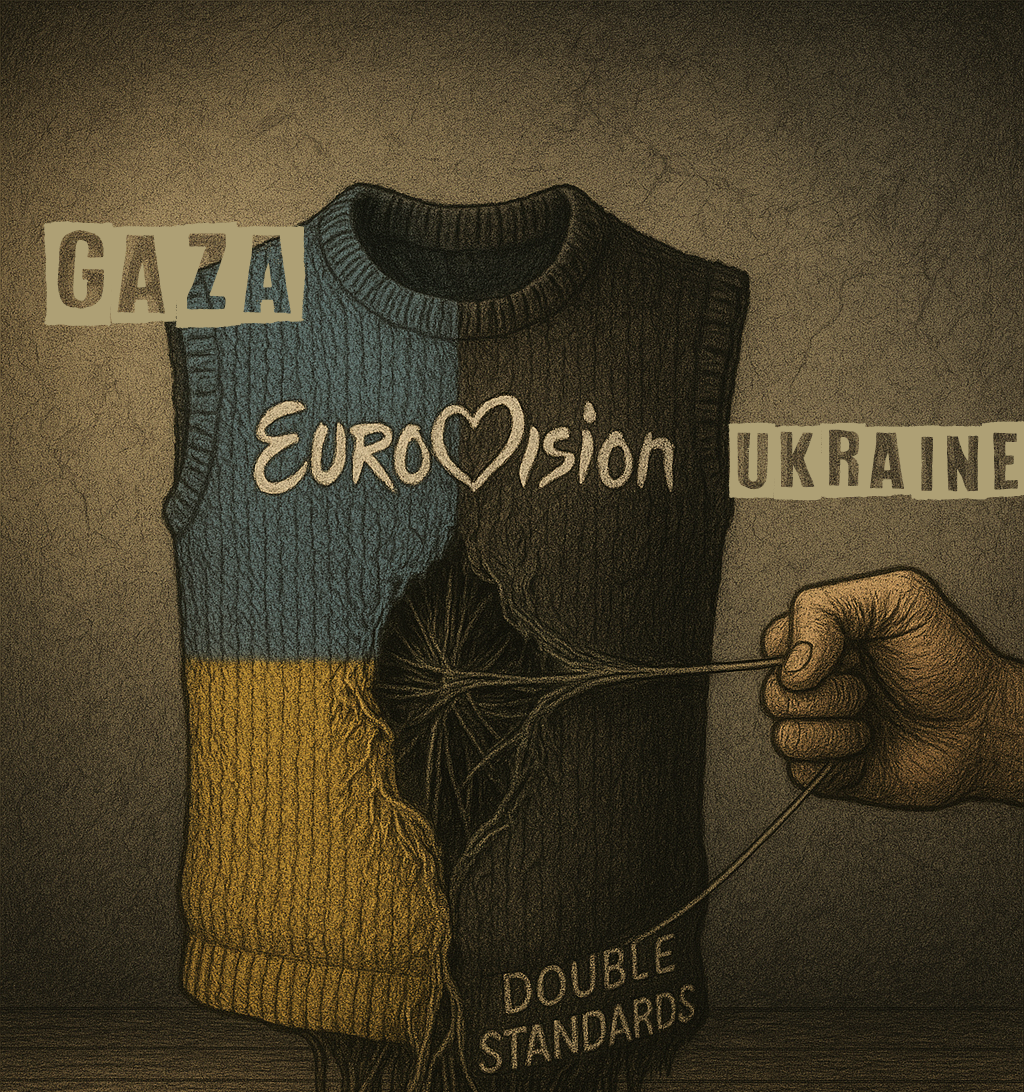
The contrast with the EBU’s treatment of Russia is unavoidable. In 2022, Russia was banned on the grounds that its participation following the invasion of Ukraine would “bring the competition into disrepute.” Today, as Israel faces mounting accusations of war crimes and mass civilian killing, the EBU has not only refused to act but has actively blocked transparent scrutiny. The BBC, backing the EBU, continues to invoke “rule enforcement” and “inclusivity,” arguments that collapse under the weight of precedent.
Under pressure, the EBU has offered cosmetic adjustments to the voting system, including reducing viewer votes. ORF’s new policies on flags and booing, while presented as gestures of transparency, are ultimately cosmetic as well. They do nothing to address the moral core of the crisis. The EBU is protecting Israel from consequences it imposed on others, while treating public outrage as a problem to be managed rather than confronted.
Political leaders and broadcasters have been blunt. Spain’s culture minister, Ernest Urtasun, said: “You can’t whitewash Israel given the genocide in Gaza. Culture should be on the side of peace and justice.” Ireland’s RTÉ described participation as “unconscionable.” Iceland’s RÚV warned that the situation had already damaged both Eurovision and the EBU itself.
Public opinion is equally clear. A recent UK poll commissioned by political advisor Pablo O’Hana found that 82% of Britons believe Israel should be excluded from the contest, with 69% supporting a UK withdrawal if it is not. The sentiment cuts across party lines and includes a large majority of Eurovision fans. This is not a fringe position; it is a mainstream one.
“The British public can see the double standard,” O’Hana said, calling on the BBC to “get a backbone and listen.” Continued participation, he warned, risks being perceived as tacit endorsement of Israel’s actions in Gaza. For a public broadcaster funded by licence-fee payers, this represents a profound challenge to legitimacy.
Eurovision’s 70th anniversary, set for Vienna in 2026, should have been a celebration of cultural exchange. Instead, it approaches amid boycotts, protests, and a credibility crisis. What was once billed as a unifying spectacle has become a battleground over values, accountability, and institutional courage.
As Graham Norton observed after Austria’s narrow win over Israel in 2025, the EBU was likely “breathing the largest sigh of relief” at avoiding the prospect of hosting the contest in Tel Aviv. That relief is revealing. In its determination to avoid confronting Israel’s actions, the EBU has not preserved Eurovision’s integrity; it has undermined it.
The question is no longer whether Israel’s participation has damaged the contest. It has. The only question now is whether Eurovision, stripped of moral coherence and public trust, can survive in its current form at all.
(Caricature credit: AI Gemini/The Muslim News)