Mahomed Faizal, Cape Town, South Africa
The 18th BRICS Summit in New Delhi opened with the bloc’s most delicate test: whether an expanded and geopolitically fractured coalition could agree on a common position on the Middle East after the illegal US–Israeli attack on Iran.
The resulting New Delhi Declaration expressed “deep concern over the continued escalation of tensions” in the region and called for “maximum restraint”, urging parties to avoid further escalation. It stopped short of naming the United States, Israel, Iran or the Gulf states. That carefully calibrated language marks a shift from the previous year’s Rio declaration, which condemned the US–Israeli campaign as a “blatant breach of international law” and reflected India’s insistence on consensus over confrontation as chair.
The reluctance to assign blame reflectsacute internal divisions within BRICS. Iran, a member since 2024, was the target of US and Israeli strikes on its nuclear facilities at Natanz, Isfahan and Fordow during the 12‑day war in 2025. The UAE, also a BRICS member, faced Iranian reprisal attacks on US military bases on its territory. BRICS foreign ministers’ meeting in Delhi this May failed to agree on a joint statement due to conflicting positions on the unlawful attack against Iran. This time, negotiations reportedly continued until 4 am before leaders reached an agreement on the declaration.
China’s stance provided an important anchor for the Middle East section of the declaration. President Xi Jinping said the war “does not serve the common interests of the international community” and called for a political settlement and a “permanent and comprehensive ceasefire”.
That position aligns with Beijing’s broader advocacy for a multipolar order and for resolving disputes through dialogue rather than coercion. It also reinforces the declaration’s generic but firm language on conflict prevention, dialogue and diplomacy. While Xi did not directly name Washington or Jerusalem in his summit comments, his call for a political settlement reinforced the text’s call for restraint and its concern over deliberate attacks on civilian infrastructure and peaceful nuclear facilities under IAEA safeguards – an indirect reference to the bombing of Iran’s nuclear sites.
For Tehran, the Delhi summit was an opportunity to press its case within a forum that includes both its adversaries and its partners. Iranian President Masoud Pezeshkian warned that Iran faces “critical, dangerous” US economic pressure and argued that attacks on economic and energy infrastructure have far‑reaching consequences, advocating instead for the use of national currencies and against punitive unilateral sanctions. On the sidelines, Pezeshkian held bilateral talks with Indian Prime Minister Narendra Modi, who urged the protection of maritime trade and the resolution of disputes through dialogue and with UAE Crown Prince Khaled bin Mohamed in the two countries’ highest‑level meeting since the war began.
Iranian Foreign Minister Abbas Araghchi, who also met Modi, framed Tehran’s approach in similarly pragmatic terms. “We will certainly make use of the opportunity provided by the BRICS Summit to continue our discussions and consultations with India in areas of mutual interest,” he said. His remarks signalled Iran’s intention to deepen ties with New Delhi while seeking broader BRICS support against unilateral pressure.
Within the plenary, Iran pushed for language that would implicitly validate its contention that strikes on safeguarded nuclear facilities violated international law, a position reflected in the declaration’s “serious concern over deliberate attacks on civilian infrastructure and peaceful nuclear facilities under full IAEA safeguards”, even though Iran is not named.
Although the declaration avoids explicit attribution on the US–Israel war on Iran, the Middle East remains central to its security and humanitarian commitments. The leaders expressed “deep concern over the continued escalation of tensions in the Middle East” and urged “maximum restraint”, warning that further escalation must be avoided.
On Gaza, it upheld the ceasefire, demanded unhindered humanitarian access, opposed the forced displacement of Palestinians, supported UNRWA and reiterated backing for a two‑state solution based on the 1967 borders with East Jerusalem as the capital of a sovereign Palestinian state.
On Lebanon, it went further still, welcoming the ceasefire, condemning continued violations and calling on Israel to “withdraw its occupying forces from all of the Lebanese territories”, the only place in the document where Israel is directly named in a demand for withdrawal.
The contrast captures BRICS’s attempt to balance the sensitivities of its Gulf and Iranian members while maintaining a coherent Global South position on occupation and self‑determination.
Analysts had modest expectations of the summit given the turbulence surrounding the war on Iran, US tariffs and the ongoing conflict in Ukraine and that members “invested in the success of this non‑Western grouping” and would be “reasonably satisfied with the modest outcome”.
For policymakers in BRICS capitals, the declaration sends three signals.
First, the bloc is unwilling to fracture over the Iran war, even when members are on opposite sides of the conflict. It is likely to favour generic calls for restraint and conflict prevention to naming and shaming.
Second, China’s emphasis on a political settlement and permanent ceasefire offers diplomatic cover to members seeking to de‑escalate without directly confronting Washington.
Third, explicit support for Palestinian statehood and opposition to demographic or geographic changes in occupied territory preserve BRICS’s traditional position on Palestine, even as the bloc treads carefully on the broader US–Israel–Iran confrontation.
In that sense, the Delhi summit’s Middle East language is less a verdict on the 2025 war than a statement of BRICS’s limits and ambitions: a coalition that can preserve consensus and affirm broad principles of restraint, dialogue and statehood, but that struggles to organise collective action or assign blame when its own members’ strategic interests collide.
By the narrow metric of diplomatic mechanics, the summit was a success: India secured a unanimous 140‑point declaration after last‑minute compromises, kept Iran and the UAE in the same room for the first time since the war and avoided a repeat of the May breakdown among foreign ministers. Yet by the standard of transformative global impact, the outcome was modest: the text offers principled positions on restraint, multilateral reform and development, but no new enforcement mechanisms, no binding security guarantees and no unified stance on the most contentious conflicts beyond the Middle East.
That tension between procedural success and substantive limitation frames BRICS’s role at a time when US influence faces pressures from tariff disputes, domestic political turbulence and competing international commitments.
The bloc is unlikely to replace Washington as the central organiser of the international system. It is, however, emerging as a parallel platform where emerging powers can coordinate on trade, finance, technology and selected security issues while offering the Global South an alternative forum for agenda‑setting and norm‑making.
In a world where US dominance is no longer assumed, BRICS’s significance lies less in grand declarations than in its ability to keep channels open among rivals, to legitimise local‑currency trade and digital public infrastructure and sustain pressure for reform of the UN and Bretton Woods institutions – even if that pressure remains incremental rather than revolutionary.
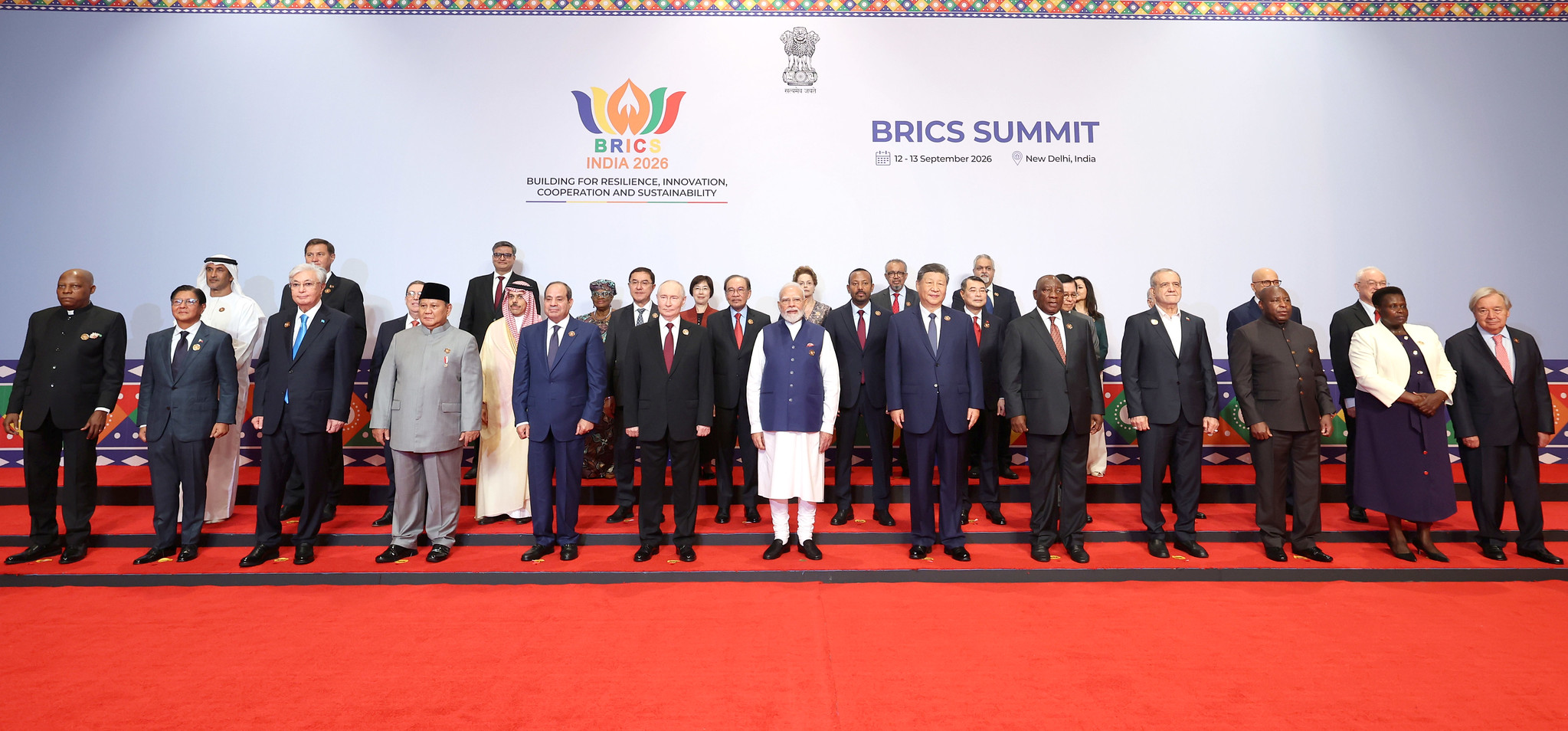
Feature photo: Leaders of BRICS member and partner countries, outreach invitees and heads of international organisations pose for a family photograph at Bharat Mandapam during the 18th BRICS Summit in New Delhi on September 13, 2026. The summit’s declaration expressed concern over escalating tensions in the Middle East but stopped short of directly blaming the US or Israel for the war on Iran. (Credit: MEAphotogallery/Flickr/CC)