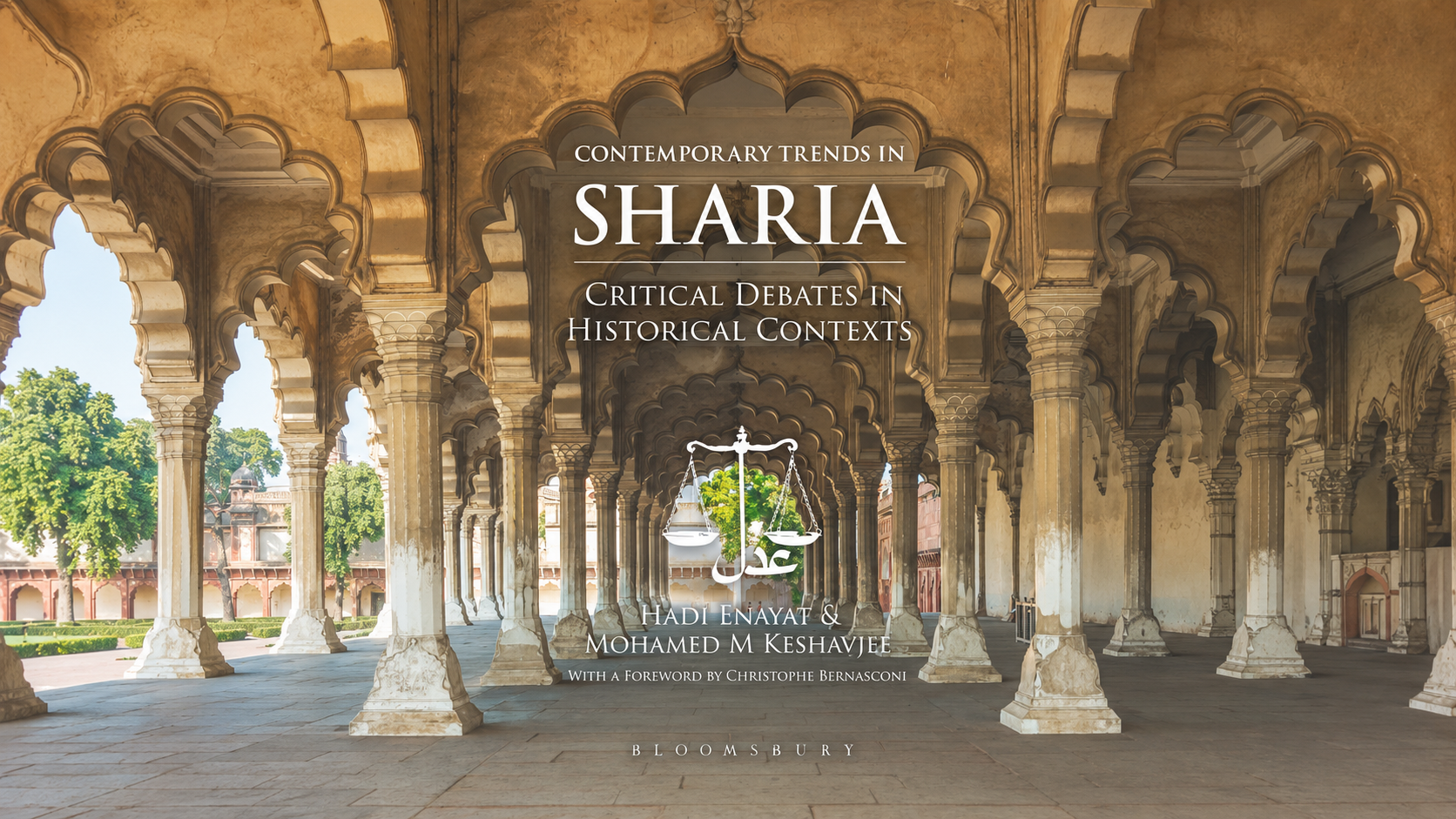
Contemporary Trends in Sharia: Critical Debates in Historical Contexts. By Hadi Enayat, and Mohamed Keshavjee. Foreword by Christophe Bernasconi. London: Bloomsbury in association with The Institute of Ismaili Studies, 2026. XX + 444 pp. £140 (hbk). ISBN 978-0-7556-5794-0 (hardcover).
From the Arabic شَرِيعَة (šarīʿa [Shari’ah], literally “path, way”) and usually mistranslated as “Islamic law”, Sharia refers to the system of law, ethics, and guidelines in Islam that govern a Muslim’s practical life, and represents a moral universe of diverse ideals, values and hopes.
The word Sharia in Arabic literally means “path” or rather “a path to water in the desert”, with the deeper meaning that there is a path of just and good conduct that exists and pleases God.
Sharia is an all-encompassing term that includes not only law in the western sense of the word but religious observances such as fasting and prayer, ritual practices such as halal slaughter, and worship in general.
Sharia is written jurisprudence and law developed based on a diversity of opinions among jurists in the classical period of Islam. While many aspects of Sharia have been modified or modernised in most Muslim countries, with regard to personal law, especially marriage and divorce, many Muslim societies still observe rulings of classical jurisprudence. The word Sharia is used in diverse ways by Muslims, and this leads to varying degrees of understanding and application.
The book under review, Contemporary Trends in Sharia: Critical Debates in Historical Contexts, has eleven chapters bookended by an Introduction and an Epilogue by both authors, and a useful Glossary.
The authors explore subjects such as the origin, evolution and multiple interfaces in the history of the Muslim peoples of Sharia (Chapter 1, Mohamed M. Keshavjee); Islamic Constitutionalism and its Discontents (Chapter 2, Hadi Enayat); Secularism, Religious Freedom and the Sharia (Chapter 3, Hadi Enayat); Criminal Justice in Islam (Chapter 4, Mohamed M. Keshavjee); Gender Justice: The Rights of Women in Islam – A Need for New Hermeneutics and a New Epistemology (Chapter 5, Mohamed M. Keshavjee); Alternative Dispute Resolution (ADR) and the Politics of Informal Justice Chapter 6, Mohamed M. Keshavjee); Sharia and Human Rights: The Clash of Universalisms and the Search for Common Ground (Chapter 7, Hadi Enayat); The Quest for a Moral Economy and the Vital Role of Faith and Sharia-Inspired Finance (Chapter 8, Mohamed M. Keshavjee); Property Rights in Sharia: Between Social Justice and Pious Neoliberalism (Chapter 9, Hadi Enayat); Developments in the Field of Organ Donation and Transplantation under Sharia in the UK (Chapter 10, Mohamed M. Keshavjee); and Continuity and Change in the Islamic law of Jihad: Modernity and the Crisis of Political Authority (Chapter 11, Hadi Enayat).
This work explores efforts undertaken by Muslims to foster new approaches to understanding Sharia that are apposite for the 21st century, critically assessing these efforts and situating them in the broader historical context of developments since the nineteenth century, including the transformation of the Sharia from a jurist’s law to state law, the secularisation of Islamic law through the judicial practice of constitutional courts and the marginalisation of the ulama as exclusive interpreters of Sharia. The book also challenges misconceptions about sharia in spheres such as gender, criminal justice and human rights. Building on the earlier Understanding Sharia (2018), which explains Sharia and the development of fiqh (Islamic jurisprudence), the focus here is on developments in the Muslim world and the Muslim diaspora.
Thought-provoking, non-sectarian and non-polemical, the book highlights the groundbreaking work of seminal thinkers in various fields of law, coupled with the authors’ analyses and commentary on their thinking. With a foreword by Dr. Christophe Bernasconi, Secretary General of the Hague Conference on Private International Law (HCCH), Contemporary Trends in Sharia will be of great appeal to educated lay readers as well as students of law, sociology and related disciplines. This book implicitly and explicitly questions some popular, and not so popular, fantasies regarding Sharia and Islam. As there is no such thing as a Christian or Western law (the United States of America has the death penalty while the European Union does not; Germany’s Constitution nowadays is different from the Constitution during the period between 1933 and 1945; different Churches have different canon laws), there is not a single Islamic legal system. Morocco and Saudi Arabia, both being monarchies, have different legal apparatuses that differfrom Iran’s, an Islamic Republic.
Hadi Enayat is Assistant Professor at the Aga Khan University’s Institute for the Study of Muslim Civilisations (AKU–ISMC) in London, and he specialises in the politics of the Middle East with a particular focus on religion, law, political theology and intellectual history. He is the author of Law, State and Society in Modern Iran (2013 — winner of the Biennial Mossadegh Prize 2013), Islam and Secularism in Post-Colonial Thought: A Cartography of Asadian Genealogies (2017), The Rule of Law in the Islamic Republic of Iran: Power, Institutions and the Limits of Reform, co-edited with Mirjam Künkler (2024).
Mohamed M. Keshavjee, with legal training in three common law jurisdictions – the UK, Kenya and Ontario, Canada – is a Barrister at Law from Gray’s Inn London, and an internationally recognised specialist in cross cultural mediation. He has keynoted leading conferences on mediation in countries as diverse as Argentina, France, Lithuania, Ireland and Canada. His first co-authored book Understanding Sharia: Islamic Law in a Globalised World received critical acclaim from various publications including the Financial Times and the Times Literary Supplement. A scholar of contemporary Islamic thought, Keshavjee has specialised in family mediation, transitional justice in post-conflict societies and Indian diasporic developments based on the 19th-century indentured labour system across the former British empire. For his commitment to peace and human rights education globally, Keshavjee was awarded the 2016 Gandhi King, Ikeda peace prize.
Carimo Mohomed, Independent Scholar, Lisbon, Portugal