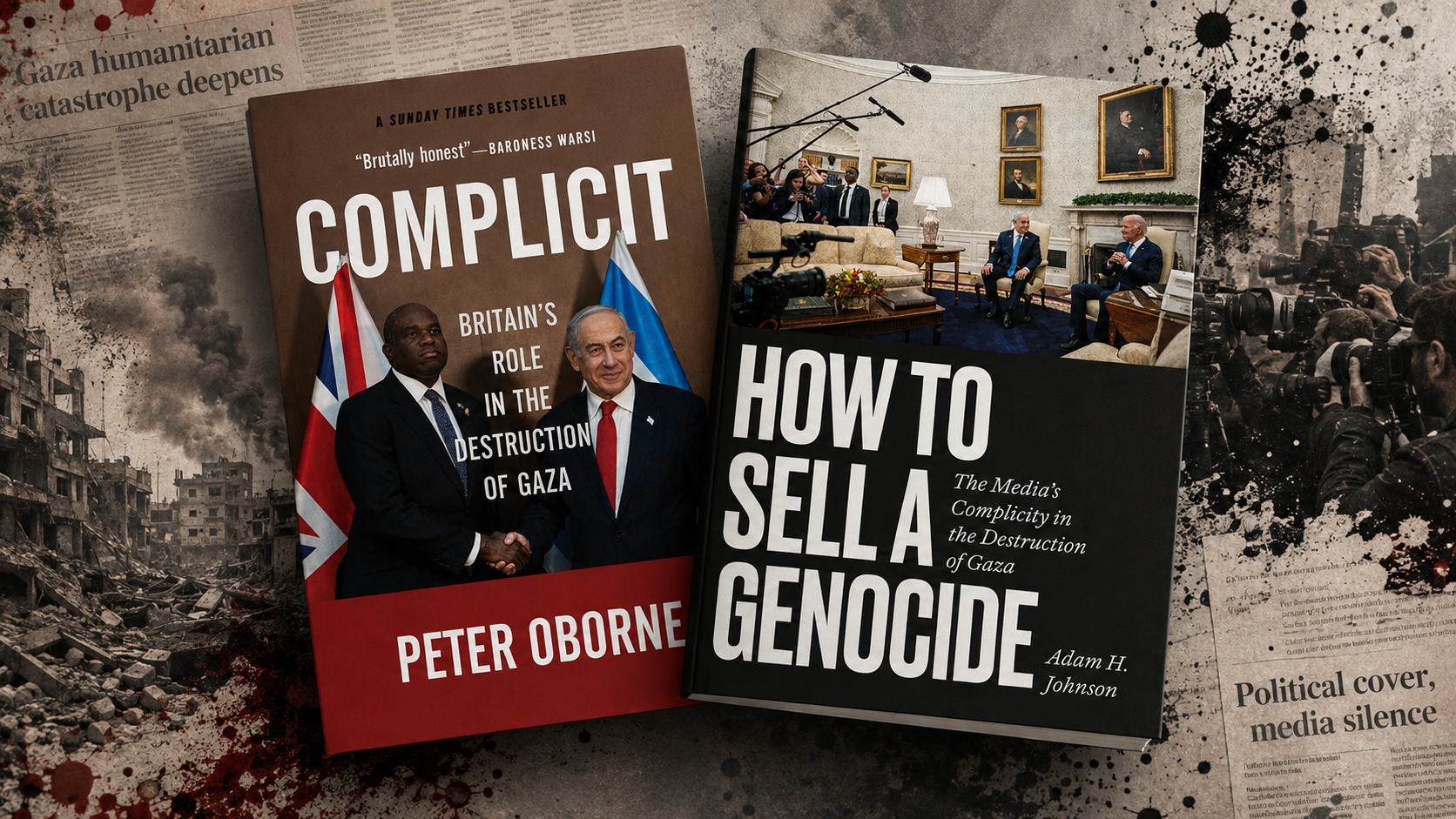
Complicit: Britain’s Role in the Destruction of Gaza by Peter Oborne, OR Books, 360 pages, paperback, £12.00. How to Sell a Genocide: The Media’s Complicity in the Destruction of Gaza by Adam H. Johnson, Pluto Press, 256 pages, paperback, £14.99.
Book covers matter as they are the first visible argument a book makes about itself and sometimes one can judge a book by its cover. Peter Oborne’s Complicit presents its case with unusual bluntness. The cover shows former British Foreign Secretary David Lammy shaking hands with international fugitive Benjamin Netanyahu, a gesture that carries the full weight of public diplomacy and political embarrassment at once. It suggests proximity to power and the uneasy courtesy that can settle over serious wrongdoing when states and institutions choose the language of normal relations.
Adam H. Johnson’s How to Sell a Genocide takes a different route. Its cover shows journalists and camera crews gathered at the White House meeting between Donald Trump and Benjamin Netanyahu, their lenses fixed on power as though the spectacle itself were the story. The image speaks to the machinery of access, framing and repetition that can turn catastrophe into an item of routine coverage.
These covers do more than advertise the books because they prepare the reader for the argument within them. Oborne’s image points toward political complicity in plain sight while Johnson’s points toward the media systems that help turn violence into something that can be absorbed, discussed and too often excused. Taken together, the two covers announce a shared concern with how public life is staged and how responsibility is softened by ceremony, language and repetition.
There are few subjects that require the moral seriousness and exacting scrutiny found in these books. Both are indictments of institutional failure in the face of Gaza’s destruction. Oborne writes as a veteran political journalist with a sharpened sense of British statecraft and its evasions. Johnson writes with the discipline of a media critic who understands how news is assembled and how that assembly shapes public understanding.
Read together, the books form a formidable pair. One examines the conduct of power. The other examines the methods by which power is translated into news.
Oborne’s account is forceful and intimate as he traces the course of British policy and public rhetoric from the opening of Israel’s assault on Gaza through the period in which destruction became normalised in official discourse. His central argument is that British governments and public commentators helped create the climate in which mass extermination could be met with formulaic statements and diplomatic caution. He moves beyond Westminster and Whitehall into the broader network of think tanks, cultural institutions and public broadcasters that help define the bounds of acceptable speech. The effect is to show that complicity is rarely the work of one office or one speech but that it is built through repeated acts of caution, omission and selective concern.
British Prime Minister Keir Starmer’s early response to Gaza is one of the clearest examples of the political climate Oborne is condemning. In October 2023 he said Israel had the right to cut off power and water to Gaza, a position he later tried to clarify, but the damage was done because the comment placed Labour’s leadership close to the logic of collective punishment at the very moment it was being carried out. Sunak’s Conservative government was moving in the same direction, having already deployed UK military assets to the eastern Mediterranean in support of Israel and framed that deployment as part of Israel’s right to self defence. The important point is continuity. Labour did not begin by breaking with Conservative policy, but by shadowing it and only later shifting toward a ceasefire after public pressure mounted. That is the political complicity Oborne captures so sharply, a complicity enacted not only in speeches and interviews but in the wider alignment of both major parties with Israel’s campaign, even as Gaza was entering humanitarian catastrophe.
Oborne’s prose has urgency because he keeps returning to consequences. He grounds policy in devastating reality, directly linking political decisions to civilian casualties, destroyed homes, blocked aid and the steady erosion of legal and moral restraint.
Oborne gives special attention to the language of official reassurance and the way it can coexist with devastation on the ground. His writing is strongest when he shows how public courtesy can shield private indifference. The result is a book that reads as both political critique and moral witness.
Johnson’s book is different in method but aligned in purpose. How to Sell a Genocide is a structural analysis of newsroom practice and media behaviour. The White House image on its cover is apt because Johnson is interested in the rituals of access that shape what audiences see. He shows how journalists clustered around power can become part of the theatre they are meant to scrutinise. His focus is on sourcing habits, editorial conventions and the commercial pressures that reward speed and familiarity over depth and independence. He is especially effective in explaining how official voices come to dominate coverage even when those voices are tied to overwhelming military force.
Johnson’s analysis has a clear and valuable discipline. He looks at headlines, framing choices and the recycling of familiar expert commentary. He shows how these habits can produce coverage that drains violence of context while giving disproportionate space to state justifications. The argument is persuasive because it moves beyond mere accusations to concretely demonstrate how media institutions foster the public detachment that enables atrocities to persist. His account of propaganda is particularly strong in this respect since he treats it as an outcome of systems and incentives rather than a crude exercise in fabrication.
Both books understand that numbers alone cannot carry the full weight of what has happened. They place testimony at the centre of their accounts. Survivors, aid workers and reporters on the ground appear as evidence against abstraction. This matters because official debate so often retreats into language that blurs responsibility. Oborne and Johnson resist that retreat.
They insist that the scale of destruction in Gaza demands direct moral language and institutional accountability. They also refuse the comfort of balance when balance becomes a way of looking away.
The books work well together because they illuminate different parts of the same field of failure. Oborne traces the conduct of the British state and the public culture that supports it while Johnson traces the contours of journalism that help make official power seem credible. Oborne shows the consequences of diplomatic cover and Johnson shows how those consequences are narrated into acceptance. The two books reinforce one another at every turn and give the reader a fuller sense of how political support and media framing can operate in concert.
Offering serious prescriptions for change, Oborne demands rigorous parliamentary scrutiny, transparent record-keeping and an honest reckoning with Britain’s history, while Johnson calls for uncompromising media literacy, independent reporting and rigorous sourcing to dismantle public detachment.
Both authors favour international legal accountability and both treat human testimony as central to any future correction. They know how difficult such change will be. Commercial pressure, political fear and institutional habit all weigh heavily against reform. Still, their books are animated by the conviction that public argument can shift and that language can be made to serve truth more honestly.
If either book has limits, they are small when measured against the scale of the subject. Oborne’s rhetoric can at times lean toward the emphatic, though the force of his argument often justifies it. Johnson’s structural method can sometimes leave less room for the small acts of resistance that occur within media institutions. Even so, these are minor concerns. What matters is that both books achieve what serious political writing should achieve. They clarify where responsibility lies and they make evasion harder.
Read together, Complicit and How to Sell a Genocide demand sustained attention. They show how public life can be arranged so that suffering is narrated as complexity and complicity is dressed up as procedure. Their covers already tell part of this story – one shows a handshake that carries the trace of political shame and the other shows the media crowd gathered around power as if proximity were a form of understanding.
Serving as stark warnings, these vital works strip away the comfortable insulation of official rhetoric and media routine. The discomfort they inflict is precisely their value – a scathing reminder that public institutions are ultimately judged not by the sanitized stories they tell, but by the atrocities they choose to see.
Mahomed Faizal