Nadine Osman
Azerbaijan began enforcing school uniform rules on October 12, turning away Muslim girls wearing hijabs and sparking protests, detentions and a diplomatic dispute with Türkiye.
Approved on September 21, the rules prohibit clothing that breaches uniform requirements or contradicts “the principle of secularism in education”. Although they do not explicitly ban the hijab, some schools have interpreted them as prohibiting headscarves. Similar rules introduced for teachers on October 6 reportedly prompted some to remove their hijab or risk losing their jobs.
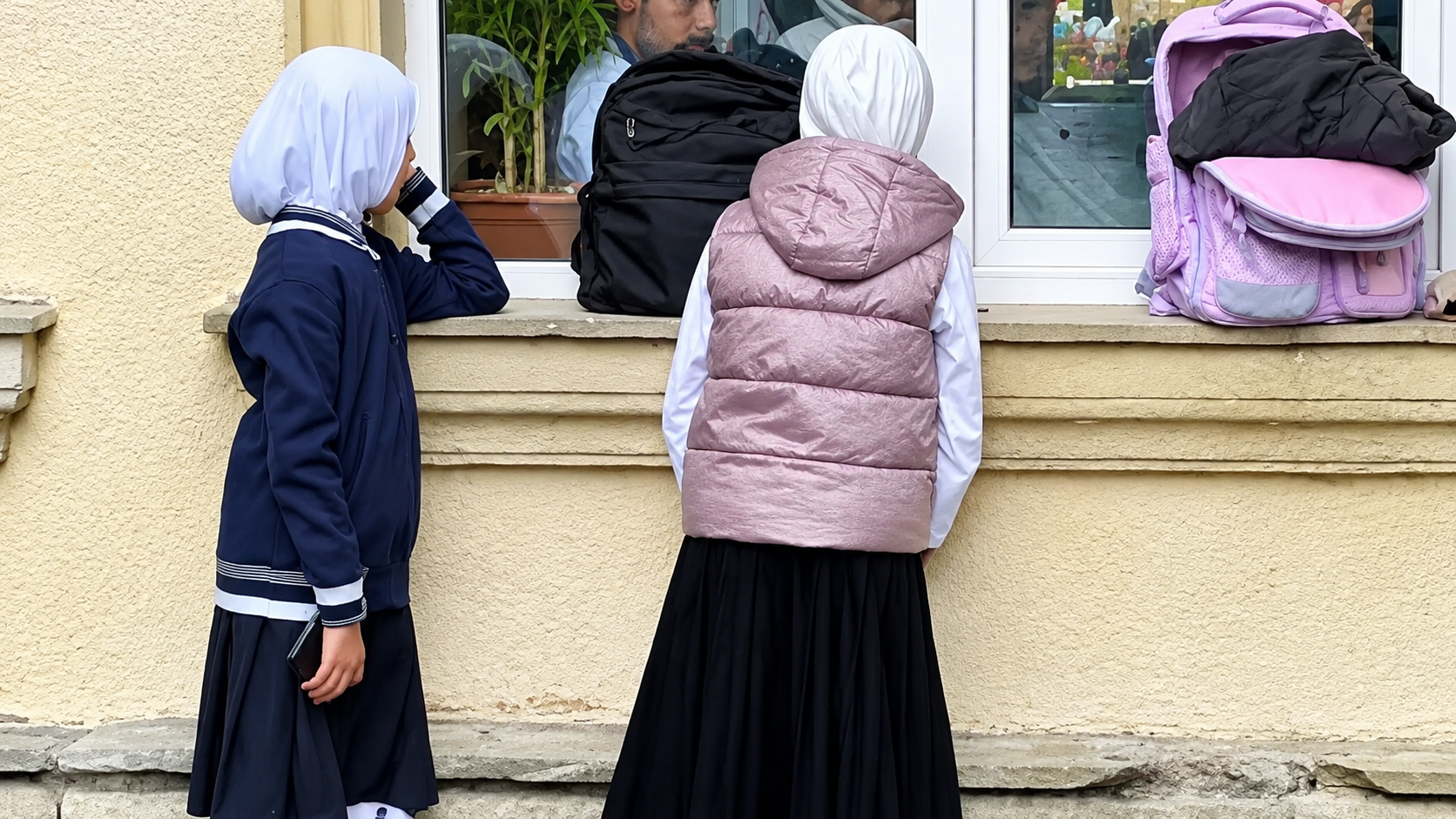
Videos shared on social media show girls being stopped at school entrances. In one recording, a teen asks staff: “You are telling me, I can’t come to school? Why should I have to give up my religion?”
Protests took place outside schools in Baku and the southern districts of Masally and Jalilabad. On October 12, the Interior Ministry said 37 people had been detained for trying to obstruct enforcement and “grossly violate public order”.
Pupils at School No. 69 in Balakhany, outside Baku, held a banner reading: ‘The hijab does not prevent anyone from getting an education.’
Shahiza Huseynova, a mother protesting outside a school in Baku’s Mashtaga district, was detained on October 13. Her husband, Agha Huseynov, told Germany-based broadcaster Meydan TV she had been warned: “Either you take off your child’s hijab and send them to school, or you go to prison.”
Activist Ilkin Huseynov, who launched the online initiative “Let Leyli Go to School” to provide free lessons for excluded pupils, was also feared detained. A friend said Huseynov left home with unidentified men at about 4 pm on October 14. His phone was switched off and the initiative’s Instagram page became inaccessible. Authorities had not commented on his whereabouts.
Users also reported problems accessing Instagram and TikTok, including through virtual private networks (VPNs).
The government says the rules uphold secular education. Critics argue that excluding girls over religious dress violates their rights to education and religious freedom and may conflict with Azerbaijan’s Law on the Rights of the Child, adopted in early 2026.
MP Nigar Arpadarai defended the restrictions in comments to 1news.az, saying children did not choose their religion independently.
“A child has no freedom to choose a religion. This is a conscious prerogative of adults,” she said.
The ban has prompted strong reactions in Türkiye, where headscarf restrictions followed the February 28, 1997, military intervention known as the “postmodern coup”. Headscarves were barred at universities, while women in public-sector jobs risked dismissal if they refused to uncover their hair. Some women went abroad to study after being denied access to education.
University restrictions were eased around 2010, and the ban on most female civil servants wearing headscarves was lifted in 2013.
Turkish journalist Hatice Orhan drew parallels with Azerbaijan in an Instagram video.
“What is happening in Azerbaijan right now reminds us of what Türkiye has experienced in its near past,” she said.
“Women wearing headscarves in Türkiye were subjected to various kinds of cruelty; there were a lot of women who could not go to school, perform their professions, or were forced to postpone their dreams.”
Content creator Gulben Tankus also criticised the ban, asking: “How is it possible in 2026 that in a Muslim country, a student is blocked from performing her religious duties?”
Solidarity protests were held outside Azerbaijan’s embassy in Ankara and consulate in Istanbul earlier in October. The Ankara demonstration was organised by Köklü Değişim, movement linked to Hizb ut-Tahrir, while Özgür-Der, a conservative Muslim group, organised the Istanbul protest.
Turkish officials also criticised the restrictions. Oktay Saral, an adviser to President Recep Tayyip Erdoğan, wrote on X: “Leaving a student who covers her head for reasons of faith at the school gate – how can this fit into any conscience, any sense of justice?”
“We expect Azerbaijan to reverse this mistake as soon as possible,” he added. “A headscarf is not an obstacle; it is a requirement of one’s faith!”
Several MPs from Erdoğan’s governing Justice and Development Party (AK Party) also criticised the rules. Azerbaijan’s ruling New Azerbaijan Party responded in a statement published by state news agency Azertag on October 13, describing the criticism as “systematic and openly slanderous”.
“It is deeply regrettable that Oktay Saral, the Turkish President’s chief adviser, and members of parliament from the ruling Justice and Development Party (AKP) made populist and irresponsible statements without taking into account the substance of the issue,” the party said.
It accused the critics of undermining bilateral ties and defended Azerbaijan’s right to determine its domestic policies. State-aligned outlet Report.az said: “Respect for Azerbaijan’s sovereign decisions is as natural and necessary as respect for Turkey’s sovereign decisions.”
Earlier in October, President Ilham Aliyev warned that no one should “stick their noses into our way of life”.
Türkiye and Azerbaijan describe their close relationship as “one nation, two states”. Turkey backed Azerbaijan in its 2020 war with Armenia over Nagorno-Karabakh, and the two countries maintain close political and military ties.
For the girls turned away from school, the rules leave them facing a choice between wearing the hijab and attending lessons.