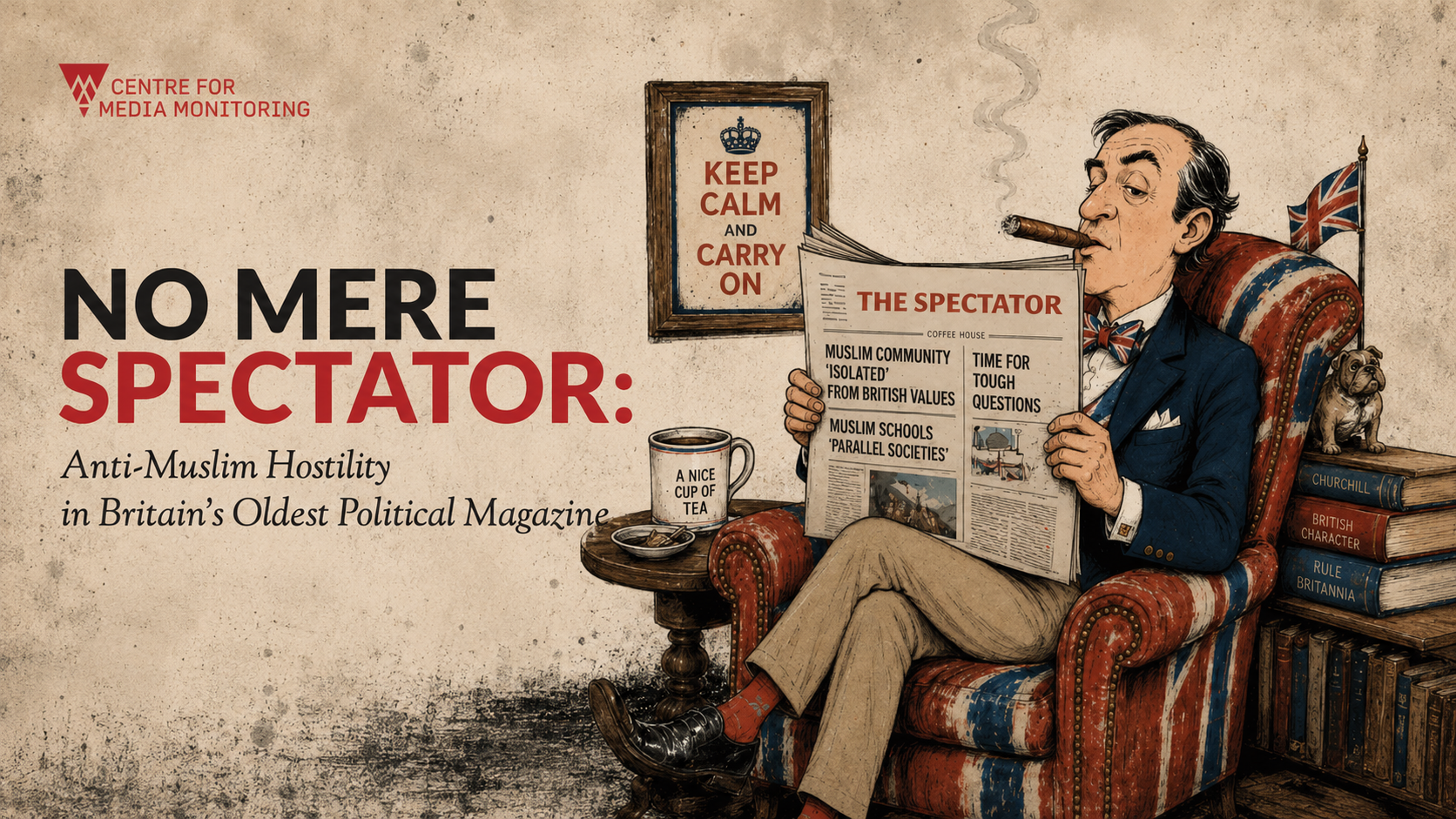
The Centre for Media Monitoring’s latest report, No Mere Spectator: Coverage of Islam and Muslim Communities (2018–2025), analyses 3,733 articles published by The Spectator over an eight-year period.
Joanne Chong
More than half of The Spectator’s articles on Muslims and Islam over an eight-year period contained measurable bias, according to a new report by a British media monitoring group focused on coverage of Muslims and Islam.
The Centre for Media Monitoring (CfMM) examined 3,733 Spectator articles referencing Muslims or Islam, published between January 2018 and December 2025. The report, titled No Mere Spectator:Anti-Muslim Hostility in Britain’s Oldest Political Magazine, found that 57.4 per cent of the analysed articles were rated “biased” or “very biased” towards Muslims or Islam.
But the findings surprised even scholars. “Some of the things I’ve read [sic in the report], I would have seen in neo-Nazi ephemera when doing my PhD,” Dr Aaron Winter, a sociologist specialising in race and anti-racism, said at the report’s launch event on July 14.
Only 11.6 per cent of the analysed articles were found to be “not biased,” while 31 per cent were rated “inconclusive,” meaning the articles contained at least one indicator of bias but did not meet the report’s threshold to be classified as biased.
The highest level of bias was found in coverage of Islamophobia, with 72.8 per cent of articles (869) rated biased. Coverage of conflict and terrorism followed, with around 60 per cent (643 articles) rated biased. Although they comprised far fewer articles, coverage of antisemitism and immigration also showed high levels of bias, with 64.8 per cent (79 of 122) and 63 per cent (75 of 119) respectively rated biased. The report also traces how the magazine’s framing aligns with a documented rise in British attitudes viewing Islam as a threat.
On Islamophobia, the report found more than a third of the magazine’s articles on the subject were framed as a threat to free speech or British values, rather than a form of discrimination. CfMM argues this allowed the magazine to portray any criticism of its own coverage as evidence of censorship, rather than something it should have to answer for. The clearest example of this, according to the report, is The Spectator’s use of “grooming gang” in arguments against any formal definition of Islamophobia. Several articles suggested that such a definition could discourage police from investigating cases involving Muslim suspects for fear of being accused of racism. CfMM disputed this, pointing to research indicating institutional and police neglect rather than concerns about appearing racist.
Percentage of articles rated “Biased” or “Very Biased”
On terrorism, the report says The Spectator questioned the motives behind Muslim migration to Europe, suggesting that while some arrived in search of a better life, others may have arrived with the intention of carrying out “jihad”. CfMM argues that this claim relies on a very narrow definition of the word “jihad.” Among the overwhelming majority of Muslims and within mainstream Islamic scholarship, jihad is understood as a non-violent concept, an individual’s spiritual and moral struggle to become a better Muslim. Under strict rules and specific conditions, the Qur’an permits armed jihad only in self-defence against actual aggressors.
On antisemitism, the report found that The Spectator consistently attributes the problem to Muslim communities, Islamic ideology, and pro-Palestinian activism. However, independent data suggests that the far right movement remains the more significant and growing source of antisemitic incidents in Britain. The Community Security Trust (CST), which monitors antisemitic incidents on behalf of the UK’s Jewish community, recorded 253 incidents with explicit far-right motivation in 2025, a 44 per cent rise from the previous year. The same CST report also recorded 39 incidents linked to radical Islamist ideology, down from 65 in 2024.
On immigration, the report says The Spectator portrays the growth of Muslim populations in Europe not as a normal demographic change, but as an organised campaign to transform or take over European society, and frames Muslim communities in Britain in a similar way. The narrative extends beyond the magazine itself. HOPE not hate, a UK-based advocacy and campaign group, found that the proportion of Britons who see Islam as a threat to the British way of life rose sharply from 30 per cent in January 2024 to 44 per cent by July that year. HOPE not hate links the rise to the Southport murders and the riots that followed.
Across the full corpus of 3,733 articles published between 2018 and 2025, the overwhelming majority were found to exhibit some form of bias in their coverage of Muslims and/or Islam.
Key finding: For every article judged as unbiased, more than five were rated either “Biased” or “Very Biased”.
The statistics behind the “takeover” framing tell a different story. According to the Office for National Statistics, Muslims made up just 6.5 per cent of the population of England and Wales in the 2021 Census.
According to CfMM’s report, a small number of writers for The Spectator, including Rod Liddle, Douglas Murray, Julie Burchill, Gavin Mortimer and Patrick West, account for a disproportionate share of the articles it rates as biased. These contributors repeatedly return to similar arguments about Muslim immigration, identity and extremism across multiple years.
The Spectator was contacted for comment.
Peter Oborne, who served as the magazine’s political editor earlier in his career, argues in the report’s foreword that The Spectator has become “one of the most influential British media apologists for bigotry, hatred and racism.” It is a magazine he claims would once have led Britain’s struggle for tolerance and now instead legitimises hostility towards British Muslims within the mainstream public debate.
The report was released on July 14 at a panel event featuring Winter, Oborne, CfMM Director Rizwana Hamid, former Conservative Party chair Baroness Sayeeda Warsi, former editor of The Sun David Yelland, and former BBC broadcaster Gavin Esler.
A separate CfMM report, titled The State of British Media 2025: Reporting on Muslims and Islam, which analysed more than 40,000 articles from 30 major UK news outlets, found that half of the analysed articles contained measurable bias against Muslims or Islam.
While CfMM argues the findings demonstrate systemic anti-Muslim bias in British media coverage, Policy Exchange, a right-leaning think tank, argues in its 2025 report, titled Bad Faith Actor, that CfMM “effectively blurs the line” between “campaigning to ensure that Muslims are not mistreated in the media, and campaigning for the media to normalise a specific and arguably contentious interpretation of Islam.”
In response, CfMM told The Muslim News it does not regard Policy Exchange as a neutral observer on the subject. The media watchdog rejected the suggestion that its methodology treats negative coverage of Muslims or Islam as evidence of bias. “Articles are assessed against several indicators used to identify anti-Muslim bias in media coverage and are not classified as biased based on a single indicator alone,”it said. CfMM also said its analysis “distinguishes between criticism of Islamism and generalisations about Muslims as a group” and that its findings are “based on recurring patterns across a body of coverage rather than conclusions drawn from individual articles.”
Joanne Chong, independent journalist.