Elham Asaad Buaras
A man has been arrested following a suspected petrol bomb attack on a Dublin mosque that left the building severely damaged, with Muslim leaders alleging the place of worship had endured weeks of intimidation prior to the blaze.
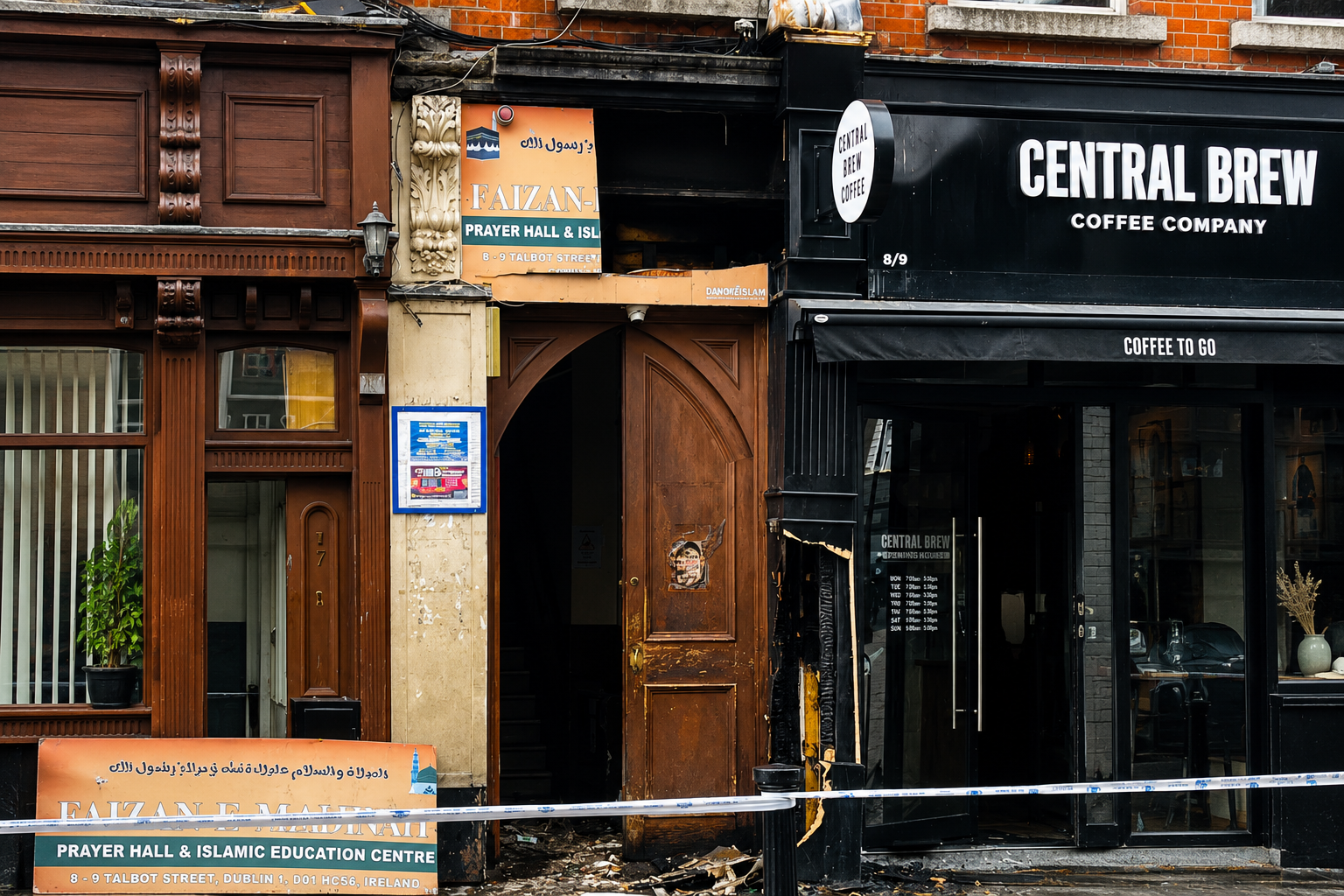
Emergency services were called to the Al-Madinah Prayer Hall, also known as the Faizan E Madinah Prayer Hall and Islamic Education Centre, on Talbot Street in Dublin city centre at around 3.35pm on June 29, after multiple reports of smoke pouring from the building. Three people were safely evacuated, and no injuries were reported.
More than 20 firefighters, supported by four fire engines and a turntable ladder appliance from Dublin Fire Brigade, battled the flames alongside Gardaí (Irish police) and ESB Networks, Ireland’s electricity network operator. Dublin Fire Brigade said it received several emergency calls reporting smoke issuing from the building, and that a full evacuation of the premises had taken place. Witnesses described how Garda officers who arrived before firefighters attempted to contain the flames using extinguishers as thick smoke billowed from the structure. Crews eventually brought the blaze under control, but not before the building had suffered extensive damage.
The incident brought parts of Dublin city centre to a standstill, with Talbot Street closed between Gardiner Street and Marlborough Street while emergency crews worked at the scene. Gardaí sealed off the area, traffic was diverted, and Green Line Luas light rail services were temporarily suspended before later resuming.
The mosque, which serves as both a place of worship and an Islamic education and community centre, has since been cordoned off for a detailed forensic and technical examination as investigators work to establish the cause of the fire. Gardaí have launched an investigation into what they described as an “incident of criminal damage by fire,” collecting CCTV footage from nearby premises and appealing for witnesses to come forward.
An Garda Síochána spokesperson confirmed that officers had arrested a man in his 40s in connection with the investigation. The suspect is currently being questioned at a Garda station in north Dublin under Section 4 of the Criminal Justice Act, which allows police to detain suspects for a limited period, while detectives continue to investigate the circumstances surrounding the fire. Although investigators are pursuing a definite line of inquiry, Gardaí have stressed they are keeping an open mind regarding the motive and have not, at this stage, linked the incident to racism or far-right extremism.
The attack drew a swift response from the Irish Muslim Council, which condemned what it described as a shocking assault on a place of worship and said it followed weeks of sustained harassment directed at the mosque. In a statement signed by its Chair, Dr Umar Al-Qadri, the Council strongly condemned the arson attack, calling it “a deeply disturbing assault on a place of worship and an attack on the fundamental values of peace, religious freedom and community safety that Ireland holds dear.” The organisation expressed solidarity with those affected, adding: “Our thoughts are with the congregation and all those affected by this appalling act. Every person must be able to attend their place of worship without fear, intimidation or violence.”
The Council went on to detail the campaign of intimidation that preceded the attack, noting that on numerous occasions, individuals associated with the far right had entered the mosque, livestreamed worshippers on social media, interrogated members of the congregation, and spread inflammatory false narratives portraying Muslims as a threat to Irish society. “Such campaigns of harassment and dehumanisation are reckless and dangerous,” the statement read. “While the Garda investigation will determine the circumstances surrounding today’s attack, sustained hate-filled rhetoric and organised intimidation create an environment in which extremists may feel emboldened to commit acts of violence.”
The Council also reiterated that it had repeatedly warned about the growing threat posed by anti-Muslim hatred and far-right extremism in Ireland. “Today’s attack demonstrates that when hatred is normalised and incitement is left unchecked, the consequences can be grave,” it said. Calling for those responsible to be brought to justice, the Council urged An Garda Síochána to conduct a thorough investigation and appealed to political leaders, social media companies, and wider society to confront hate speech, organised intimidation, and extremist propaganda before further violence occurs. It also reaffirmed the Muslim community’s place in Irish society, stating: “The Muslim community has long been an integral part of Irish society, contributing positively to every aspect of national life. We will not be intimidated by those who seek to divide our communities through fear and hatred. We remain committed to working with people of all faiths and backgrounds to uphold the values of mutual respect, justice and peaceful coexistence.”
The attack also prompted a response from the Muslim Council of Britain (MCB), which expressed solidarity with the Irish Muslim community while warning of a wider pattern of anti-Muslim attacks across Europe. Dr Wajid Akhter, Secretary General of the MCB, said: “Another day, another arson attack on a mosque whilst worshippers are inside, this time in central Dublin, Republic of Ireland at the Al Madinah Prayer Hall. We are deeply concerned that hate-filled criminals feel emboldened to commit such acts of violence and intimidation across the UK and Europe, the causes of which are well documented.”
Noting that worshippers had been safely evacuated and that nobody was injured, Dr Akhter added: “Whilst the Gardaí investigation is ongoing, we stand in solidarity with our Irish friends, neighbours and all peace-loving people working hard to address false narratives about minority communities.”
Forensic specialists remain at the scene examining the damaged mosque, while detectives continue reviewing CCTV footage and appealing for anyone with information to come forward.