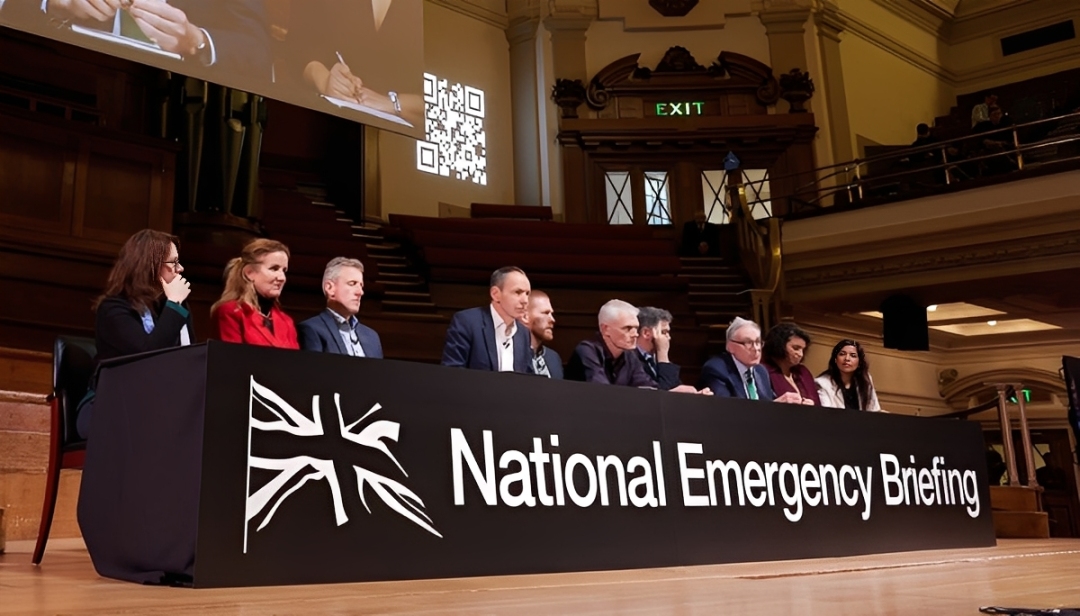
On November 27, ten experts gathered at Westminster for the UK’s first National Emergency Briefing to issue a dire warning and call for immediate and unequivocal action to address the impending collapse brought on by climate change. The speakers, drawn from fields including climate science, national security, health, economics and food security, delivered brief speeches highlighting climate threats and how they would specifically affect the UK population. In attendance at the exclusive event were Members of Parliament, journalists, and celebrities who were implored to take decisive action and sign a letter to PM Keir Starmer and national broadcasters asking them to televise the declaration of a national emergency.
The speakers did not hold back with warnings, illustrating widespread collapse of infrastructure, mass starvation, social unrest, and eventual governmental breakdown. The chair called out biased news outlets peddling climate misinformation spread by the fossil fuel industry and warned of the long-term harm of underestimating climate change and keeping the public from understanding its effects. Experts brought the issues back to everyday concerns like food and energy prices, housing and safety, and overall trust in the government.
Climate, Nature, and Biodiversity
Nathalie Seddon, Professor of Biodiversity, explained how nature is a critical infrastructure and that the UK has only about half of its biodiversity remaining, with one in six species at risk of extinction. Seddon articulated how much human populations rely on natural systems to survive, needing pollinators for crops and peatlands which absorb floodwaters. Soil degradation costs the UK £1 billion per year and is a major risk for further inflation and food insecurity. By implementing nature-based solutions, which have demonstrated success, the UK can reverse course and make itself more resilient to climate shocks.
The briefing acknowledged that the COP system, where international leaders come together to reach a consensus on responding to climate change, is not working. Professor Kevin Anderson spoke about the climate and warned that warming of 4ºC by the end of the century is possible and would mean “systemic collapse” .
Economy
Economies thrive under stable systems, garnering investment with reliable returns. Climate shocks fuel global instability, but markets continue to be managed under the assumption of stable conditions and functioning ecosystems. Angela Francis, Director of Policy Solutions at the World Wildlife Fund – UK, spoke about how it is the government’s job to change the rules of the economy as shifts occur. If governments do not prioritise investing in the infrastructure to make renewable energy the norm and continue allowing fossil fuel companies to operate with the same market and government incentives as renewables, the clean energy future will never be realised. Net-zero solutions have been shown to pay back dividends, but businesses are reluctant to invest the initial capital in bringing about such solutions. Francis believes it is the job of governments to change market rules as the conditions under which those markets operate change.
Economies will pay for climate change in one way or another. Natural disasters regularly cause damage in the billions of pounds. Many areas of the UK have houses which are now considered “uninsurable”, leaving residents to rebuild on their own should a flood or storm decimate their homes. Rebuilding takes investment, and rebuilding with climate resilience in mind will help populations adapt to the coming changes.
National Security
Lt General Richard Nugee spoke about how climate change is a threat multiplier and that governments will be unable to effectively respond to cascading disasters. Such an inability to support the population through trying times will result in government mistrust. As has been seen in many countries, when people lose faith in the government, non-state actors fill the void and have the potential to radicalize vulnerable people.
The military used to consider itself exempt from addressing climate change. However, Nugee states that NATO’s Article 3 “stresses the need for each country’s ability to withstand and recover from all types of shock, whether they’re military, natural disasters, or other crises.” The military is increasingly being called upon to respond to domestic natural disasters, potentially affecting their ability to respond to international threats.
The Ask
The briefing’s three aims are a televised national emergency briefing, a national emergency response, and to have the UK lead stronger global action. The group calls on the public to sign a letter to PM Keir Starmer and national broadcasters asking them, “to hold an urgent televised national emergency briefing for the public, and to run a comprehensive public engagement campaign so that everyone understands the profound risks this crisis poses to themselves and their families.”
The UK has experienced damaging, if localised, natural disasters in recent years. As the UN’s consensus-seeking climate model ends up with nations signing weak agreements, individual governments will work on a smaller scale to mitigate disasters at home. Declaring a national climate emergency would be a significant step towards acknowledging and addressing the seriousness of the issue. The group are currently producing a documentary to further promote their goal of getting the UK to take strong action to avoid a multi-pronged disaster.
Feature photo: Ten of the UK’s leading experts across climate, nature, weather, health, security and law deliver the National Emergency Briefing. (Credit: NEB/PanelQuestions60)
Sarah Sakeena Marshall, Data Assistant