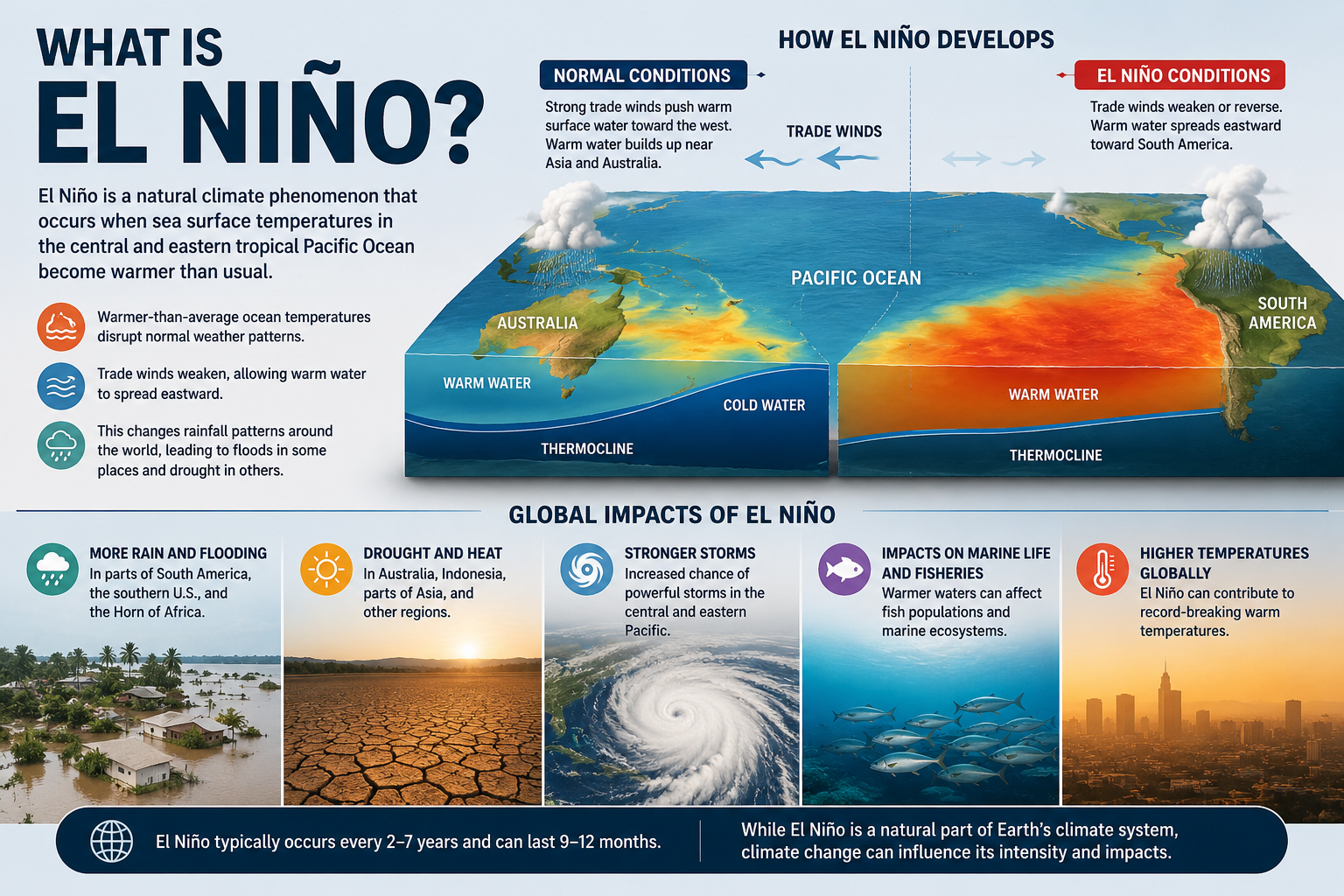
This year and next, the climate phenomenon known as El Niño will affect weather patterns around the world, bringing about drought, record-breaking summer temperatures, stronger Pacific storms, and significant flooding. El Niño events occur every 2-7 years and last approximately 9-12 months. They are associated with higher sea surface temperatures in the tropical Pacific Ocean, weaker trade winds, and altered marine life migrations. The last major El Niño event occurred in 2015-2016, and contributed to drought in Ethiopia, water shortages in Puerto Rico, and significant flooding in the UK. Scientists believe that this El Niño will be even stronger, calling it a Super El Niño, because while the phenomenon can be confirmed by a 0.5°C increase in Pacific Ocean temperatures, they predict an increase of up to 3°C. While an El Niño’s weather effects usually peak in November, they have already been observed in August and many nations have begun to act by setting up response plans, storing food, and distributing water.
Local and global implications
The UK’s Met Office warns of a windier, wetter weather in autumn and early winter in the UK. While this year has been the hottest on record, next year will likely surpass it. Professor Adam Scaife, Head of Long-Range Forecasting at the Met Office stated, “This latest El Niño is likely to be a significant event – perhaps one of the most intense on record.”
According to the International Federation of Red Cross and Red Crescent Societies (IFRC), “Forecasts indicate that the Atlantic will see below-average cyclonic activity, with fewer than the historical average of 14 named storms and seven hurricanes. Meanwhile, forecasts for the Pacific predict between 15 and 22 named storms, of which between nine and 14 are expected to become hurricanes, and between five and nine of those are expected to become major hurricanes.”
The UN World Food Programme warned of 49 million people more could be pushed into acute hunger by the end of 2027 as a result of the Super El Niño. It has activated anticipatory action plans in several African and Central American countries, providing a combined $14 million in support and helping around half a million people prepare for extreme-weather shocks.
How nations are preparing
The effects of this Super El Niño are already being felt, but are expected to become severe early next year, decimating harvests and severely flooding some areas. The IFRC suggests that governments adopt clear response protocols and immediately release emergency funding when scientifically evidenced thresholds are met. India has been preparing for anticipated food shortages by storing as much rice and wheat as possible. In Sri Lanka, the government has arranged for water delivery by truck for 72,000 people across multiple districts every 2-3 days as they battle severe drought. There, officials anticipate that end-of-year monsoon rains will offset some of the damage but expect a return to drought-like conditions early next year. Drier conditions in Panama are forcing a drawdown to the number of ships able to navigate through the Panama Canal, a major global shipping lane, to preserve freshwater for the locks system. The World Meteorological Organization is ramping up efforts to brief countries on preparedness and risk management, by “developing a series of webinars and technical exchanges to strengthen regional coordination, communication and preparedness in response to the emerging El Niño event.”
How individuals can prepare
Flooding, drought, shipping disruptions, power outages, and price spikes all become major concerns during periods of extreme weather. Individuals can prepare by signing up to receive government alerts related to extreme weather events, heeding evacuation warnings, and making a plan with their families. Furthermore, it is suggested that important documents be stored in waterproof and/or fireproof containers and be easily accessible in case of a sudden evacuation. To prepare against extreme heat, people should stay hydrated, learn to identify the signs of heat exhaustion and heat stroke, and keep instant cold packs and electrolyte pouches on hand. In the run-up to a potential power outage, residents may invest in backup batteries or a generator, maintain stores of non-perishable foods, and talk with trusted neighbors about pooling resources. Most municipalities have emergency response teams and information available to the public where residents can learn about what protocols are in place for extreme weather events locally.
The climate effects scientists have warned governments to take action against for years are being felt the world over. Uncontrollable wildfires, heat records being broken year after year, and severe precipitation leading to flooding and landslides will continue affecting communities. While El Niño is a natural planetary phenomenon, human-induced climate change has likely exacerbated its effects, and it is up to individuals and governments alike to prepare for and mitigate the worst of those effects.
Sarah Sakeena Marshall, Consultant, Writer, Editor, Climate Change & National Security