US President Donald Trump has cast himself as the architect of Gaza’s ceasefire. His supporters present it as evidence of decisive leadership: Israel’s bombs briefly silenced, negotiations nudged into motion, and a pathway to “rebuilding” finally opened. But this narrative collapses under even minimal scrutiny.
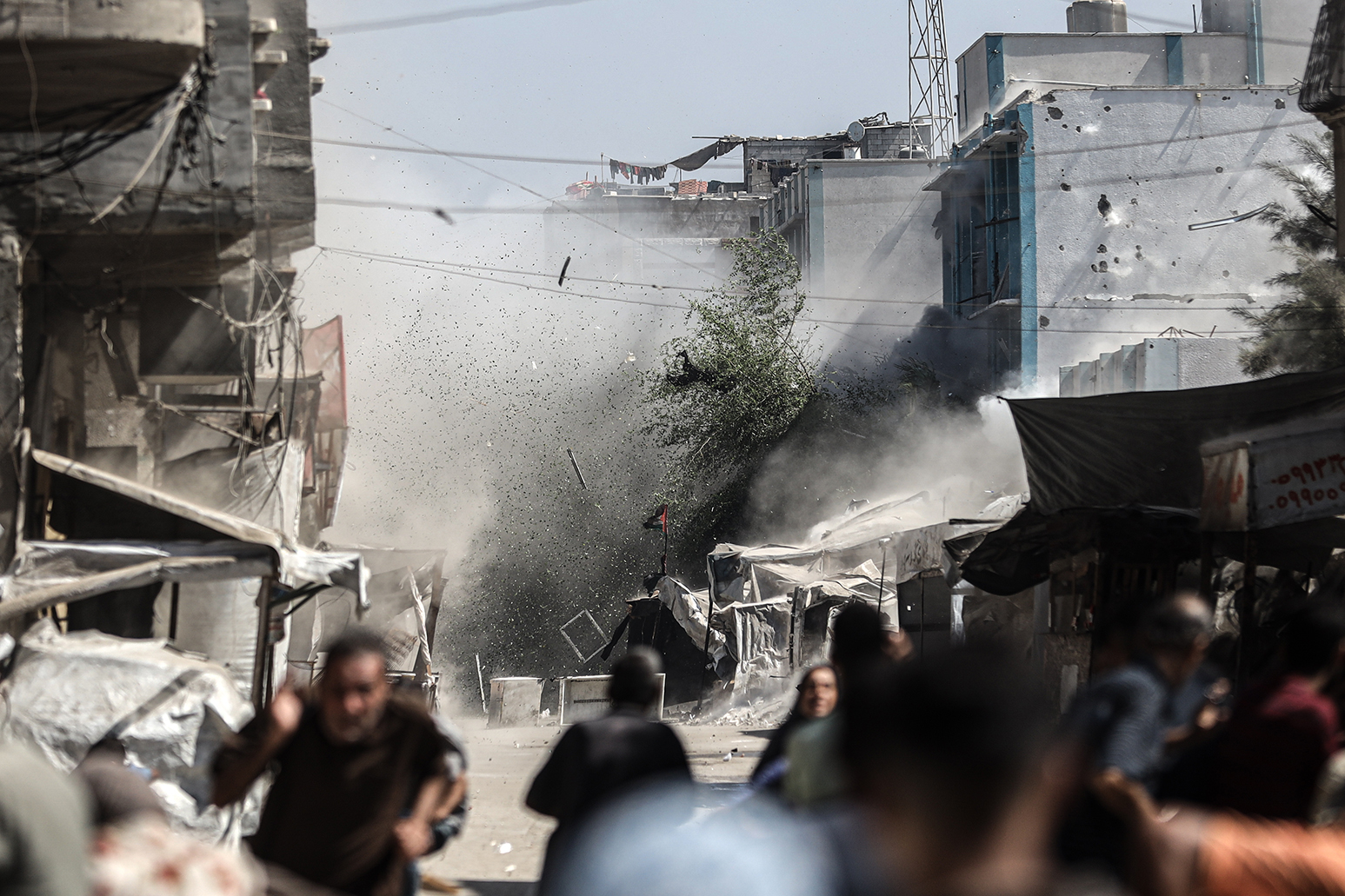
The ceasefire Trump now claims credit for arrived only after catastrophe on a historic scale. More than 700,000 Palestinians have been killed, the vast majority of them women and children. Over 171,000 have been injured.
Around 84 per cent of the Gaza Strip has been destroyed—rising to more than 90 per cent in areas such as Gaza City. More than 330,000 housing units have been damaged or obliterated, with over 90 per cent of all homes affected. Entire neighbourhoods have been wiped from the map.
Hospitals were not spared.
Al-Shifa, Nasser, Al-Quds, and dozens of other health facilities were bombed, raided, or rendered inoperable through attacks and the systematic denial of fuel and medical supplies. More than 500 schools were damaged or destroyed, many while sheltering displaced families. Hundreds of mosques were reduced to rubble. Gaza’s social, cultural, and physical infrastructure has been deliberately dismantled.
And even now, despite the ceasefire, Palestinians continue to be killed almost daily. Israel routinely violates the agreement, restricts humanitarian aid, and maintains a siege that ensures suffering does not end—it is merely managed.
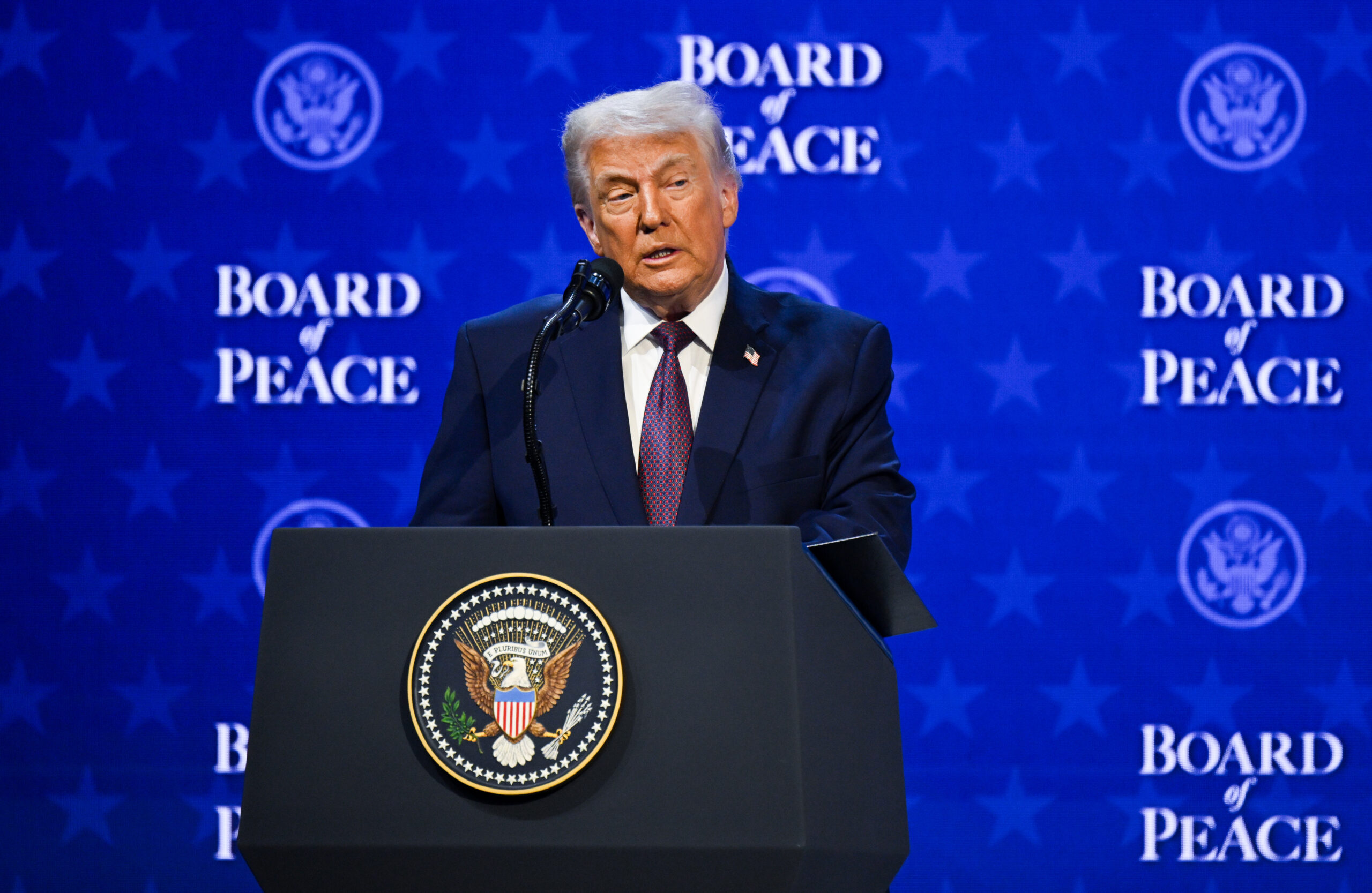
It is against this backdrop that Trump unveiled his so-called Board of Peace (BoP) at the World Economic Forum in Davos, presenting it as a bold alternative to the UN and a new model for peacebuilding. In reality, the BoP represents something far more dangerous: power without accountability, and peace without Palestinians.
From ceasefire mechanism to parallel global order
The Board of Peace was initially marketed as a narrowly defined mechanism linked to a UN Security Council resolution overseeing Gaza’s post-war recovery. Several states backed the resolution believing it would bind the United States to a ceasefire and reconstruction framework.
Yet the BoP’s official charter makes no direct reference to Gaza at all. Instead of a temporary body focused on one devastated territory, the board claims a permanent, global mandate to promote “peace” and “good governance,” explicitly positioning itself as an alternative to existing international institutions.
Its language mirrors Trump’s long-standing hostility to multilateralism: the UN is dismissed as slow and ineffective; the BoP is cast as “nimble,” “pragmatic,” and results-driven.
What was framed as a response to Gaza has thus morphed into a Trump-controlled parallel order—untethered from international law, unconstrained by accountability, and designed to operate according to Washington’s political preferences.
No Palestinians at the table
The most striking feature of the Board of Peace is not what it proclaims, but who it excludes.There are no Palestinians on the board or its executive arm. None. This is despite Gaza serving as the original justification for its creation. By contrast, an Israeli businessman, Yakir Gabay, has been granted a seat—an inclusion that speaks volumes about whose interests are prioritised.
Palestinians are instead confined to a subordinate body, the National Committee for the Administration of Gaza (NCAG), responsible for day-to-day administration under strict external oversight.
The NCAG holds no authority over borders, finance, reconstruction, or political direction. It exists to manage, not to decide.This is not inclusion; it is containment.
The structure ensures Palestinians remain objects of governance rather than political actors—administrators of decisions made elsewhere about their land, their economy, and their future.
Erasure as reconstruction
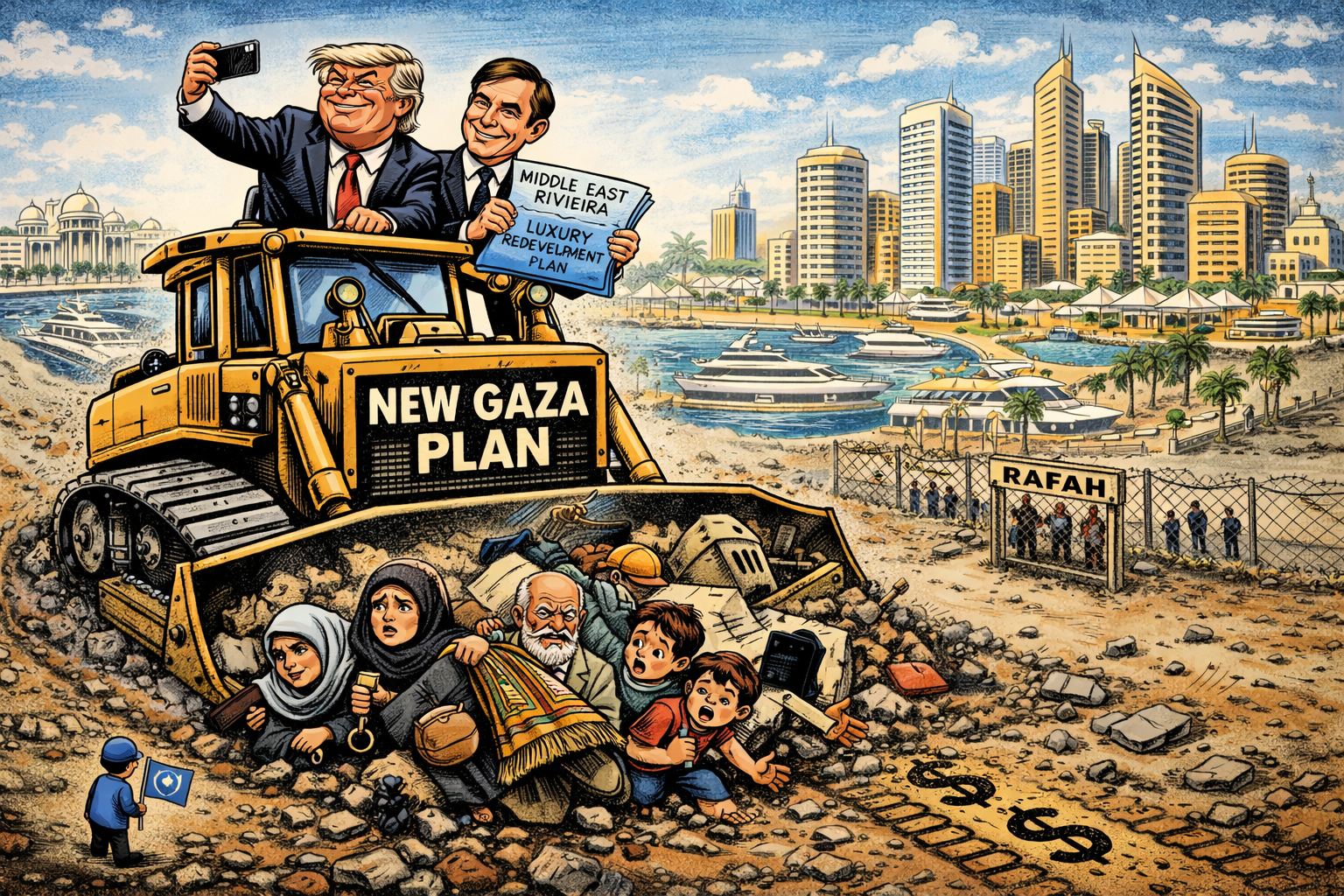
The logic of exclusion was laid bare when Jared Kushner unveiled a $30 billion “development plan” for what he termed “New Gaza.”
The proposal envisions the wholesale bulldozing of the Strip and its transformation into a luxury economic zone—a “Middle East Riviera”—under Board of Peace supervision.
Palestinians were not consulted. The presentation materials, riddled with basic Arabic spelling errors, betrayed a profound absence of local knowledge or engagement. In this vision, Gaza is not a living society to be rebuilt with its people, but a blank slate onto which an external economic fantasy can be imposed.
That erasure is compounded by the fact that Gaza itself is largely the product of earlier dispossession: a small coastal district turned into one of the world’s most densely populated refugee concentrations after 1948. To propose its redevelopment without acknowledging this history is to repeat it.
Reports suggest Palestinians would be confined to a fenced-off area near Rafah—effectively refugees on their own land for a second time—while the rest of Gaza is redeveloped for investment, tourism, and elite consumption. This is not reconstruction. It is dispossession repackaged as prosperity.
A divided world, a clear warning
Some states, particularly in the Middle East, have joined the Board of Peace hoping to secure humanitarian access or restrain further violence. Others have refused outright.
Spain, France, Norway, Sweden, Denmark, and Slovenia have declined participation, citing the exclusion of Palestinians and the board’s position outside the UN framework. Spain’s prime minister was unequivocal: Gaza’s future must be decided by Palestinians.
Human rights organisations have been equally forthright. Amnesty International has described the BoP as a “brazen disregard for international law and human rights.”
Critics warn that it entrenches power hierarchies, privileges wealth and political alignment—reportedly requiring enormous financial contributions for permanent membership—and sidelines established multilateral norms.
Peace without Palestinians is not peace
For Palestinians, the message is devastatingly familiar.
A body created in their name, justified by their suffering, and empowered to reshape their land excludes them from real authority. Gaza becomes a testing ground for a broader geopolitical experiment, while Palestinians are expected to accept decisions imposed upon them as the price of “peace.”
The Board of Peace is not a failure of inclusion. It is an architecture of exclusion by design.
And it makes one reality unmistakably clear: once again, Palestinians are being asked to disappear politically so that others can decide what peace should look like.
Editorial image: Created using AI (ChatGPT).
TOP STORY: Trump’s “Board of Peace”: From Gaza reconstruction to a global agenda without Palestinians