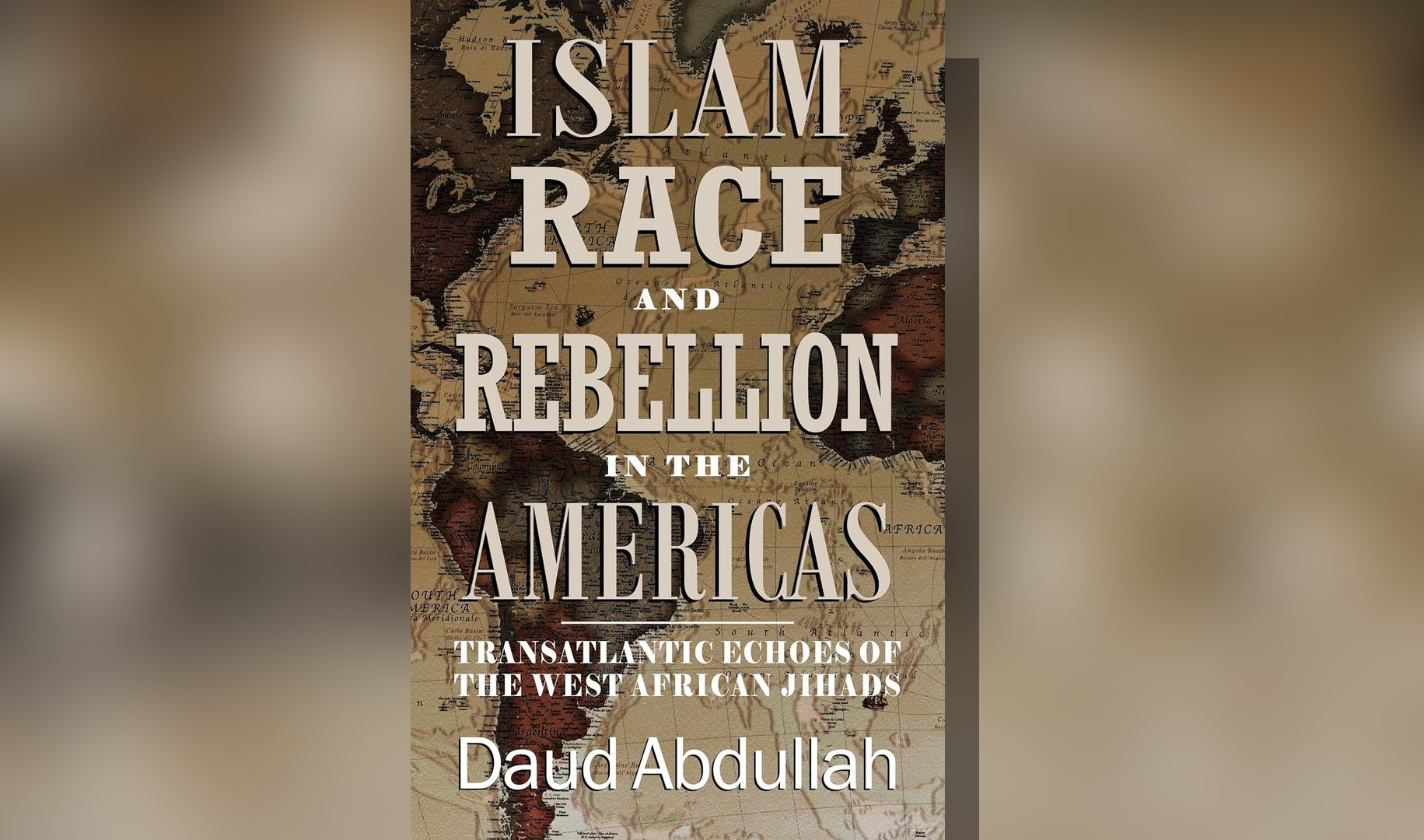
Islam, Race and Rebellion in the Americas: The Transatlantic Echoes of West African Jihads by Daud Abdullah. Pb. 195 pages. Hansib Publications. 2025. £10.99
Daud Abdullah’s Islam, Race and Rebellion in the Americas is a book that moves like a tide across centuries, carrying with it the memories, faith and defiant hope of West African Muslims who were uprooted, chained, scattered and yet remained unbroken. The book is an excavation of a buried intellectual and spiritual world – a world that crossed the Atlantic in the minds of enslaved Wolof, Fulani, Mandinka and Hausa Muslims and erupted in acts of resistance that reshaped the moral landscape of the Americas. Abdullah writes against the grain of traditional slave historiography, insisting that economic structures and racial hierarchies alone cannot explain the audacity of uprisings like the 1521 Hispaniola revolt or the 1835 Malê Revolt of Bahia. Instead, he re-centres Islam, as faith, law, literacy, discipline and shared identity and as an animating political force, a compass that oriented entire communities toward justice even in the heart of a world designed to crush them.
The book begins by tracing the long shadow of Islamophobia, presenting it as a medieval inheritance rather than a contemporary pathology. Abdullah draws a clear and chilling line from the Crusades to the conquest of the Americas, showing how anti-Muslim prejudice travelled alongside European imperial expansion. To colonisers shaped by centuries of Christian-Muslim conflict, the presence of African Muslims in the Americas was perceived as a threat.
Their discipline, literacy in Arabic and deeply internalised ethical frameworks made them a distinct category of enslaved people, viewed with suspicion and punished with exceptional harshness. For European enslavers who had inherited Crusader anxieties, the mere existence of a Muslim consciousness was itself a form of rebellion. Abdullah calls this the “neo-Crusader logic” of Atlantic slavery, a system that not only sought to extract labour but also to supplant religious belief.
Within this crucible, Islam became a revolutionary language. Abdullah vividly reconstructs the intellectual life of enslaved Muslims, men and women who carried Qur’anic verses in their memories, who taught one another to write on scraps of cloth or smoothed earth, who prayed in forests under the watch of the moon, who forged community through ritual purification and recitation. Arabic literacy served less as a technical skill and more as a covert infrastructure of communication.
The book describes coded messages concealed in Qur’anic citations, networks that crossed plantations and disciplined brotherhoods that transcended ethnic divisions. In Abdullah’s telling, the 1835 Malê Revolt emerges as the culmination of an Islamic tradition of collective moral action, rooted in West African jihad movements that had reshaped Senegambia, Futa Jallon, Sokoto and beyond.
By foregrounding this intellectual lineage, Abdullah challenges dominant scholarly narratives that marginalise the religious agency of enslaved Africans. He does not dismiss these frameworks but argues they are incomplete. Faith, he insists, mattered and Islam offered a coherent worldview that named oppression as injustice, enjoined solidarity, sanctified resistance and placed the struggle for liberation within a cosmic moral order. It is here that the book is at its most compelling by showing that the political imagination of enslaved Muslims was carried to the Americas, intact and formidable.
Abdullah also situates these rebellions within the broader arc of Islamic resistance to Empire. From West Africa to Southeast Asia, from Sokoto to Aceh, he traces how movements grounded in Islamic ethics challenged European domination through guerrilla warfare, mass mobilisation and moral persuasion. The Atlantic slave revolts, he argues, were part of the same civilisational confrontation. It was a battle between colonising powers convinced of their divine mandate and Muslim communities determined to preserve their dignity. This framing repositions enslaved African Muslims as actors whose ideological commitments shaped the twilight of the European empires.
The book’s resonance extends far beyond the nineteenth century. Abdullah shows how memories of Muslim resistance inform modern political thought across the Muslim world, revitalising notions of justice, collective obligation and ethical struggle. These historical legacies feed into contemporary debates which centre around revolutionary activism versus reformist gradualism, resistance versus accommodation, the limits of violence and the moral grammar of liberation. The idea of the ummah, the duty to defend the oppressed and the right to challenge tyranny, concepts born from Qur’anic ethics and lived in plantation rebellions, continue to animate Muslim movements today. Abdullah’s work thus serves as a bridge between past and present, illuminating why many contemporary struggles against racism, Islamophobia and imperial power still echo the vocabulary of earlier centuries.
Crucially, the book confronts the epistemic violence of modern historiography. Abdullah argues that many revisionist histories of slavery, in their zeal to emphasise race or economics, have inadvertently erased the spiritual reality of the enslaved. Faith, argues Abdullah, becomes decorative and incidental. The book restores that missing dimension, showing how Islam was far more than just a religion but a political, intellectual and psychological fortress. And in so doing, Abdullah challenges us to rethink the very foundations of Atlantic history. The rebellions in Bahia, Jamaica, South Carolina and elsewhere, Abdullah asserts, while viewed in contemporary history as simply acts of racial defiance, are essentially expressions of a transatlantic Islamic consciousness that European empires tried and ultimately failed to extinguish.
The implications for the current global landscape are stark. The Islamophobia that criminalised enslaved Wolof and Fulani Muslims is the ancestor of the suspicion that shadows Muslims today. Abdullah draws these lines with care but urgency – from colonial depictions of Muslims as inherently rebellious to contemporary portrayals of Muslim communities as perpetual threats, the continuities are unmistakable. To read this book, therefore, is to gain a deeper understanding of slavery and a clearer view of the racial-religious architectures that still shape global power.
In the end, Islam, Race and Rebellion in the Americas is an act of intellectual restoration. It returns to African Muslims their voices, their ideas, their courage and their disciplined faith. It situates their rebellions within a global tradition of resistance and makes visible the ideological power that sustained them. Abdullah’s prose is measured but forceful; his archival reach is wide; his interpretive lens is uncompromising. This is a necessary book that expands the boundaries of diaspora studies, reorients Atlantic historiography and insists that the spiritual struggles of the enslaved be recognised as political philosophy in motion.
In this profoundly human book, the enslaved cease to be shadows, but become thinkers, believers, rebels, men and women who prayed before they rose, who wrote before they fought, who remembered who they were even when the world tried to strip that memory away. Abdullah gives them back their story and in doing so, he gives us a deeper, truer understanding of the Americas they helped shape.
Mahomed Faizal, Cape Town, South Africa