Elham Asaad Buaras
Top British universities are under fire after it emerged they spent nearly half a million pounds on a shadowy private intelligence outfit accused of “spying” on their own students and academics.
A damning joint investigation by Al Jazeera English and Liberty Investigates has revealed that at least 12 institutions hired a firm run by former military intelligence officers to track campus activism – particularly pro-Palestine protests.
The universities named include University of Oxford, a group of London’s leading institutions, and several major civic universities across England and Wales.
They include King’s College London, London School of Economics, Imperial College London and University College London, as well as the University of Bristol, University of Manchester, Manchester Metropolitan University, University of Nottingham, University of Sheffield, University of Leicester, and Cardiff Metropolitan University.
The company at the centre of the storm, Horus Security Consultancy, pocketed a total of £443,943 between January 2022 and March 2025 to trawl social media, flag protest activity and produce intelligence briefings for universities.
Using AI-powered tools to “harvest” vast amounts of online data, the firm compiled thousands of student posts into daily updates – with some universities paying up to £900 a month for reports on protest encampments and activism.
Among those caught up in the monitoring was Rabab Ibrahim Abdulhadi, who was subjected to a secret counter-terror risk assessment before being allowed to speak at a university event.
She said, “You’re supposed to be innocent until proven guilty … but they actually made an assumption of guilt and started investigating me because of my scholarship”.
She added, “What am I supposed to study and teach about to avoid this unwarranted, unfair and unjust scrutiny and surveillance?”
At the London School of Economics, a student protester involved in pro-Gaza demonstrations had her social media posts lifted directly into paid intelligence briefings sent to university security teams.
Reacting to the revelations, the student said, “We knew surveillance was happening by the university, but it is shocking to see how systematised it is”.
She added it was “deeply scary” to see how much money universities were “willing to invest” in such monitoring.
The findings emerged after FOI requests were submitted to more than 150 universities by Al Jazeera English and Liberty Investigates – with several institutions refusing to release the briefings, citing “commercial sensitivity”.
Critics say the secrecy only deepens concerns that universities are quietly policing political activism behind closed doors.
Jo Grady, General Secretary of the University and College Union, blasted the practice as “shameful”, saying universities had “wasted hundreds of thousands of pounds spying on their own students”.
The firm itself was founded by former lieutenant-colonel Jonathan Whiteley and later brought in ex-SAS officer Tim Collins, who has controversially claimed pro-Gaza protests are driven by foreign influence.
“What we’re seeing really is a Russian/Iranian orchestrated media campaign which is being willingly swallowed by the West,” he said.
He has also suggested that pro-Palestine protesters who “misbehave” should “face the full consequences of the law … and those people who are not from this country should be deported until they can never come back”.
Legal experts have sounded the alarm over the use of such surveillance tactics. Gina Romero warned, “The use of AI to harvest and analyse student data under the guise of open source intelligence raises profound legal concerns.”
She added the monitoring risks creating a “state of terror”, saying, “Most students I have reached out to are experiencing psychological trauma, mental exhaustion, and burnout […] many of them are leaving activism altogether”.
Universities insist the monitoring is about maintaining safety and point to obligations under the Counter-Terrorism and Security Act 2015 and the controversial Prevent programme.
Responding to enquiries from The Muslim News, a spokesperson for the University of Oxford said: “Allegations of surveillance are inaccurate. External security consultants are used solely to carry out safety risk assessments for public events and known protests—not to monitor individuals or political activity.”
A spokesperson for the University of Nottingham told The Muslim News: “We have used Horus for horizon scanning specifically in the areas of domestic activism and animal rights. It is not focused on any specific group or political issue, and the university does not monitor or share any information related to individuals with this company.
“The university strongly refutes the accusation that the use of this service for monitoring purposes constitutes ‘spying’ or covert surveillance of our staff and students. The information which is lawfully gathered is freely shared in the public domain across a range of platforms including mainstream media reports, social media channels, online forums etc.
“The university supports freedom of speech and lawful protest but this activity helps us to identify potential safety concerns and to keep our campuses safe for our staff and student communities.”
Meanwhile, a spokesperson for the University of Manchester told The Muslim News: “We have engaged Horus twice to provide additional due diligence on visiting speakers in order to fulfil the university’s legal obligations under the Prevent duty. Additional checks were commissioned due to specific risk factors that required further independent information.
“In both cases the events were allowed to proceed and the speakers were permitted to attend.
“We have not commissioned such a report on a student or colleague.”
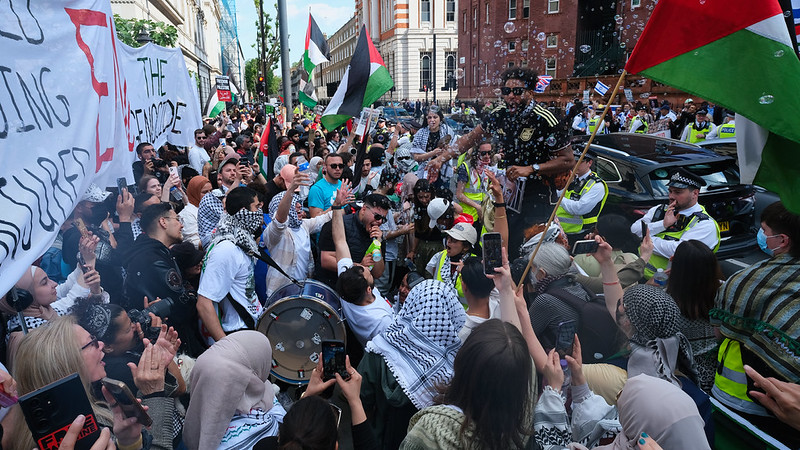
But the row comes amid a global surge in pro-Gaza campus protests since late 2023, as students demand universities cut ties with companies linked to Israel’s war in Gaza.
Now, critics warn the line between campus security and political surveillance is being dangerously blurred – with Britain’s top universities accused of turning their gaze inward on the very students they are meant to protect.