Kamran Shezad & Bishop Graham Usher
We write as friends who first met while sharing how our respective faith communities are responding to the climate and nature crises the world faces. This year, Ramadan and Lent begin at much the same time which is very unusual, and a lovely thing to celebrate.
For Christians seeing their Muslim neighbours observing a holy Ramadan, and for Muslims seeing their Christian neighbours observing a holy Lent, there is the opportunity to reflect on what these days teach us about restraint, justice and care for creation.
Ramadan arrives each year as a month of renewal: of faith, discipline, gratitude and compassion. It is a sacred time that draws Muslims closer to God through fasting, prayer, generosity and deep reflection. Yet, in the midst of global environmental crises (climate change, mass waste, species loss, water scarcity and air pollution), Ramadan also provides a powerful spiritual framework for confronting the challenges facing our planet.
Christians observe the 40 days of Lent as a period of fasting, penitence, self-reflection and restraint in preparation for Holy Week and Easter. Like Ramadan, there is an intentional breaking of the attachment to worldly desires, as Christians seek to grow in faith and in devotion to God in Jesus.
From an Islamic perspective, Ramadan is about simplicity, humility and restraint. When Muslims fast, they temporarily withdraw from consumption and become acutely aware of their dependence on God for even the most basic needs. Hunger softens the heart, focuses the mind and nurtures empathy towards the poor and vulnerable.
These are not merely private spiritual benefits; they also have social and ecological implications. A heart that feels the pain of hunger is less likely to waste food. A person who experiences vulnerability is more likely to support justice. Communities that honour limits are better prepared to live sustainably on Earth.
But the reality today is that modern consumer culture has crept into how Muslims observe the blessed month. Instead of simplicity at iftār, communities can witness excess: tables overflowing with more food than can be eaten, disposable plastics piling up at communal iftars and shopping frenzies in the run-up to Ramadan and Eid al-Fiṭr. Markets advertise luxury Ramadan collections and social media pushes curated images of lavish decorations and extravagant meals.
Many Muslims offer an honest reflection that some of this behaviour contradicts the very spirit of fasting. Likewise, the commercialisation of Christmas and Easter, with their expectations and excesses of presents and chocolate— can shift attention away from the core themes of these Christian festivals.
The Prophetic way reminds Muslims that Ramadan is not about consumption but about restraint. The Prophet (peace and blessings be upon him) ate little, shared much and warned against wastefulness.
The Qur’an teaches: “Eat and drink, but do not be wasteful. Indeed, He does not love the wasteful.” (7:31) This one verse alone challenges the excess that has become normalised in many communities today. If it is taken seriously, Ramadan becomes an environmental lesson: eat mindfully, take only what is needed, share with others and respect creation.
Likewise, for many Christians there is a focus during Lent on simpler food, perhaps becoming vegetarian, or giving up certain luxuries – chocolate being the favourite.
Linking Ramadan to the environment is not a modern invention or a political trend; it is deeply rooted in Islamic ethics. God describes humans as Khalīfah al-Arḍ (steward on Earth). Stewardship means caring for water, land, animals and future generations. It means recognising that the Earth is an amānāh, a trust, and Ramadan trains Muslims in this stewardship by teaching self-control. If humans cannot control the desire for food and drink from dawn to sunset, how will we control the overconsumption of goods, fuel and resources throughout the year?
Our global situation highlights why this matters. Scientists speak of World Overshoot Day, the date each year when humanity uses up the amount of resources that the Earth can regenerate in 12 months. After Overshoot Day, we are essentially living on ecological ‘credit,’ depleting forests, fisheries, soils and clean water faster than the planet can replenish them.
Five decades ago, Overshoot Day fell in late December, last year it arrived on July 24. This shift reminds us that our lifestyles, especially in wealthy countries, are beyond the limits of what the Earth can sustain. Islam teaches that transgressing limits has consequences, spiritually and materially. Christianity challenges greed and storing up things for our own use, with a concern to share the bounty of the earth more equitably.
In recent years, many churches have encouraged a more environmentally conscious Lent, for example, by urging congregants to reduce meat consumption, cut single-use plastics, walk instead of drive, or reduce energy use. These initiatives are not about political ideology; they are about faith expressing itself through the care for creation.
When Muslims, Christians and people of other traditions recognise these shared values, we have an opportunity to make a collective difference. Faith communities represent billions of people worldwide, united by moral teachings that discourage waste, encourage generosity and promote gratitude. Rather than viewing climate change as solely a scientific or governmental problem, we should see it as a moral and spiritual challenge.
Together we recognise the need to ask: how do we live gently on the Earth so as not to violate the rights of future generations, or the poorest people globally who are least able to adapt and be resilient to environmental disaster, or the myriad of other species who share this single planetary home? Each is our neighbour.
This reflection arises from our shared commitment to our respective faiths and what they teach each of us about the care of the environment. We encourage you to reach out to your neighbours of a different tradition and continue the conversation.
If you are wondering how to observe a more environmentally conscious Ramadan, whether in the kitchen, at the mosque or at home, resources now exist to support you on that journey. A good starting point is www.ecoramadan.earth, which offers practical guidance grounded in Islamic values.
For Christian resources on observing Lent sustainably, see Go Green(er) for Lent – Eco Church (2002).
Kamran Shezad – Director, Islamic Foundation for Ecology and Environmental Sciences & Co-author, Al Mizan: A Covenant for the Earth
The Rt Revd Graham Usher – Bishop of Norwich; Church of England lead bishop for the environment
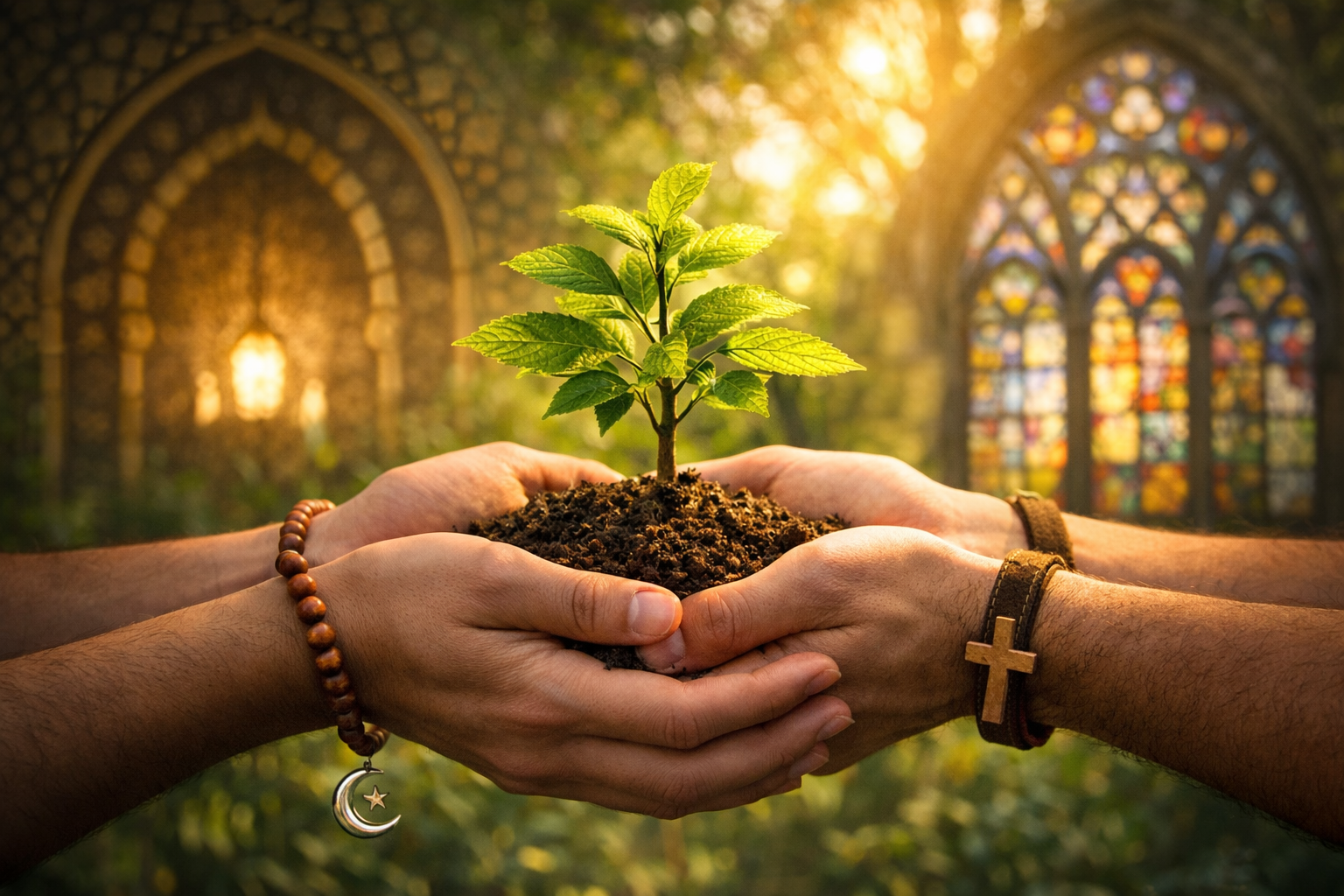
Image: Faith communities united in care for creation — reflecting the shared call to stewardship during Ramadan, Lent, and beyond. (Credit: OpenAI/The Muslim News)MORE RAMADAN NEWS
Exclusive —Ramadan message from political leaders
Faith, fasting and finding balance: Young Muslims on Ramadan 2026
MCB launches Ramadan campaign to boost Muslim voter turnout ahead of local elections
Davison High School to host third annual Big Iftar
Ramadan 2026 Advertorial: Make eye drops a part of your routine: wake, drops, eat, pray, done!