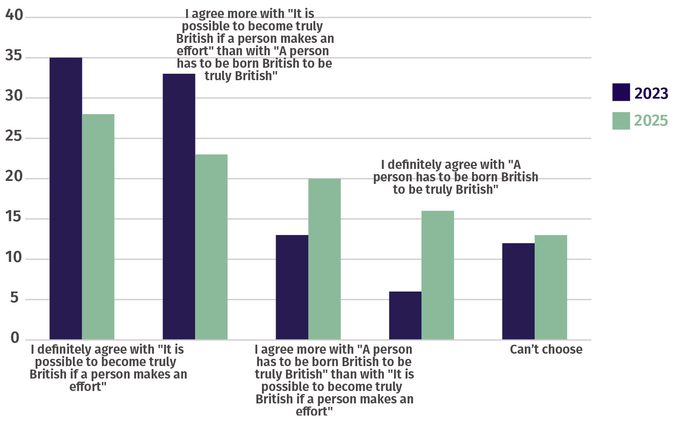
The proportion of people who believe British identity is something a person is born with rather than something they can become has almost doubled since 2023, according to new research that warns of a growing shift towards ethno-nationalist views.
Polling conducted by YouGov for the Institute for Public Policy Research (IPPR) found that 36% of respondents now believe a person must be born British to be “truly British”, up from 19% two years ago. Despite the rise, a slim majority of voters (51%) still believe Britishness is based on shared values and behaviour rather than ancestry.
The findings suggest that civic ideas of British identity remain dominant overall, but that exclusionary narratives rooted in ethnicity, birthplace and heritage are gaining ground.
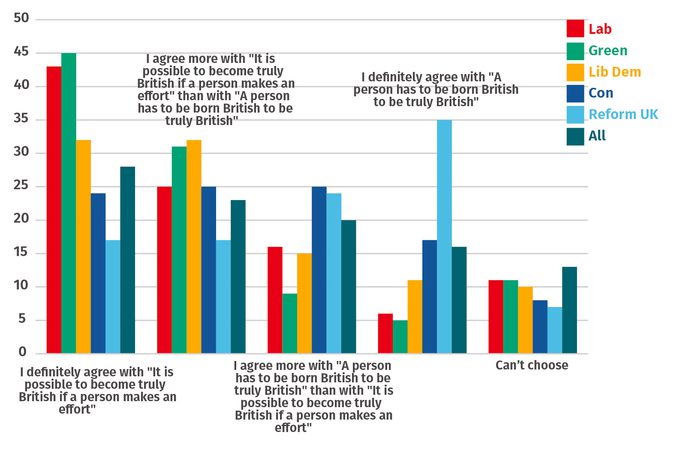
Support for such views was strongest among those intending to vote for Reform UK. Nearly six in 10 Reform supporters said British identity was ethnic rather than civic, while 71% said having British ancestry was important to being truly British. More than a third said they would be prouder of Britain in 10 years’ time if there were fewer people from ethnic minority backgrounds, and one in 10 said having white skin was important to being a good British citizen.
By contrast, respondents across most other major parties, including Labour and the Conservatives, were more likely to define Britain as a civic community bound by shared values rather than shared ancestry.
When asked what makes a good British citizen, respondents overwhelmingly prioritised behaviours and social contribution. Obeying the law was cited by 64%, raising children to be kind by 62%, and working hard by 48%. Only 8% said a good citizen involved prioritising British-born people over others, while just 3% said white skin was important.
Similarly, when asked what would make them proud of the UK in a decade’s time, respondents focused on living standards and public services rather than demographic change. A well-functioning NHS was the most popular answer, chosen by 69%, followed by affordability (53%) and access to affordable housing (36%). Significantly fewer said reductions in immigration or ethnic diversity would make them proud.
IPPR said the findings pointed to the growing influence of hard-right narratives on national identity, citing proposals for mass deportations, the rise in far-right protests and an increase in hate crime as evidence that ethno-nationalism is moving closer to the political mainstream.
Parth Patel, an associate director at IPPR, said the shift posed a fundamental challenge to progressive politics. “Politicians and activists on the right are trying to change how we think about ourselves and one another,” he said. “They want belonging to this nation to be defined by ancestry and historical claims, and they are beginning to change the hearts and minds of some people in Britain.”
He added that progressives were now facing opponents who rejected “far more basic tenets of human equality” than economic fairness alone, and warned against treating the trend as inevitable.
The thinktank urged the government to respond by articulating a clearer, more confident account of national identity. It called on ministers to build on the prime minister’s recent party conference speech and develop a broader programme of national renewal spanning economic, social and democratic reform.
Nick Garland, an associate fellow at IPPR and former political speechwriter to the chancellor, Rachel Reeves, said the polling showed that public opinion still favoured an inclusive vision of Britishness. “A vast majority of the public still believes in a nation built on shared values and common interests, not birthplace or background,” he said. “The task now is to give voice to that belief and offer a forward-looking story of who we are, rather than allowing division to define the debate.”
The YouGov survey was conducted among 2,370 adults in Great Britain between December 9 and 10, 2025 and replicated a question used in the British Social Attitudes survey to distinguish between civic and ethnic conceptions of national identity.
Feature photo credit: Daria Agafonova/Pexels