Elham Asaad Buaras
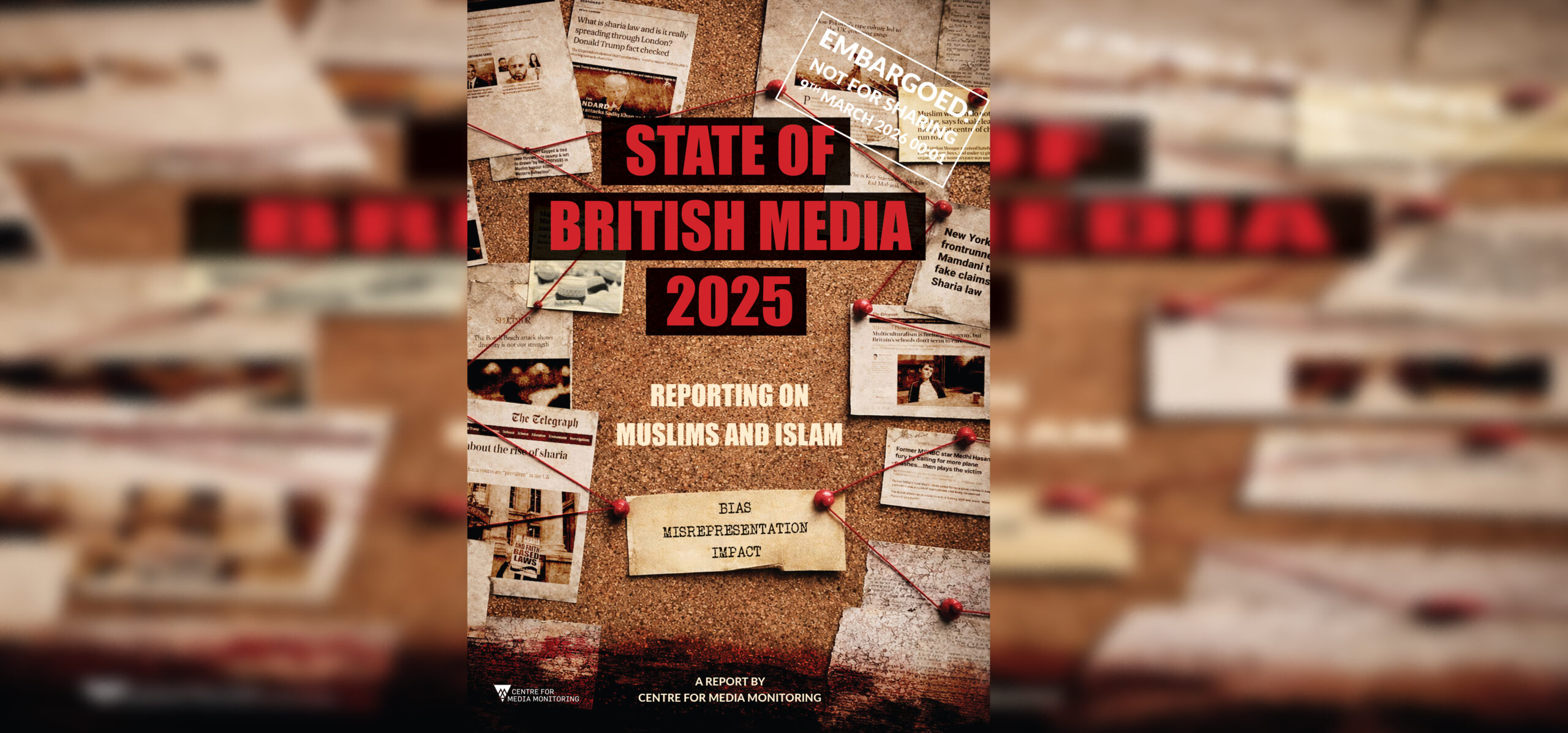
Nearly half of UK news articles referencing Muslims or Islam contained measurable bias, according to the largest and most detailed study of its kind. Conducted by the Centre for Media Monitoring (CfMM), the analysis examined 40,913 articles across 30 major newspapers, digital news sites, and broadcasters in 2025.
The report, titled State of British Media 2025: Reporting on Muslims and Islam, found that 70 % of these pieces linked Muslims or Islam to negative themes such as crime, extremism, cultural conflict, or “threat,” while 44.44 % omitted crucial context. Generalisation appeared in 17 % of articles, disproportionately in right-wing outlets, and over 5,000 pieces—or 13.13 % of the dataset—misrepresented Muslim beliefs, surveys, or practices. Problematic headlines, though relatively rare, were concentrated in specific publications, with GB News recording a 39 % generalisation rate.
“As the largest study of its kind ever conducted in the UK, this report presents deeply concerning evidence of structural bias in how Muslims are portrayed in the UK press,” says Rizwana Hamid, Director of CfMM.
“When nearly half of all articles referencing Muslims or Islam are biased, and almost 70% associate Muslims with negative aspects or behaviours, it points to a systemic problem within our media ecosystem. When entire communities are repeatedly framed through lenses of suspicion or threat, it inevitably shapes public attitudes, political debate and the everyday lives of British Muslims.”
Seasoned journalist and author, Peter Oborne said, “Not all the findings in this report are unexpected. Who would have guessed that the Spectator is the most Islamophobic media outlet in Britain! But this authoritative and fair-minded study is a sobering and scrupulous reminder of the prejudice British Muslims must endure. And it’s getting worse. Much worse.”
The report evaluated articles for bias using five key criteria: negative association, misrepresentation, broad generalisations, omission of context, and misleading headlines. Articles with two or more indicators were classified as biased, while those with four or five were deemed very biased, representing the most extreme distortions. By contrast, public service broadcasters and international wire services showed far lower levels of bias. The BBC recorded a “very biased” rate of just 0.86 % and the lowest overall negative association among major domestic outlets, while Reuters, Associated Press, and Agence France-Presse reported significantly lower rates of misrepresentation and generalisation, demonstrating that responsible, contextually accurate reporting is achievable when editorial standards prioritise accuracy.
While bias appeared across the media spectrum, a small group of outlets accounted for a disproportionate share of the most problematic reporting. Researchers identified The Telegraph, Daily Mail, GB News, The Spectator, The Daily Express, The Sun, The Times, and The Jewish Chronicle as the primary drivers of extreme bias.
Overall, “very biased” content made up around 5 % of total coverage, yet The Telegraph, Daily Mail, and GB News alone produced nearly 46.8 % of all “very biased” articles, despite contributing only 22.5 % of total coverage. The report notes that this clustering “demonstrates that severely problematic content is not equally distributed across the media landscape but reflects identifiable editorial cultures.”
The Spectator had the highest proportion of extreme bias relative to output, with 26.3 % of its articles meeting the most severe criteria. Researchers described this as “a complete breakdown of editorial standards,” observing that negative, generalised portrayals of Muslims and Islam were near universal rather than exceptional.
In terms of volume, The Telegraph produced the most “very biased” pieces, with 391 articles — nearly one fifth of all such content. The Daily Mail followed with 340 articles, and GB News contributed 225.
The CfMM report highlights multiple case studies showing how editorial choices—through selection, framing, omission, or emphasis—can transform factual reporting into misleading or hostile narratives.
Several outlets, including The Telegraph and GB News, claimed a survey of young French Muslims showed a majority believed “Islamic law should take precedence over French law.” In reality, the survey focused on family law matters, such as marriage and divorce, where respondents prioritised personal religious practice. Stripping these qualifiers turned a narrow finding into a broad claim about legal allegiance, stoking fears of Muslim separatism.
In December 2025, following the terror attack in Sydney, 136 biased UK articles were published within four days. The Telegraph led with 29, GB News with 13, and The Sun with 11. One GB News report claimed an imam delivered a “rallying cry to burn their houses,” while in context, he condemned extremism and the remark referred to societal responses to perpetrators. Removing context misrepresented Muslim religious leadership and amplified fear.
The Telegraph suggested that halal slaughterhouses, especially non-stunned facilities, had poor hygiene and animal welfare standards. The coverage omitted that 88 % of halal chicken in England and Wales is pre-stunned and that Food Standards Agency inspections cover multiple compliance factors. The narrow focus risked implying that halal practices are inherently unhygienic or cruel.
Reporting on a primary school where Muslim pupils performed ablution was framed as a clash between religion and secular schooling. Coverage in The Telegraph, Daily Mail, and GB News shifted attention from pupils’ religious rights and dignity to the discomfort of staff, downplaying efforts to accommodate diverse practices.
The Daily Express suggested London demonstrations supporting Palestine were “directly linked” to the Bondi attack, describing protests as a “sinister cloak for antisemitism” and calling for the closure of mosques and Islamic schools. This invoked conspiracy-style rhetoric, associating legitimate political activism with terrorism and inflaming polarisation.
The Sun labelled a murder as a “Muslim honour killing,” explicitly tying the crime to Islamic identity, while other tabloids avoided linking it to religion. CfMM noted Islam forbids killing innocents, and The Sun later amended its headline following complaints.
The Daily Mail published pieces attributing grooming gang issues to “foreign imams” and Pakistani heritage men. The Spectator linked UK grooming failures and terrorism to Pakistan’s “rape culture” or claimed, “diversity is not our strength,” exemplifying cultural determinism and selective evidence use.
Even unrelated government policies were reframed through an anti-Muslim lens. Teacher training to address misogyny was portrayed by some outlets as privileging Muslim communities. The Telegraph labelled the burka and niqab “tools of patriarchal oppression,” while GB News claimed some Islamic cultures do not teach gender equality. Such selective coverage, known as femo-nationalism, weaponises feminist concerns against minoritised groups while downplaying systemic misogyny in majority contexts.
Together, these case studies illustrate how editorial decisions—from framing and sourcing to headline selection—can distort facts, amplify stereotypes, and shape public perception of Muslims in the UK. Researchers noted this pattern (sometimes called “femo-nationalism”) in which feminist concerns are selectively weaponised against minoritised groups while downplaying misogyny in majority contexts, leading to skewed public understanding of both misogyny and Muslim communities.
The CfMM report stresses that bias is not inevitable. Coverage of Muslims in areas such as sports, entertainment, arts, everyday life, health, and economics exhibited far lower levels of bias, demonstrating that fair reporting is possible when editorial decisions prioritise accuracy and context over sensationalism.
Public service broadcasters and international wire services consistently outperformed major tabloids and right-wing outlets, suggesting that editorial independence and global standards help mitigate bias. Metro UK, for example, fact-checked misinformation about Sharia law in London, while the Evening Standard provided detailed contextual accounts of Sharia councils, explaining their role within UK law rather than portraying them as shadow courts.
The Guardian illustrated responsible journalism through an opinion piece by senior East London Mosque leader Sufa Alam, centring Muslim women’s voices in debates about community events and avoiding portrayals of them as passive subjects.
Other publications, including The New Statesman, Prospect Magazine, The Economist, The New European, and Christian Today UK, recorded zero problematic headlines in 2025, and several maintained generalisation rates below 10 %, showing that they are accurate.
The report warns that biased coverage extends beyond media criticism to affect democratic discourse and policy. By systematically associating Muslims with threat, conflict and cultural otherness while omitting context and nuance, news coverage can bolster support for discriminatory attitudes, legitimise harmful stereotypes, and influence workplace interactions, voting behaviour and public policy.
For Britain’s Muslim population, estimated at over four million people, media coverage serves as a primary source of information for the non-Muslim majority, shaping perceptions of identity, loyalty, risk and belonging. Researchers cite evidence linking negative media portrayals with higher rates of hate crime, discrimination in employment and social segregation, emphasising that irresponsible reporting contributes to real world harm.
The CfMM report concludes that British media coverage of Muslims and Islam during 2025 fell short of journalistic standards of accuracy, balance, and context, but its authors emphasise that meaningful change is achievable. They recommend including Muslim voices in all stories involving Muslims, particularly in political, crime, and opinion reporting, and caution against sweeping generalisations that attribute behaviours or beliefs to entire communities without evidence. Coverage should also extend beyond conflict, crime, and politics to reflect everyday life, culture, the arts, and economic participation. Strengthened editorial oversight, including headline review protocols, is recommended to prevent sensationalist framing. Meanwhile, newsrooms are encouraged to increase diversity and offer cultural competency training. The report further calls for topic-specific standards for sensitive subjects such as terrorism, immigration, and religion, alongside regulatory mechanisms to address persistent bias beyond individual complaints.
Highlighting the central role of editorial decision-making, the report asserts that choices around framing, sourcing, and headline selection ultimately determine whether coverage informs or inflames, and that journalistic integrity depends on a consistent commitment to accuracy, nuance, and a diversity of perspectives.
Photo: State of British Media 2025: Reporting on Muslims and Islam (Credit: CfMM)