Abu Yusra Choudhury
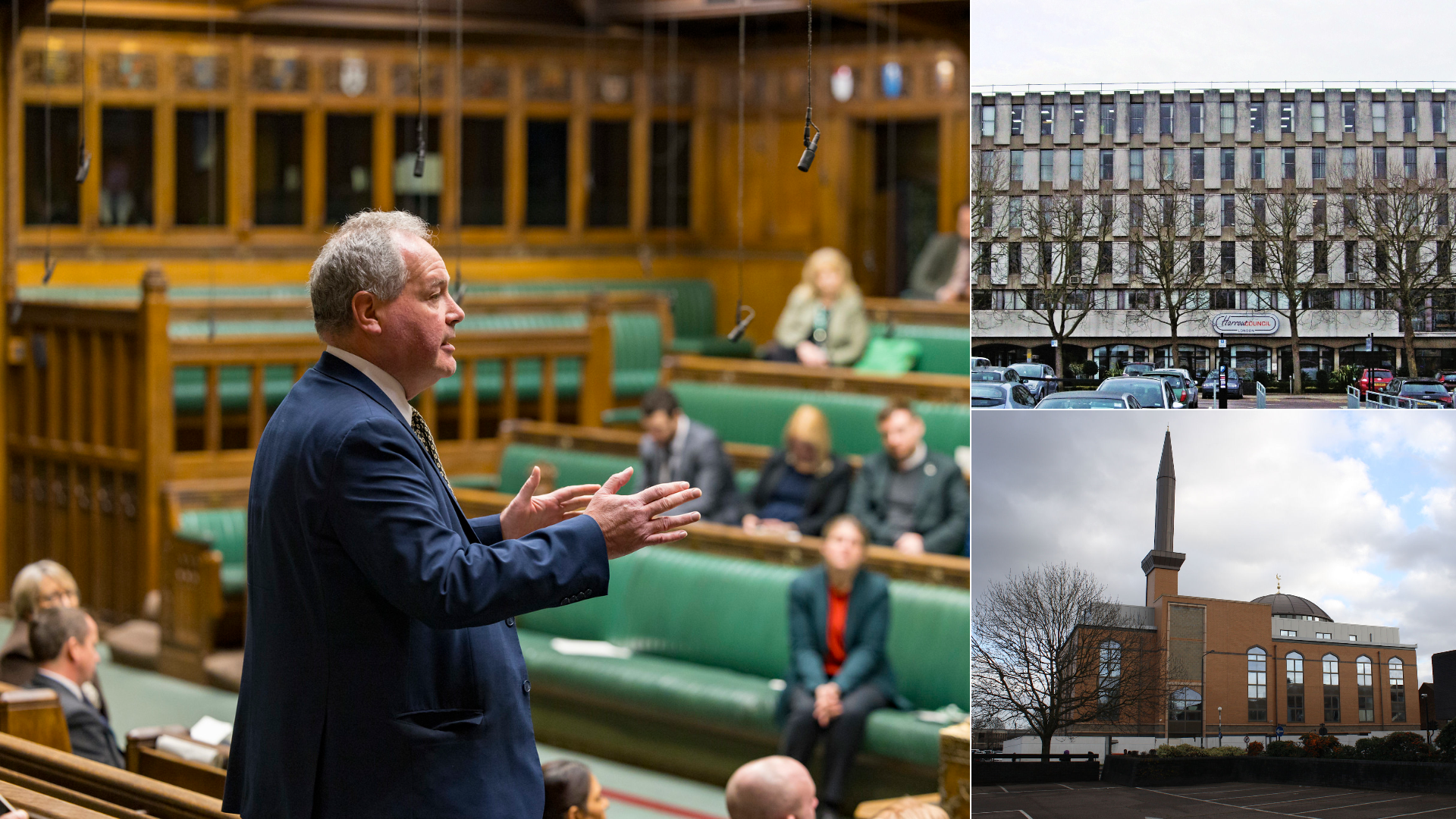
When Conservative MP Bob Blackman rose in the Commons on March 5 to describe the disruption of a Holi celebration in Harrow, his words were unambiguous. “Thugs from the Central Mosque,” he told the chamber, had attacked peaceful Hindu worshippers.
Within hours, those words were reverberating far beyond the Westminster bubble: echoing on GB News, splashed across the pages of Indian newspapers, and lighting up the WhatsApp groups that link diaspora communities from London to New Delhi.
There was, however, a problem. The Metropolitan Police’s own account of what happened in that Harrow car park on the evening of March 3 differed markedly from Blackman’s description.
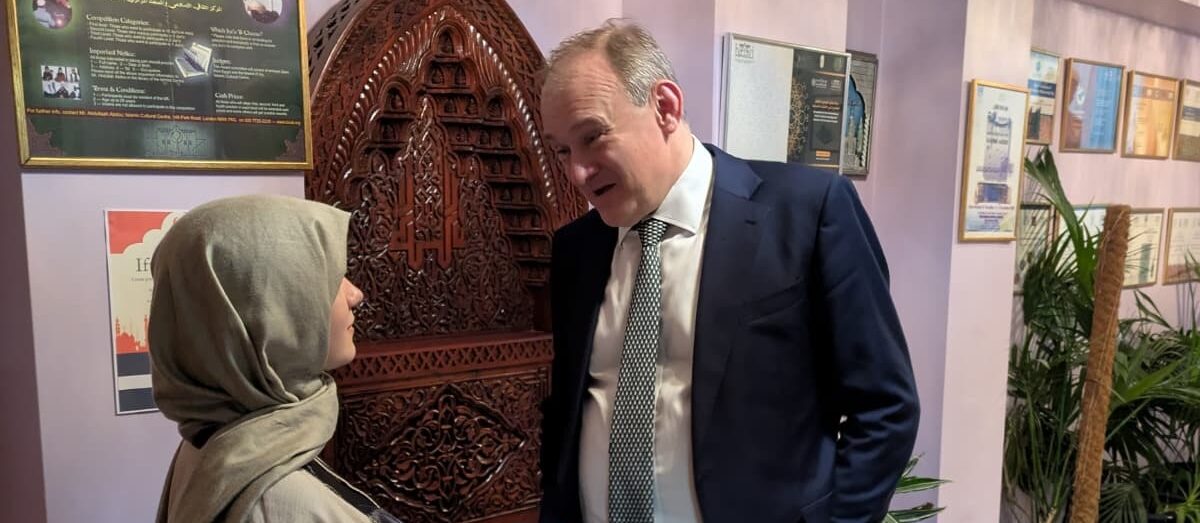
The Holi celebration took place in the car park of the former Harrow Civic Centre, directly opposite Harrow Central Mosque, where worshippers were attending nightly Tarawih prayers during Ramadan — placing two large gatherings in proximity on the same evening.
“I have been in regular contact with the investigation team,” said Harrow’s policing lead Superintendent Zubin Writer in a statement, “who inform me that this is not the case and that this incident was not targeted at Hindu or Islamic communities.” The police had arrested a 14-year-old boy on suspicion of affray and a racially aggravated offence: for making racial slurs directed at the Black community. No injuries were reported.
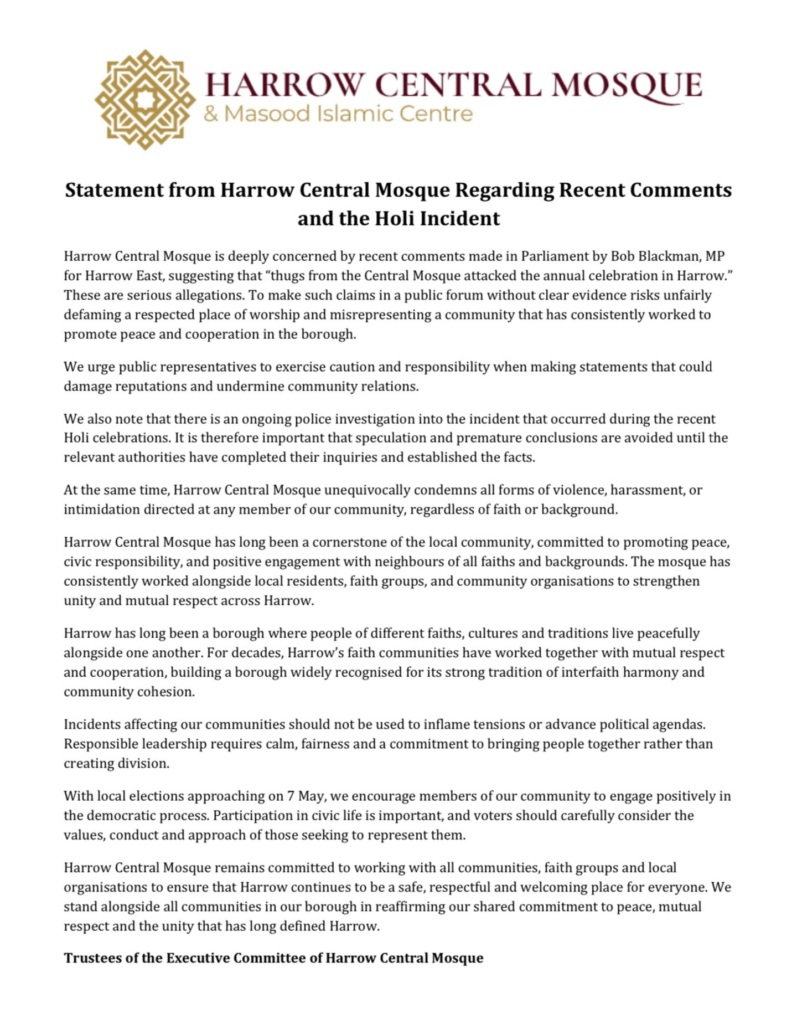
Harrow Central Mosque said that Blackman’s remarks, made “in a public forum without clear evidence risks unfairly defaming a respected place of worship and misrepresenting a community that has consistently worked to promote peace and cooperation in the borough”. Neighbouring Labour MP Gareth Thomas was also critical, saying he was “disappointed that some politicians, including my neighbouring MP, Bob Blackman, have publicly speculated about the incident” while a live police investigation was under way.
The UK Indian Muslim Council went further, warning that Hindutva-aligned organisations, notably INSIGHT UK, had exploited the incident by circulating claims that Muslim youths had attacked the celebration — claims the council described as “fake news” that “risks stoking unnecessary communal tensions.”
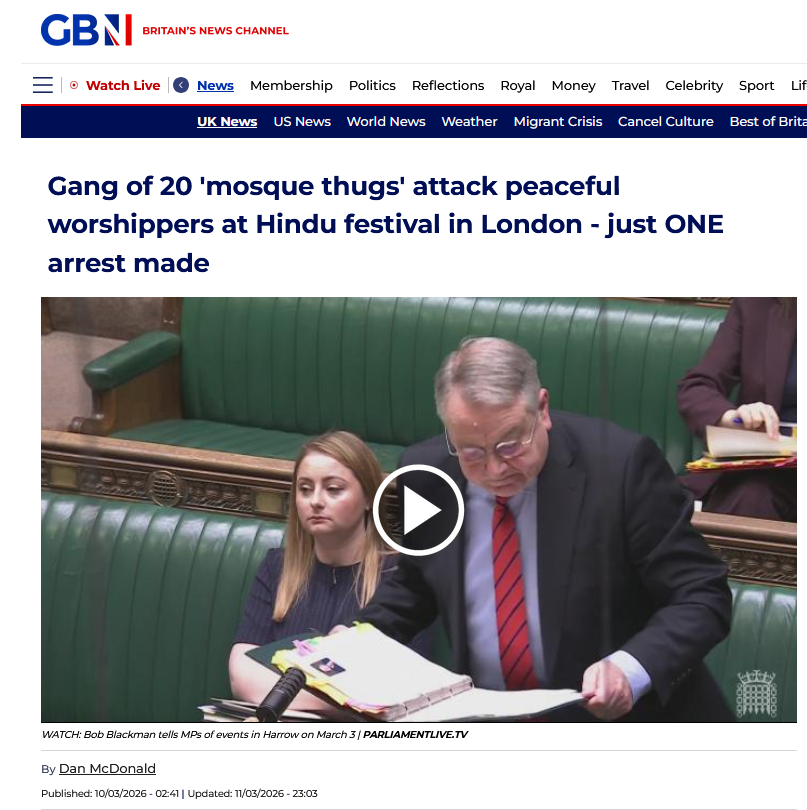
Blackman’s remarks were amplified swiftly. GB News ran the story under the headline “Gang of 20 ‘mosque thugs’ attack peaceful worshippers at Hindu festival,” accusing police of refusing to acknowledge a targeted attack.
In a study published on March 9, the Centre for Media Monitoring described GB News as “one of the most harmful outlets in terms of anti-Muslim bias, ranking among the worst performers across all bias indicators despite its relatively recent launch.”
The story crossed borders rapidly. India’s FirstPost linked the Harrow incident to alleged attacks on Indian shopkeepers in Wembley by “suspected Somali gangs,” weaving unconnected events into a single narrative of communal threat. This pattern of reframing local disputes for international audiences has been extensively documented.
An analysis published by the Center for the Study of Organized Hate in January 2025 found that Indian right-wing media routinely amplifies claims of Hindu persecution abroad, often without verification, in ways that serve domestic political agendas aligned with the ruling BJP.
The Harrow incident was not the first time Blackman has made unver claims in Parliament. In early 2025, he told Parliament that Hindus across Bangladesh were “being subject to death, their houses and temples burned.” The then-Bangladeshi Interim Government publicly rejected these claims. Investigative journalism by Bangladeshi outlets found that many alleged incidents were driven by political or personal motives, not religious targeting.
Blackman has, notably, said little about the well-documented persecution of Muslims in India: a country in which a UK government inquiry found that the violence during the 2002 Gujarat riots was “planned, possibly months in advance” by Hindu nationalist organisations, with the support of the state government then led by Narendra Modi.
The Harrow MP’s alleged connections to Hindu nationalist networks in Britain are well documented. In 2017 he hosted a parliamentary event for Tapan Ghosh, a Hindu nationalist who is said to have praised the genocide of Rohingya Muslims. The Conservative Party has never taken action against him.
The Leicester riots of 2022 provide the starkest precedent for where this kind of rhetoric leads. An independent inquiry published last month — ‘Better Together: Understanding the 2022 Violence in Leicester’, led by academics at SOAS and LSE — found that Hindu nationalist ideology was “a clear factor” in the violence. The report documented how Hindutva organisations possessed “greater resources, including the support of international media networks and backing from elements of the Indian government,” allowing them to dominate the public narrative while Muslim involvement “was largely confined to a few local actors.”
Against this backdrop, the Conservative Party’s complaint of sectarianism could ring hollow. Speaking at the party’s spring conference on March 7, leader Kemi Badenoch accused the Greens of “campaigning on sectarian voting lines” after their victory in the Gorton and Denton by-election on February 26, in which both the Conservatives and Reform had accused the Green Party of courting the Muslim vote by running campaign material in Urdu.
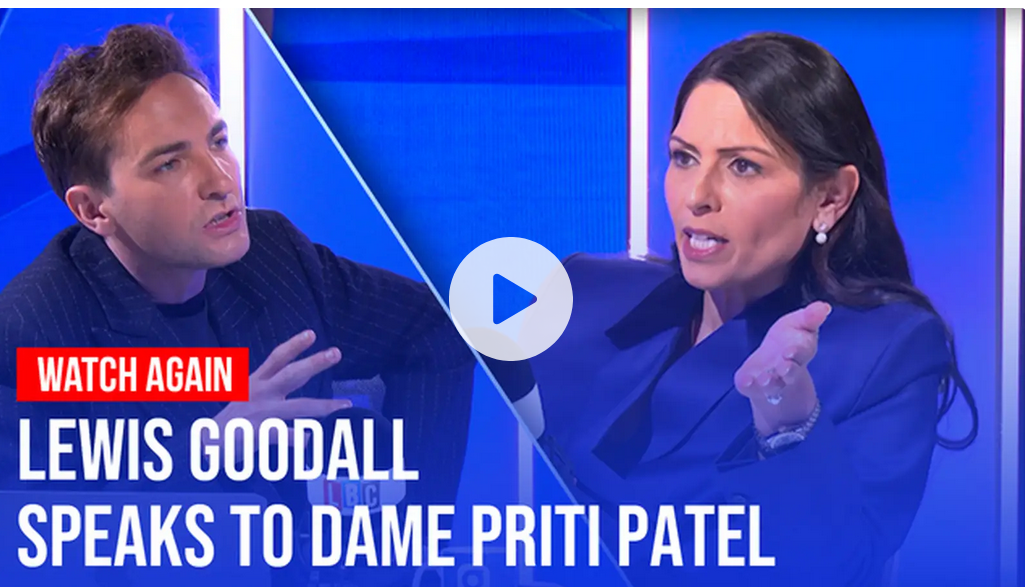
The charge did not survive contact with the party’s own record. On LBC, Shadow Foreign Secretary Dame Priti Patel was challenged on March 1 by journalist Lewis Goodall about the Conservatives’ own history of targeting British Indian voters with community-specific campaign videos. Asked what the difference was, Patel was unable to provide one. The Conservative Party has for years actively cultivated the British Hindu and British Indian vote, circulating WhatsApp messaging, hosting Hindu nationalist figures in Parliament, and accepting donations from organisations tied to the far-right BJP and RSS.
Badenoch claimed that Labour had “created the monster of harvesting Muslim community bloc votes.” Her own party, meanwhile, received less than two per cent of the vote in Gorton and Denton, losing its deposit in the process.
Meanwhile in Harrow, the Metropolitan Police have asked for patience while their investigation into incident continues. That is a reasonable request. Whether the politicians who have already reached their verdicts will honour it is another matter.
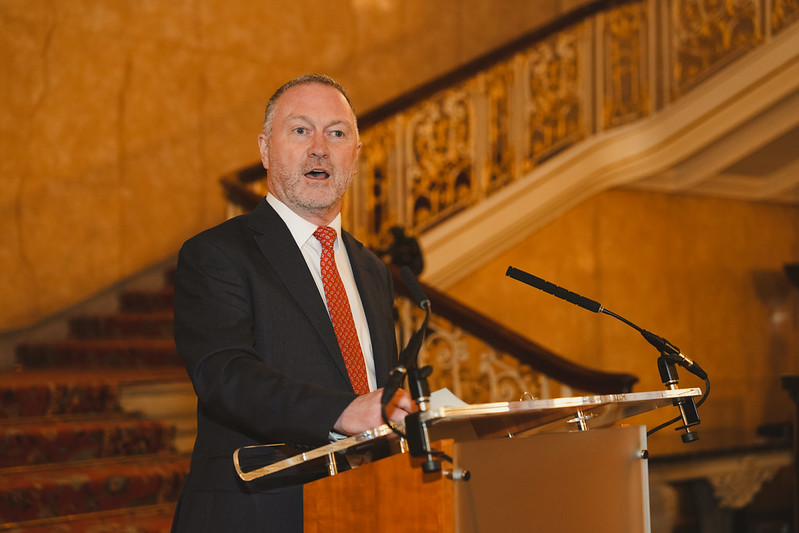
Feature photo: Conservative MP Bob Blackman, who alleged in the Commons that “thugs from the Central Mosque” disrupted a Holi celebration in Harrow at the former Harrow Civic Centre car park — a claim disputed by the mosque. (Credit: UK Parliament/Flickr; Robert Cutts; Jim Linwood/Wikimedia Commons)