F atema Zainab Rajwani walked free from court on February 4, just a week before a landmark High Court ruling declared the UK government’s proscription of Palestine Action unlawful. Acquitted of aggravated burglary and violent disorder alongside five co-defendants, her release—and the subsequent judgment—was hailed as a significant victory for the right to protest and a rebuke of overreaching counter-terrorism powers.
In an exclusive interview with The Muslim News, Rajwani recounts that night at an Israeli-owned drone facility in Bristol, her traumatic 18 months in custody, and her ongoing fight for justice.
“I was arrested in the early hours of 6 August 2024 after we broke into the Israeli-owned Elbit Systems UK site in Filton, Bristol,” Rajwani recalls. Then a 20-year-old film and media studies student, she was arrested on her birthday. She describes the Bristol headquarters as “one of the largest Elbit sites,” dedicated to drone research and development, and officially opened by the Israeli ambassador. “The simple aim was to damage as much weaponry as possible,” she explains.
“When we entered that factory, it was to do all we could to stop extreme harm and violence continuing at the hands of the Israeli regime and their British accomplices.”
During her trial at Woolwich Crown Court, which began in November 2025, Rajwani spoke directly to the jurors: “I had damaged drones, which is what I went in to do.”
Court footage showed her dismantling a quadcopter drone with a crowbar, underscoring her insistence on peaceful intent and challenging the prosecution’s portrayal of the activists as violent. “The charge implies an intention to harm others,” she explained. “It was clear from the evidence that our only goal was to dismantle weapons being used in a genocide.”
The prosecution claimed that activists assaulted security guards and wielded sledgehammers to “threaten and damage people.” Rajwani vehemently rejected this: “None of us initiated violence. It was chaotic from the start. A security guard ran at one of my co-defendants with a whip.”
She described further disorder, including a co-defendant being tasered without warning: “When the police intervened, they tasered someone without even shouting ‘taser’—as they’re supposed to—and didn’t identify themselves as officers.”
Rajwani was pepper-sprayed, while other co-defendants sustained serious injuries. “Two were fully PAVA-sprayed on their faces. One was struck in the neck with a sledgehammer by a security guard. Another had her finger broken, was tasered twice, and kicked in the ribs.
The prosecution pushed this narrative of violence through cherry-picked, edited footage, hiding what actually happened that night.”
After more than 36 hours of deliberation, the jury cleared all six defendants—dubbed the “Filton 6”—of both burglary and violent disorder charges. While they found no evidence of intent to harm individuals, the financial impact of the protest remained a focus.
The raid reportedly caused around £1 million in damage, prompting the Crown Prosecution Service (CPS) to announce retrials on outstanding charges, including criminal damage for all six defendants, violent disorder for Charlotte Head, Samuel Corner, and Leona Kamio, and grievous bodily harm for Corner, who remains in custody. The ruling also reshaped the wider “Filton 24” case.
At a February 18 hearing, the CPS offered no evidence against the remaining 18 defendants on the most serious counts, resulting in not guilty verdicts. Retrials will now proceed only on the charges where verdicts have yet to be reached.
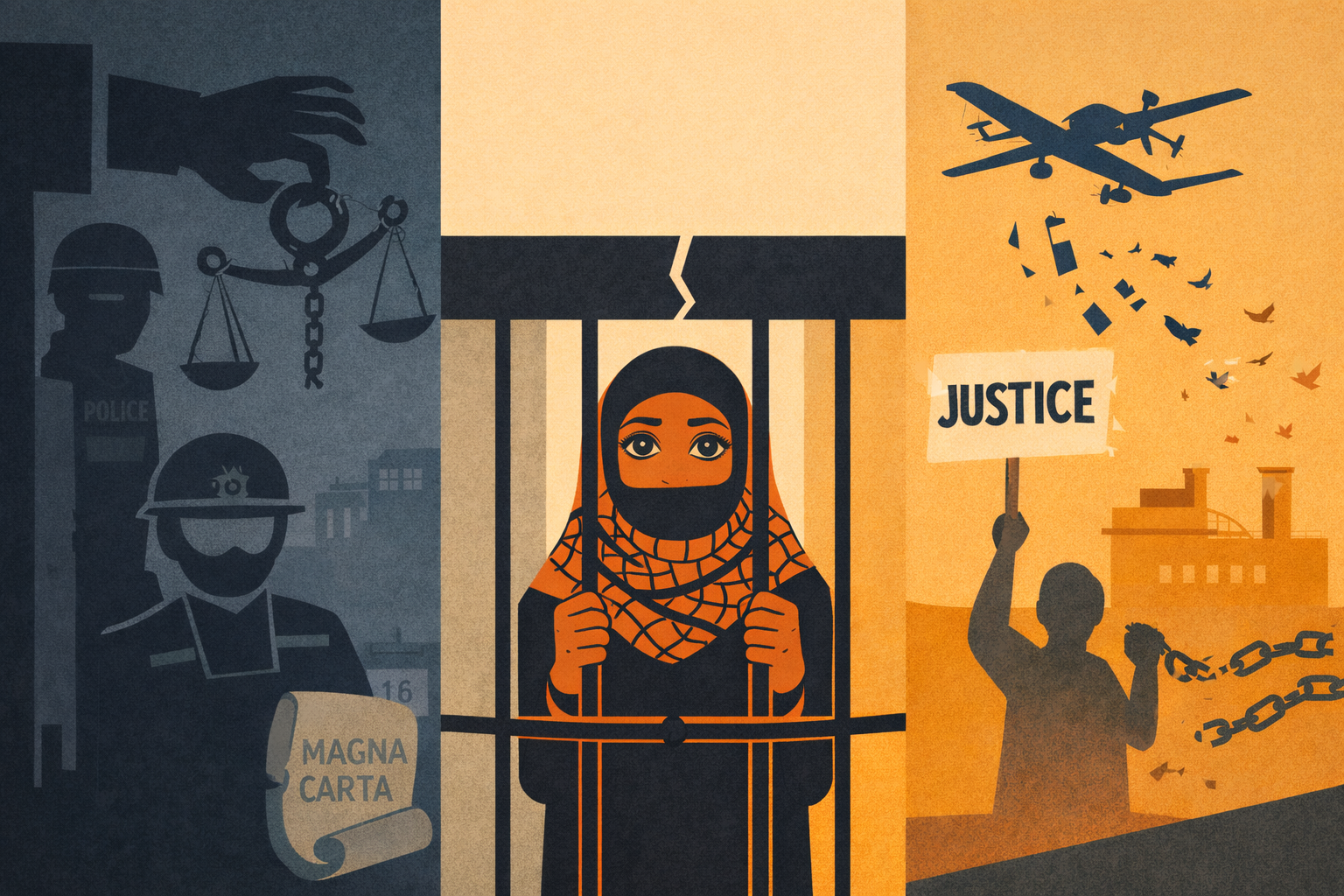
If the courtroom battle was bruising, Rajwani says the aftermath in custody was profoundly traumatic. While in police detention, two officers entered her cell. “They said, ‘You are now being investigated under Section 5 of the Terrorism Act—preparation and instigation of acts of terrorism.’”
She was transferred to a specialist terrorism suite in Hammersmith and held incommunicado. “My family didn’t know where I was for almost a week. I wasn’t able to contact them or see them for a month.”
Despite facing no terrorism charges, Rajwani was classified as a Category A prisoner at HMP Bronzefield. Her detention was compounded by the government’s proscription of Palestine Action on July 5, 2025—a designation that dramatically escalated the stakes for anyone associated with the group.
Conditions were severely restrictive. “You have to be followed everywhere by an officer. Phone numbers, including my mother’s, weren’t approved for weeks. They didn’t approve my solicitor’s number for three weeks.” She also alleges intrusive treatment: “Male officers used to come in without knocking, even when I was changing.” Religious accommodation was inconsistent. While allowed a hijab, she found few or no Shia resources, leaving her “very disconnected from my faith.” Her keffiyeh was confiscated; books and letters were withheld. “They would come into my cell and flick through my books to check if they were appropriate—and not terrorist material.”
Eighteen months under such restrictions left a lasting psychological toll. “Prison was traumatic. I often have anxiety attacks over loud noises—keys jangling. I can’t hear a police siren without being transported back to the terrorism suite. I’m still scared of being yelled at for hugging my mother too long.”
Yet she found perspective within those walls.
“I heard so many stories while inside. It taught me how unjust our criminal justice system is,” she says, describing women imprisoned after abusive relationships or mental health crises.
For her mother, Sukaina, the first week of Rajwani’s detention was paralysing. “It was traumatic. We were all expecting Fatema back. It was her birthday the day before, and then she didn’t show up. For days, the family didn’t know her whereabouts. It was insane. I always thought the police were here to protect us. It couldn’t be further from the truth. I’m grateful that the jury, ordinary people, could see through all the lies put forward by the prosecution.”
Rajwani remains on bail pending retrial, subject to conditions including restrictions on internet-capable devices. Legal action over her prison treatment is on hold. Reflecting on her activism, she traces it back to childhood boycotts and marches with her mother, but says the Gaza war marked a turning point.
“There’s something horrifying about society normalising seeing people die, horrific weapons used every day to kill children. Yes, it’s about Palestine—but it’s also about our accountability as human beings, whether in Palestine, Sudan, Congo, or Kashmir.”
Nine days after Rajwani’s acquittal, the High Court ruled the government’s proscription of Palestine Action unlawful.
“The proscription massively broadened police powers, allowing arrests just for showing general support for Palestine, regardless of Parliament,” Rajwani says. “Multiple people have been arrested by counter-terror officers, not even for supporting Palestine Action, but just for talking about Gaza.” She called the ruling “landmark in acknowledging how much it impacted people’s right to peacefully protest,” adding: “From my experience… it broadened the Terrorism Act even further, treating ordinary people like criminals.”
Huda Ammori, Palestine Action co-founder whose legal challenge led to the ruling, described it as vindication and called for the proscription’s immediate suspension.
“Considering the thousands going through the criminal justice system for holding signs saying ‘I oppose genocide, I support Palestine Action’—and the chaos that creates—it’s ridiculous to try maintaining an unlawful ban. The proscription was unlawful from the start. Even if the government appeals, I’m confident it will be lifted soon.”
Kerry Moscogiuri, Chief Executive of Amnesty UK, welcomed the ruling as “a crucial defence of the right to protest at a time when it has been under sustained and deliberate attack,” warning that unchecked counter-terror powers could be abused.
Having already spent nearly £700,000 defending the proscription in court, the Home Office struck a combative tone, with Home Secretary Shabana Mahmood announcing an appeal and insisting the order was “rigorous and evidence-based” and approved by Parliament, even as the ban has already cost police forces over £10 million in enforcement, including £8.73 million by the Met during just four days of protests. The Metropolitan Police, in contrast, said officers would act “pragmatically and proportionately,” focusing on evidence gathering rather than immediate arrests.
On her own legal situation, Rajwani is clear-eyed. “I see my acquittal [on the violent charges] as vindication—that I am not a violent person and never intended violent offences. As for my pending criminal damage charge, that vindication will come at my trial when I am hopefully acquitted.”
Above all, Rajwani urges the public to scrutinise the evidence themselves. “I urge people to look at all the facts of the case, not just the prosecution narrative. The jury made their decisions after seeing almost every piece of evidence.”
For now, she is adjusting to life outside prison walls, savouring simple freedoms many take for granted. “I opened my front door with my own key. I’m just enjoying the fresh air—and the ability to walk in a straight line.”
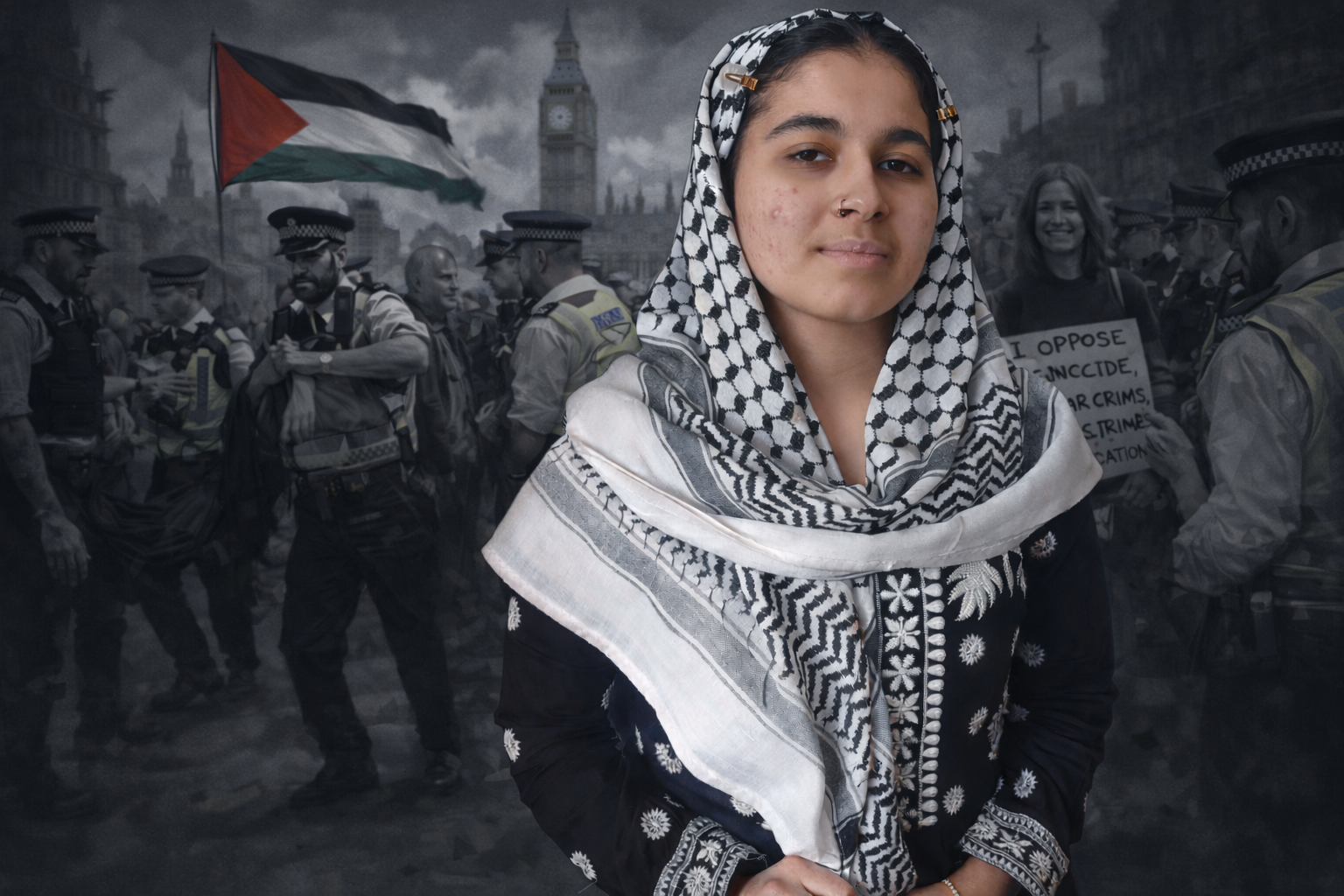
Feature photo: Fatema Zainab Rajwan (Credit: Ahmed J Versi/The Muslim News)