Middle East Correspondent
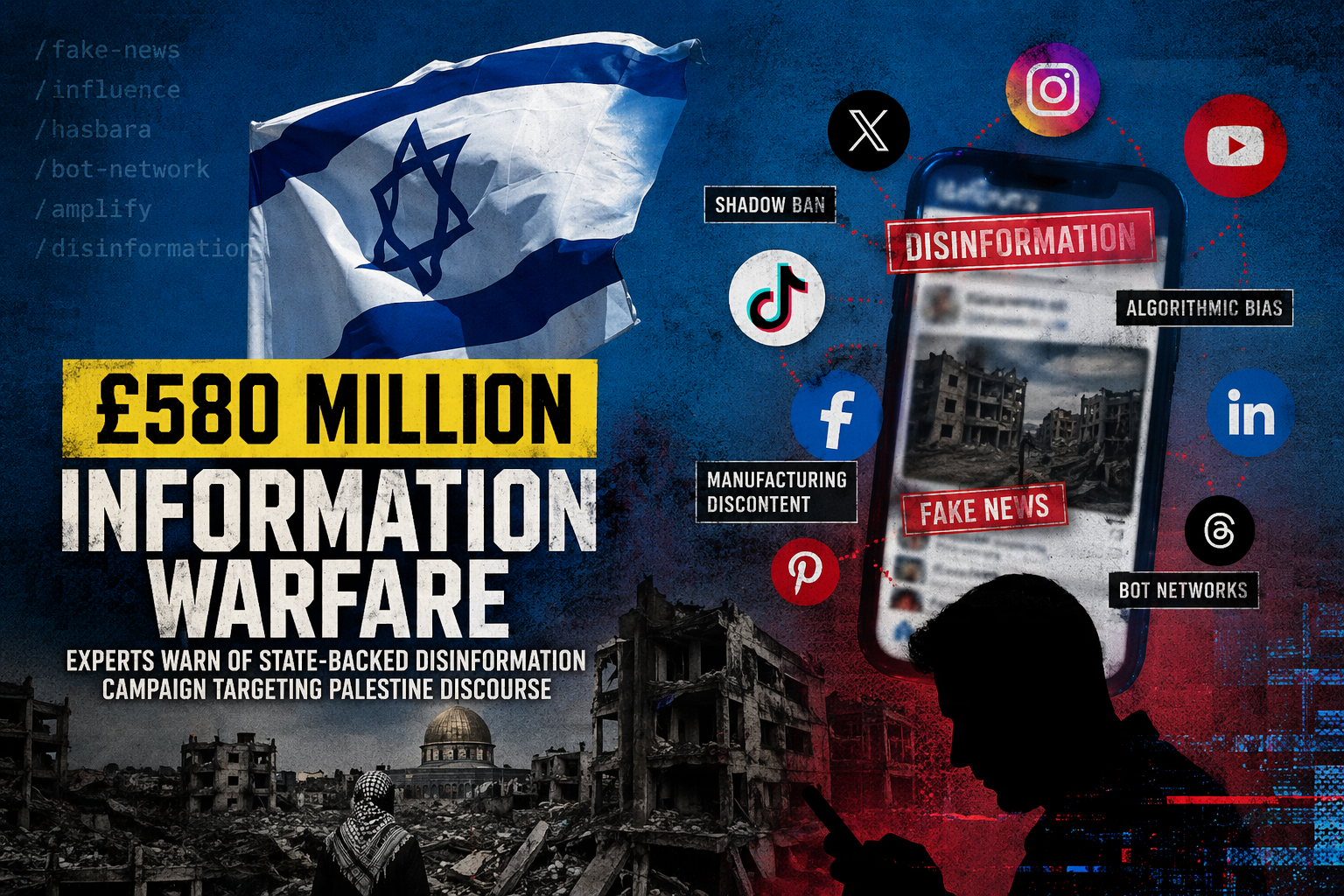
A £580 million state-backed disinformation campaign aimed at shaping global narratives on Palestine is being deployed across social media and artificial intelligence platforms, experts have warned, describing it as a coordinated form of “information warfare”.
The warning emerged during an April 7 webinar hosted by the Global Alliance for Palestine (GAFP), where academics, digital rights advocates and investigators outlined the scale, structure and evolving tactics of Israeli hasbara, as well as strategies to counter it.
“The challenge is no longer simply to expose falsehoods, but to ensure that truth itself carries consequences.”
Founded in London in July 2025, GAFP brings together civil society organisations, academics and public figures to coordinate international support for Palestinian rights, challenge narratives justifying occupation and abuses, and increase political pressure on complicit institutions.
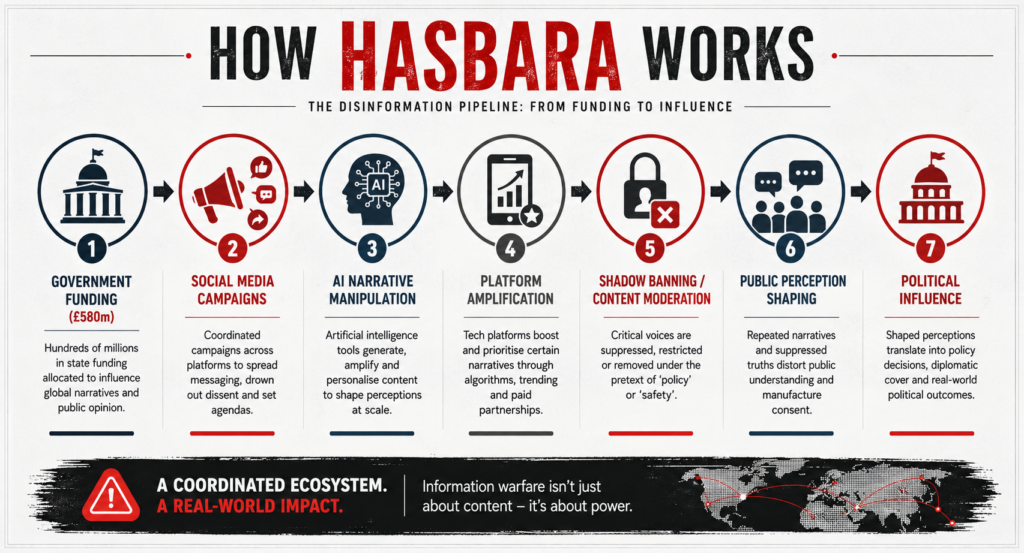
Opening the discussion, GAFP Chair Lujane Abdullah described the current landscape as “state-sponsored information warfare,” revealing that £580 million has been allocated in 2026 for social media campaigns and AI-driven influence. She warned that this expanding ecosystem is “trying to shape what the machines tell us.”
Speakers argued that such efforts are not new, but have evolved into a more sophisticated system of narrative control. Professor Miriyam Aourag, an anthropologist at the University of Westminster, characterised “hasbara” as a central component of any “violent project of domination,” introducing the concept of “manufacturing discontent” to explain how doubt is systematically cast on Palestinian realities when consent cannot be secured.
At the same time, she suggested the strategy is under strain. Modern hasbara, she said, is “trapped between a rock and a hard place,” as real-time documentation of violence increasingly contradicts official narratives. Rather than engaging every misleading claim, Aourag advised activists to adopt a more strategic approach, with a division of labour in which specialists focus on debunking while others prioritise “real political activism.”
The role of major technology platforms was also a key focus. Nadim Nashif, Executive Director of 7amleh, pointed to systemic bias in companies such as Meta and Google, arguing that Arabic content is disproportionately targeted. He said such material is “over-moderated,” with aggressive classification systems introduced years before equivalent safeguards for Hebrew content.
Nashif further alleged coordination between hasbara units and tech platforms, claiming Palestinian voices are frequently suppressed through shadow banning, while state-backed narratives are amplified through lucrative partnerships. He urged activists to assert their “right to be there” on mainstream platforms, while also supporting alternatives such as Upscrolled.
Beyond platform dynamics, speakers emphasised the growing importance of investigative tools in challenging disinformation. Tariq Kenney-Shawa, Policy Fellow at Al-Shabaka, highlighted the use of Open-Source Intelligence (OSINT), including forensic reconstructions of the killing of Hind Rajab, as a means of establishing verifiable accounts of events.
However, he cautioned that evidence alone is insufficient to drive change. OSINT, he said, must be coupled with sustained political pressure, urging activists to move beyond documentation and towards “making the truth actually have tangible consequences” through advocacy and mass mobilisation.
The human impact of disinformation was underscored by Hala Hanina, a PhD researcher who left Gaza before the latest escalation. She described how narratives such as the bombing of Al-Ahli Hospital and claims of “40 beheaded babies” were used to shape international perception, often by “casting doubt” on Palestinian accounts.
Recalling her father’s words, she said: “You have the responsibility to show the reality,” urging activists to centre Palestinian voices and challenge what she described as “Western media complicity” in amplifying state-backed narratives.
Investigative journalist Anas Ambri offered practical tools for tracking influence operations, demonstrating how platforms such as Google’s Ads Transparency Centre and US Foreign Agent filings can expose the financial infrastructure behind online campaigns. These records, he said, reveal millions spent on influencers to “flood the zone” with coordinated messaging.
Ambri pointed to one case in which a firm operating a “bot-based program” resigned following public backlash, arguing that tracing these digital footprints can play a critical role in holding actors accountable. He encouraged activists to “follow the digital paper trail” as part of a broader strategy to disrupt disinformation networks.
Across the discussion, a common theme emerged: a shift away from reactive rebuttal towards proactive intervention. Speakers stressed that combining digital evidence with political organising, lobbying and financial scrutiny is essential to transforming online awareness into real-world impact.
As the scale and sophistication of information warfare continues to grow, participants warned that the challenge is no longer simply to expose falsehoods, but to ensure that truth itself carries consequences.