Elham Assaad Buaras
The UK government’s claim that Israel is only a “minor customer” in the F‑35 fighter jet programme is facing intense scrutiny. Evidence shows the country has played a central operational and developmental role in the programme.
On February 16, Israel’s ambassador to the United States, Yechiel Leiter, told Israel Hayom that Israeli pilots have logged more F‑35 flight hours than all other foreign partners combined. He added that their feedback reaches Lockheed Martin, whose CEO said the data and developments were “worth many billions” to the company. The remarks were reported by The Times of Israel on the same date.
The UK is the only Tier 1 partner outside the US, producing around 15% of the aircraft. Other partners include Australia, Canada, Denmark, Italy, the Netherlands, and Norway. Israel currently operates 48 F‑35 jets, with 27 more on order. On January 21, three F‑35s were transferred from the British air base RAF Mildenhall to Israel. In February, Israel Aerospace Industries (IAI) delivered its 350th fighter jet wing to Lockheed Martin for production.
The UK government has received evidence from organisations including Al‑Haqq and the Global Legal Action Network (GLAN) as part of a High Court case challenging the exemption of F‑35 components from export restrictions linked to Gaza. Despite this, ministers continue to describe Israel as a “minor customer.”
In a letter dated February 19, Hamish Falconer MP, Minister for the Middle East, wrote to Dame Meg Hillier MP, “The UK Government has stopped direct exports of F‑35 parts for use by Israel. The only exception is for the global programme, of which Israel is a minor customer.”
Former Foreign Secretary David Lammy told Sarah Champion MP, Chair of the International Development Committee, in a letter dated 1 September 2025, “We are unaware of any possible breaches of IHL having been linked to the limited evidence of F‑35 use in Gaza and it is worth remembering that, where UK‑produced F‑35 parts go to the global spares pool, Israel operate a very small proportion of over 1,000 F‑35s in the global fleet.”
Israel’s modified F‑35I Adir jets have been in active use since October–December 2023. Former IDF Chief of Staff Lt. Gen. Herzi Halevi confirmed in November 2023 that the aircraft provided close air support to ground troops at distances of around 200 metres. In December 2023, US officials said they were delivering spare parts and capabilities for the F‑35 to Israel at high speed, describing the jets as “absolutely outstanding” in combat and useful for operational testing.
The Israeli Air Force has modified its F‑35s to operate in “beast mode,” allowing them to carry four 2,000lb bombs. The IAF claims these jets are the only F‑35s to conduct strikes in this configuration. On July 13, 2024, an Israeli attack on Al‑Mawasi in Khan Younis killed 90 Palestinians, according to reporting by The Independent in May 2025, which noted the strikes caused significant civilian casualties.
A spokesperson for Campaign Against Arms Trade (CAAT) said, “Israel’s extensive use of the F‑35 aircraft and the value of the data generated through their operations highlight discrepancies between government statements and operational reality. We call on the UK government to correct the record on Israel’s role in the F‑35 programme and to reconsider the continued involvement of UK‑produced parts in the global supply chain.”
Lockheed Martin is the largest arms company in the world by military revenue, according to the Stockholm International Peace Research Institute, and the US accounts for 43% of global arms exports. Alongside the UK, other F‑35 partners include Australia, Canada, Denmark, Italy, the Netherlands, and Norway. Israel has emerged as one of the programme’s most active operators.
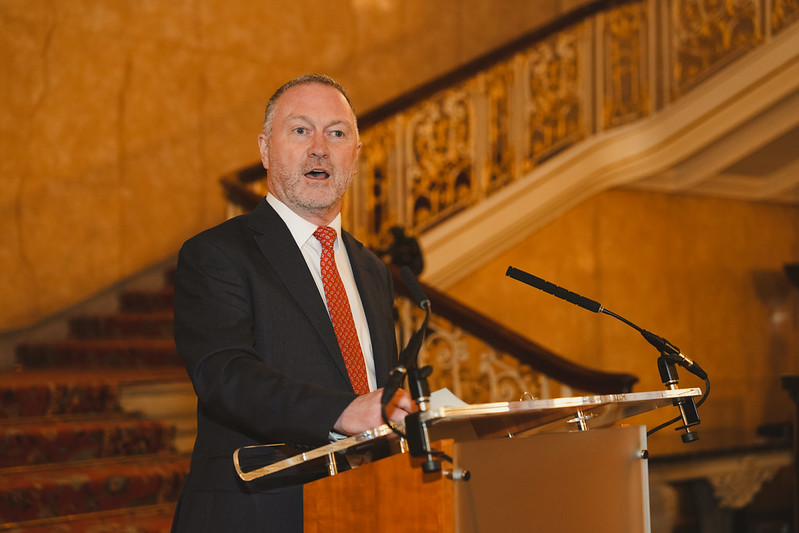
Feature photo: UK Minister for the Middle East Hamish Falconer speaks in the House of Commons. Falconer defended the government’s claim that Israel is only a “minor customer” in the F-35 programme. (Credit: House of Commons/Flickr CC)